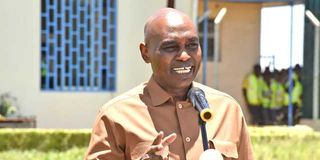
The United Democratic Alliance (UDA) has moved its party primaries for the Ol Kalou Member of Parliament position from Saturday, May 9, to Friday, May 8, leaving ten contestants scrambling to adjust their campaign strategies.
Factors such as voter age demographics and ward-level voting blocs are expected to be critical in determining the winner of the party’s ticket.
“The change of date has affected our supporters and us psychologically, but we must remain accommodating for the bigger picture of our party,” said contestant Ndung’u Wangenye.
Fellow aspirant Mary Nyokabi noted that her original campaign programme ran through to Friday evening, with specific activities planned for targeted areas, forcing her to replan her final push.
“The change was communicated in good time,” Nyokabi said. “Even with Saturday as the original date, we faced time constraints, so moving it to Friday is a practical decision. It takes into account several factors, including potential logistical challenges if the polls were held simultaneously with DCP on Saturday.”
“We in UDA are flexible and ready for the Friday nominations. While the change has affected our schedules, it is for the greater good,” said Mugo, who cites 27 years of professional leadership experience as his main strength.
Woman Representative Faith Gitau, who is coordinating UDA campaigns, said the shift followed a request and subsequent agreement among the contestants.
“The party had to listen to them. We are happy our candidates can reason together and make informed choices; it shows commitment to party unity,” Ms Gitau said. “Naturally, this shift requires the party to move swiftly to ensure all logistics, including venues, are ready. We are engaging the Ministry of Education to find a win-win solution regarding school venues.”
UDA Elections Board Chair Anthony Mwaura assured the public that the exercise would not disrupt learning, as schools have just reopened for the second term.
“We have requested the use of classrooms nearest to the school gates. Only one room is needed per station, ensuring minimal disruption,” Mr Mwaura said.
The high number of contestants poses a significant challenge, particularly when viewed through the lens of historical voting patterns. In Ol Kalou constituency, the Kanjuiri and Mirangine wards—both within Mirangine Sub-county—traditionally vote as a solid bloc. It was this bloc that propelled the late Ol Kalou MP David Kiaraho to Parliament.
The opposing bloc consists of the Karau, Kaimbaga and Rurii wards within Nyandarua Central Sub-county. Although these three wards have a numerical advantage, voter turnout there has historically been lower than in Mirangine.
Data from the 2022 General Election highlights this divide. In Mirangine Sub-county, Kanjuiri Ridge had 15,596 registered voters and Mirangine had 14,695, totalling 30,291 voters. Meanwhile, in Nyandarua Central Sub-county, Kaimbaga had 13,540, Karau had 13,594, and Rurii had 15,572, for a total of 42,706 registered voters.
In 2022, Kiaraho (Jubilee) secured 24,058 votes, defeating UDA’s Kamau Ngotho, who garnered 19,380. Although both hailed from Karau Ward, Kiaraho’s dominance in Mirangine—combined with a share of the Nyandarua Central vote—guaranteed his victory.
“Whoever convinces Mirangine is likely to win,” said former Karua MP Ken Mukira. “The challenge with Nyandarua Central is that despite the high numbers, many voters are businesspeople or employees in flower farms who often fail to turn out on polling day.”
Mr Mukira also noted that age is a defining factor, suggesting that the path to victory lies in winning over voters aged 36 and above.
“Voters in that bracket are not easily swayed once they decide. They listen quietly, are not emotional, and while they are hard to predict, they are incredibly reliable once convinced,” he added.
However, these traditional patterns may be disrupted by the sheer number of candidates, with most wards producing more than two aspirants. Political analyst and former Rurii Ward MCA Wahome Kamoche described these blocs as a “headache” for parties.
“We have 22 candidates across UDA, DCP and Jubilee, alongside those from smaller parties and independents,” Mr Kamoche said. “I would not rule out an independent or small-party candidate winning. The high number of contestants in the primaries will certainly distort the usual bloc arithmetic.”
The field remains crowded. From Kanjuiri Ridge, the list includes Muturi Thambo, Maina Kiambati, Paul Waiganjo, Dr Kimani Mwangi, George Kanuri, Wangenye Ndung’u and Joseph Chuchu. Mr Kanuri, who is running on a UDA ticket, previously contested in 2017 and 2022 but lost to Kiaraho after focusing his campaign on Ol Kalou town.
From Nyandarua Central, the contenders include Peter Karanja, Gabriel Gathure, Mary Nyokabi, Muchina Nyaga, Engineer Paul Mugo, Lawyer Kiragu Wathuta, Beatrice Kamau and Kamau Ngotho.