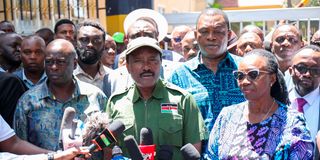
The United Opposition has issued a two-week ultimatum to Inspector-General of Police Douglas Kanja, warning that they will resort to nationwide street protests if security agencies fail to address their concerns.
They want the agencies to interdict and prosecute “rogue” officers, hunt down violence planners and financiers, and conduct an independent probe of all recent attacks on the members of the opposition.
The escalation of grievances now places the police leadership, President William Ruto and the Interior ministry at the centre of a deepening national security confrontation.
The opposition, led by Democracy for the Citizens Party (DCP) leader Rigathi Gachagua, delivered the warning on Friday at Jogoo House where they confronted the country’s top police commander over up to 24 attacks on Mr Gachagua's rallies, meetings and even church services across the country.
Also present were People’s Liberation Party leader Martha Karua, Wiper’s Kalonzo Musyoka, Democratic Action Party of Kenya’s Eugene Wamalwa and Democratic Party’s Justin Muturi.
The latest and most dramatic being last Sunday’s violent assault at ACK Witima Church in Othaya where gunmen stormed a service attended by opposition leaders, fired shots at vehicles and sent worshippers fleeing in panic.
Mr Kanja together with his deputy Eliud Lagat had jetted back into the country on Wednesday morning after a 10-day official trip to Tokyo, Japan.
He spent much of Thursday shuttling between high-level meetings at the office of Interior Cabinet Secretary Kipchumba Murkomen as the government sought to contain the fallout.
Mr Gachagua said the attack had been executed by a special police unit he identified as Nairobi Sierra, telling the Inspector General to his face that what unfolded at Witima Church was not random violence but a calculated attempt on his life.
“I met with the IG and looked him on his face with his people and looked at him straight in the eye and told him that the attack at Witima Church on Sunday in Othaya was not an ordinary attack, it was an assassination attempt targeted towards Rigathi Gachagua sanctioned by William Ruto and a special squad of police officers called Nairobi Sierra of 12 officers was dispatched to eliminate us in church,” Mr Gachagua said, adding that two vehicles were sent from Nairobi, one from Buruburu Police Station and another from Makadara Police Station.
The opposition also handed over the police officers’ details, demanding that “those officers be arrested, disarmed and taken to court” before the coalition returns to the streets beginning February 16.
The police boss stepped directly into a crisis that had already hardened into a political showdown, with church leaders condemning the violence and opposition figures accusing the state of complicity and the coalition formally petitioning President Ruto in his capacity as chair of the National Security Council.
During the meeting that lasted two hours, opposition chiefs presented a set of demands they want acted upon before the two-week deadline lapses, including immediate arrests of those behind recent attacks, comprehensive investigations into a growing list of incidents they say point to political orchestration, and firm guarantees that the police will act impartially and protect opposition leaders during public engagements.
In their petition, the opposition also called for the immediate launch of independent, impartial and comprehensive investigations into all the incidents detailed in the letter, arguing that only an external and transparent process could restore credibility to the security agencies, while simultaneously demanding the suspension and prosecution of all police officers and civilians found to have participated in or facilitated the attacks.
They further pressed the State to take urgent measures to guarantee the personal safety and constitutional rights of Mr Gachagua, his family, opposition supporters and members of the public attending political events, warning that continued inaction would amount to state-sanctioned intimidation, and urged the government to restore public confidence in the national security system through visible adherence to the Constitution, accountability of security commanders and strict observance of the rule of law.
“They are telling us that they want to look at the OB and investigate. What investigations? These are intimidation tasks but they are not going to get away it. The National police service should be impartial not to take instructions from President William Ruto,” Mr Musyoka said.
At the same time, the opposition laid before the National Security Council what it describes as a chilling timeline of at least 24 separate attacks targeting its leaders and supporters across multiple regions, incidents that begin with disrupted political meetings and steadily escalate into ambushes, gunfire and organised violence.
According to the petition, the pattern first emerged in Central Kenya where hired youths armed with clubs and stones repeatedly broke up opposition forums in towns such as Nyeri, Murang’a and Kirinyaga, blocking convoys on major highways, vandalising vehicles and forcing leaders to abandon scheduled rallies as police allegedly watched without intervening.
The violence then spread to Embu where opposition supporters were chased from a town hall meeting after goons stormed the venue, to Nakuru where stones shattered windscreens of a campaign convoy leaving several people injured, and to Kiambu where armed groups descended on a community gathering, forcing organisers and residents to flee into nearby homes.
Similar scenes, the petition says, played out in Laikipia, Meru, Thika, Karatina and parts of Nairobi’s outskirts, with organised attackers arriving moments before or during opposition events, dispersing crowds through violence and disappearing without arrests, creating what the opposition describes as a climate of fear designed to choke off political activity.
By early this month the attacks had shifted from disruption to direct targeting of opposition leaders themselves, with convoys trailed by unidentified vehicles after rallies in Murang’a, gunshots fired into the air near meeting venues in Nyeri to scatter crowds, and several vehicles belonging to opposition figures later found damaged, incidents that heightened fears of a more dangerous phase of political violence.
The violence soon spilled into places of worship, with church services attended by opposition politicians disrupted by armed youths who stormed compounds, issued threats and broke windows as clergy intervened to shield congregants while police responses were slow or absent, culminating in the Othaya church attack which the opposition now frames as the clearest evidence yet of a coordinated and escalating campaign.
It was against this backdrop that the tense closed-door meeting at Jogoo House took place, with Mr Kanja joined by Deputy Inspectors General Eliud Lagat, Gilbert Masengeli, the National Police Service Director of Operations Philip Opiyo and other senior commanders as opposition leaders laid out their grievances and demanded action not only against the hired goons captured on camera but also against political figures they allege are orchestrating the violence from behind the scenes.
The opposition agreed to share their itinerary with the Mr Opiyo who will be coordinating security during campaign rallies of the opposition.
Police chiefs, according to insiders, promised thorough investigations but urged the opposition to coordinate closely with security agencies ahead of public events and to declare civilian firearm holders attending their meetings so officers could distinguish licensed carriers from criminals, a suggestion that some opposition figures viewed as an attempt to shift responsibility onto victims rather than confront perpetrators.