The planned March 27 National Delegates Convention of the ODM is shaping up as a defining test for factions aligned to the party leader Oburu Oginga and Secretary General (SG) Edwin Sifuna, with both camps keen to consolidate influence in a party navigating delicate political realignments following the death of its founder Raila Odinga.
The NDC, sanctioned by the National Executive Committee (NEC) is a moment of reckoning for camps loyal to Dr Oginga and the embattled SG Sifuna, with the outcome likely to influence the party’s internal balance of power.
Whereas the NEC resolved to remove Mr Sifuna from office and appointed his deputy Catherine Omanyo to act in that position until a substantive holder of the position is elected, Political Parties Dispute Tribunal (PPDT) gave him a crucial temporary reprieve barring the party from executing his ouster.
Kisii Governor Simba Arati and ODM party leader Dr Oburu Oginga at Sameta grounds in Kisii County during the 'Linda Ground' function on January 25, 2026.
Photo credit: Ruth Mbula | Nation Media Group
Dr Oginga has declared Ms Omanyo the SG, touting Mr Sifuna as the “SG for the courts,” throwing spanner in the works ahead of the crucial gathering.
The ODM’s constitution states that a Special Session of the National Delegates Conference shall be summoned by the National Chairperson upon the decision of the National Executive Committee or upon a requisition in writing signed by at least one third of the delegates eligible to attend an Ordinary Session of the National Delegates Conference.
The notice and agenda convening the meeting shall be sent out by the Secretary General at least twenty-one days before such date and published at least twice on a daily English newspaper with the greatest circulation, in addition to at least two Swahili radio broadcasts carried by a leading broadcasting station.
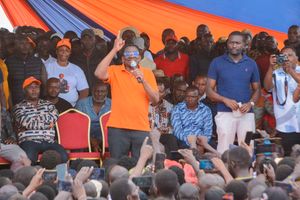
ODM Secretary-General Edwin Sifuna addresses supporters in Kitengela on Sunday, February 15, 2026.
Photo credit: Stanley Ngotho | Nation Media Group
ODM Executive Director Oduor Ong’wen confirmed that preparations for the convention are already underway.
“We have put in place an organising committee which is tasked with drawing the agenda,” he said.
“Once the agenda has been drawn, it will be made public.”
Even as the party moves ahead with the planned ceremony, Mr Sifuna’s camp has adopted a cautious stance, signalling that its participation will hinge on who ultimately controls the event.
ODM Deputy Organising Secretary Caleb Amisi, a close ally of Mr Sifuna, said their attendance would depend on whether the camp aligned to Dr Oginga or Mr Sifuna’s faction takes charge of the proceedings.
Asked whether they will attend the planned NDC, Mr Amisi said; “It depends on who convenes it, if it is Oburu I won't go. If it is Sifuna I will go.”
Nation has established that Dr Oginga’s camp is crafting the convention as a pivotal moment to redefine the party’s direction without triggering “a disruptive internal showdown.”
In a calculated bid to balance internal democracy and party stability, ODM is crafting an NDC agenda that avoids “sweeping elections” while still placing its top officials before delegates for scrutiny and approval.
A high ranking member of the opposition outfit confided in Daily Nation that amid wrangling over leadership and the direction the party should take ahead of the 2027 poll; the convention will be a “strategic consolidation exercise rather than a leadership overhaul.”
According to the party’s National Executive Committee (NEC), the convention will deliberate on ODM’s strategic direction, ratify key decisions of party organs, and lay the groundwork for the forthcoming General Election.
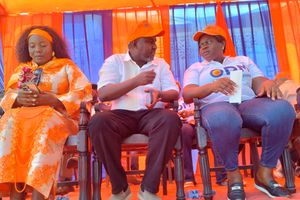
From Left: ODM Secretary General Catherine Omanyo, Junet Mohamed and Homa Bay Governor and ODM National Chairperson Gladys Wanga during the Linda Ground political rally at Mkunguni Square in Lamu Old Town on Thursday, February 12, 2026.
Photo credit: Kalume Kazungu | Nation Media Group
However, unlike previous conventions that featured competitive elections for party officials, Nation established that there will be no fresh elections for new office holders until 2027.
Instead, the new officials including Dr Oginga, his three deputies; Abdulswamad Nassir, Simba Arati and Godfrey Osotsi, National Chairperson Gladys Wanga among other officials approved by the party’s National Governing Council(NGC) in Mombasa last year “will be presented individually before delegates for either confirmation or rejection.”
This move, observers say, signals “continuity and controlled internal democracy.”
Multiple interviews with officials disclosed that the arrangement allows the supreme organ of the party to exercise oversight without plunging ODM into early internal contests that could distract from national political strategy.
“There will be no elections for new party officials until 2027, but the party leader, the three deputies and the chairman will be presented to the delegates for either rejection or confirmation,” said a high ranking source in the party.
“Whoever is rejected, an alternative will be proposed to the delegates to decide because this is the supreme organ of the party.”
This move, could still complicate Dr Oginga’s camp, as delegates may opt to kick out some officials, a move that could give Mr Sifuna’s team an upper hand if Dr Oginga’s camp fails to stamp authority.
But there are also fears that with the sanctioned talks between ODM and the ruling President William Ruto’s United Democratic Alliance (UDA), State might weigh in the NDC and “intimidate the alleged renegades,” giving Dr Oginga’s camp an upper hand.
In 2014, the infamous “men in black” incident occurred during the ODM party’s NDC at Kasarani Gymnasium in Nairobi on 28 February 2014.
On that day, a group of men dressed in black suits stormed the venue during voting, overturned tables, smashed ballot boxes and destroyed election materials, forcing party officials to call off and suspend the elections.
ODM leader Oburu Oginga (second left) and other party officials listen as acting party secretary-general Catherine Omanyo (centre) reads a statement on the removal of Edwin Sifuna as secretary -general on February 11, 2026.
Photo credit: Pool| ODM
The chaos disrupted the convention and left the process unfinished, leading to selection of compromise candidates.
At the planned March 27 NDC, sources who spoke to Nation noted that crucially, officials will not be presented as a unified slate, but as individual names for approval — a calculated move aimed at defusing claims of block politics within the party’s top ranks.
“The opposing team might present themselves with suggestions during that period,” added the source, hinting at the possibility of alternative names emerging from dissenting factions.
The NDC comes at a delicate political moment for ODM as it repositions itself within the evolving opposition landscape and recalibrates its strategy ahead of 2027.
By avoiding full-scale elections this year, the party appears keen to maintain stability at the top while still offering delegates a structured opportunity to express confidence — or dissent — in the current leadership.
Party insiders say the March convention will focus more on policy direction, coalition strategy and grassroots mobilisation rather than personality battles.
ODM Deputy party leader Godfrey Osotsi during a public rally by Linda Mwananchi faction of the ODM at Busia Stadium in Busia County on February 8, 2026.
Photo credit: Alex Odhiambo | Nation Media Group
With the NDC recognised as ODM’s highest decision-making organ, all eyes will be on whether delegates endorse the status quo or signal subtle shifts within one of Kenya’s most influential political formations.
ODM’s decision to avoid full-scale elections reflects lessons drawn from past experiences where internal contests exposed divisions.
Analysts say the party is keen to avoid internal turbulence at a time when ODM unity remains fragile.
“ODM is trying to walk a tightrope between democracy and stability,” said political analyst Chris Omore.
“Full elections at this stage could open up intense rivalries that may weaken the party’s cohesion further, ahead of 2027. What they are doing is allowing accountability while avoiding destabilization.”
Over the years, ODM has been one of Kenya’s most influential political parties, shaping opposition politics and serving as a major vehicle for mobilizing grassroots support.
However, recent political developments—including shifting alliances, emerging opposition formations and internal succession debates following Raila Odinga's death on October 15 last year—have forced the party to rethink its internal processes.
The NDC is therefore expected to serve as a platform for reinforcing unity while recalibrating strategy.
Embattled ODM party Secretary-General Edwin Sifuna (left) and party leader Oburu Oginga. Ruth Odinga (inset) has sided with Sifuna regarding the leadership and direction of the ODM party.
Photo credit: Nation Media Group
At the heart of the NDC’s significance is the broader question of succession and leadership continuity within ODM.
The upcoming convention will provide the first major opportunity for delegates to formally endorse—or reject—the current leadership arrangement.
Analysts say the outcome will offer important signals about the party’s internal dynamics and its readiness for the 2027 elections.
Beyond internal leadership matters, the NDC is expected to focus heavily on coalition strategy.
Dr Oginga has said that whereas their options are open, the party will first give President Ruto's UDA party first priority in the 2027 coalition talks.
ODM has historically played a central role in coalition politics, partnering with other parties to mount competitive challenges against the ruling establishment.
ODM’s approach to the upcoming convention reflects a broader balancing act between competing priorities.
On one hand, the party must uphold democratic principles and allow members to exercise oversight over leadership decisions.
On the other hand, it must maintain stability and unity in order to remain politically effective.
By avoiding full-scale elections while still allowing delegates to confirm or reject officials, ODM appears to be pursuing a middle path.
This approach allows the party to demonstrate internal democracy without exposing itself to potentially divisive contests.
Ultimately, the NDC will serve as an important barometer of ODM’s internal cohesion and strategic direction.
Observers say that the convention’s outcomes will send signals not only to party members but also to the broader political landscape.
A smooth convention with strong endorsement of the current leadership would reinforce ODM’s image as a stable and organized political force.
Conversely, visible dissent or leadership rejections could signal emerging fractures.
The party’s National Elections Coordinating Committee chairperson Emily Awita had promised to provide finer details regarding the NDC but had not done so by the time of going to press.