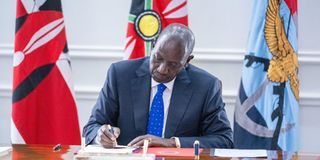
President William Ruto’s assent to the Judges’ Retirement Benefits Bill, 2025, on Monday was the culmination of a 30-year journey of various efforts to provide for the retirement benefits of Judges.
Various taskforce reports presented to Parliament have been advocating for the improved welfare of the judges.
The report includes the 1992 Kotut Report (Report of the Committee to Inquire into the Terms and Conditions of Service of the Judiciary), the 1998 Justice Kwach Report (Report of the Committee on the Administration of Justice) and the 2006 Justice Onyango Otieno Report (Report of the subcommittee on the Ethics and Governance of the Judiciary).
Others include The 2007 Justice Bosire Report (Report of the Task Force on Terms and Conditions of Service for Judicial Staff), The 2008 Justice Kihara Kariuki Report (Report of the Committee on Ethics and Governance of the Judiciary) and the 2010 Justice Ouko Report (Report of the Task Force on Judicial Reforms).
During this period, specific legislation was passed and updated to provide for the retirement benefits of other civil servants, Members of Parliament and designated State Officers.
However, judges have long been ignored and are the only State Officers left to rely on the outdated provisions of the Pensions Act (Cap. 189), which came into operation on January 1, 1946.
The Judges’ Retirement Benefits Act, which has been in the National Assembly for 11 months, was formulated by an inter-ministerial Taskforce that was gazetted by the Chief Justice, with members drawn from the Judiciary, National Treasury, Directorate of Pensions and the Office of the Attorney General.
The Act will operationalise the constitutional guarantees of judicial independence and security of tenure under Article 160 of the Constitution by providing predictable, secure and fiscally sustainable retirement benefits for judges.
It also aligned with the constitutional protection in Article 160(4) which prohibits variation of a judge’s remuneration or benefits to their disadvantage during tenure.
Judges in office at the commencement of the Act shall therefore remain within the existing Defined Benefits pension regime administered under the Pensions Act in order to ensure continuity of their existing entitlements while preventing the erosion of benefits already accrued by serving judges.
A judge appointed after the commencement of the Act shall contribute 7.5 per cent of their basic salary, with the Government contributing 15 per cent of the judge’s basic salary.
The Act will extend specified post-retirement benefits to judges who retired after the promulgation of the Constitution but before the commencement of the Act.
While their pension entitlements remain governed by the Pensions Act, they become eligible for the enhanced benefits, such as medical cover and diplomatic privileges.
The new law will see judges enjoy an increment on their pension capped at five percent. Currently, pension reviews are undertaken every two year in line with the Pensions Increase Act (Cap.190), which provides for a three percent increment for all pensions along with any previously granted increases.
The new law also stipulates that the judges exiting service due to mental or physical incapacitation shall be entitled to at least 50 percent of what they would have received had they served at least 10 years and left upon reaching the age of 65 years.
Unlike other public officers who retire at 60, judges are required to work up to the age of 70 and may only elect to retire early at the age of 65.
While assenting to the Bill, President Ruto said he was glad that judges would join other Kenyans in a pension scheme, which he noted would give judges the same benefits enjoyed by other Kenyans.
“Now we have a legal framework that will give the opportunity for our judges to serve in an environment where they know their future and retirement are guaranteed,” President Ruto said.
Beyond pension, the Bill provides for a range of non-pension benefits aimed at preserving the dignity of judges after retirement. These include medical cover, diplomatic passports and access to government airport lounges.
However, immediately the President assented to the Bill, Senior Counsel Muthomi Thiankolu warned that the move risked affecting judges’ pay slips and may pose a constitutional challenge.
“The core constitutional issue is whether transitioning judges from a non‑contributory to a contributory pension arrangement amounts to an adverse alteration of their terms and conditions of service, contrary to Article 160 (3) of the Constitution,” Dr Thiankolu wrote in his Facebook account.
Dr Thiankolu pointed out that from an actuarial and public debt management perspective, the rationale for moving to contributory and defined‑contribution schemes is well‑established and arguably sound. However, “difficulty arises from the unique features of Kenya’s post‑2010 constitutional architecture governing judges’ pensions and retirement entitlements, particularly the categorical prohibition on adverse variation in judicial remuneration and benefits,”
“The ultimate question, therefore, is not the wisdom of the shift in public‑sector pension policy, but whether, given the Constitution’s design and the special status of judicial remuneration, such a change can lawfully be applied to sitting judges,” he said.