Kenya’s public pension bill has crossed the Sh200 billion mark for the first time, highlighting the growing burden on an Exchequer already struggling to make timely payments to retired civil servants.
The Treasury spent Sh207.19 billion on pension and gratuities in the financial year ended June 2025, reflecting a growth of 39 percent from the Sh148.9 billion paid the previous year.
Pension payments now account for 11.6 percent of all payments from the Consolidated Fund Services (CFS), up from the 8.4 percent a year ago.
Pensioners are grappling with delayed pension payments amid a cash crunch facing the Exchequer, even as the number of retirees remains on the rise. For example, the Treasury failed to wire Sh23 billion to pensioners in the year to June 2024.
The National Treasury building in this picture taken on April 16, 2025.
Photo credit: Dennis Onsongo | Nation Media Group
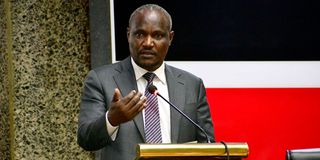
“There have been challenges when pensioners leave employment and wait for too long to get their payment mainly because of system challenges. There are also other issues behind delayed payment of pension,” Treasury CS John Mbadi recently said.
The Sh207.19 billion represents 92.8 percent of the Sh223.14 billion that was allocated for pension and gratuities in the year to June 2025, which also marked the first time that the allocation surpassed the Sh200 billion-mark.
Pension and gratuities, public debt and salaries of constitutional offices are the three items paid from the CFS with public debt gobbling the biggest share at upwards of 85 percent in a financial year.
In the year to June 2025, 87.1 percent (Sh1.59 trillion) of the Sh1.79 trillion CFS budget was used on public debt payment compared to 90.3 percent (Sh1.56 trillion) the previous year when the CFS budget stood at Sh1.766 trillion.
The number of retirees is estimated at over 260,000 and the Treasury is anticipating a surge in these numbers by the end of June next year.
At least 85,000 public servants were expected to exit service between last year and June 2026 upon attainment of the retirement age of 60.
The growth in the pension bill is one the biggest headaches to the government of the day, given that it has to continually increase the budget for this item amid mounting public debt payment gobbling 69 percent of the tax revenues in a financial year.
The spike in the pension bill prompted the Treasury to reject a proposed law that sought to have pension-adjusted for inflation in order to cushion public service retirees. The government is, however, seeking to introduce a cost of living adjustment for judges' pensions.
Expenditure on pension has surged by 87.8 percent in the last four years, from Sh110.36 billion that was spent in the year that ended June 2021, as Treasury comes under increased scrutiny over the pain that pensioners endure in getting their dues.
The Commission of Administrative Justice –a State entity that investigates and addresses injustices in the public sector, recently called out the Treasury over the continued struggles that retirees continue to face in accessing their pension.
“Indeed, accessing pension has remained a perennial problem for Kenya's retired public officers with many of them compelled to make endless trips to pensions offices in pursuit of what is rightfully theirs,” CAJ said early this year.
CAJ says that it received 318 complaints against the Pensions Department between 2019 and the start of this year, with 274 cases being on delayed pension.
Last month, Mr Mbadi said that the Treasury would re-engineer the pensions management system and launch a pensioner self-registration platform, all geared to enhance biometric verification and reduce pension processing time from several months to less than 30 days.