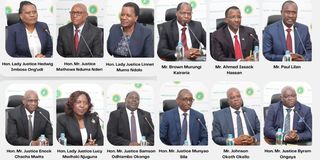
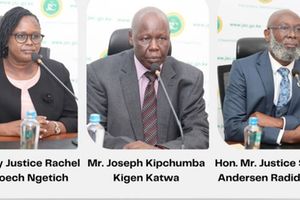
After interviewing 35 candidates for the 15 posts of judge of the Court of Appeal, the Judicial Service Commission (JSC) settled on four women and 11 men.
The JSC said it evaluated their professional competence, communication skills, integrity, fairness, good judgment and legal and life experience.
Hedwig Ong’udi.
Photo credit: Pool
She is a judge of the High Court. She was admitted as an advocate in 1985 and immediately joined the Judiciary as a district magistrate II. She was appointed a judge of the High Court in 2011.
Justice Ong’udi was the first presiding judge of the anti-corruption division of the High Court. The Law Society of Kenya (LSK) recognised her as the judge of the year in 2019. Asked why she wanted to join the Court of Appeal, the judge said she is a committed person and would have no problem working with fellow judges.
On is the best way to address case backlog, Justice Ong’udi said the court should device a way of dealing with all the pending applications, then embark on main appeals.
He chairs the Independent Policing Oversight Authority. Mr Hassan was admitted to the Roll of Advocates in 1995. He has been the Institutional Governance Adviser, UNDP Somalia; an adviser to the Cambridge Conference on Electoral Democracy in the Commonwealth; Malaysian Commonwealth Studies Centre; an electoral commissioner; Electoral Commission of Afghanistan; chairperson of the Interim Independent Electoral Commission and the Independent Electoral and Boundaries Commission.
He was asked about the “chicken-gate” scandal but denied being a part of it. Mr Hassan said investigations would tell how the money was wired from the UK to Kenya and who benefited. He said the Ethics and Anti-Corruption Commission investigated the issue and took some people to court.
“I have never been involved in corruption. Chickengate is the only thing being used to defame me,” he said, adding that he brings to the Judiciary 30 years of experience in different fields.
Senior Counsel Katwa Kigen
Senior Counsel Katwa Kigen.
Photo credit: Jared Nyataya | Nation Media Group
He has a Master of Laws degree from the University of Nairobi and was admitted to the Roll of Advocates in 1996. Mr Kigen has practised for about 30 years “at almost all levels – from tribunals, magistrates, the High Court as well as global jurisdictions”.
He was asked to assume he was an MP and a Bill is proposed to limit the right to freedom from cruelty. Mr Kigen said the Constitution cannot be derogated and he would vote against the Bill.
Asked how he would handle a case in which he is conflicted, Mr Kigen said he would inform fellow judges and recuse himself from the matter.
Paul Lilan.
Photo credit: File | Nation Media Group
He is the chairperson of the Capital Markets Tribunal. He holds a Master’s degree in Management and Leadership. He was admitted to the Roll of Advocates in 1996. Mr Lilan was the chairman and founding trustee, Crossroads Prison and Rehabilitation Ministries. He also chaired the Kenya Industrial Property Institute.
High Court Judge Chacha Mwita at the Milimani Law Court on January 26, 2024.
Photo credit: Francis Nderitu | Nation Media Group
Justice Mwita is a judge of the High Court. He was admitted to the Roll of Advocates in 1991. The judge was questioned about circumstances that lead to issuing injunctions at first instance – where the defendant party is yet to be served . He said it is determined on a case-by-case basis.
“Even certain organs that complain about ex-parte orders come to seek injunctions. The Constitution prescribes situations one can issue an ex-parte order,” he said.
Employment and Labour Relations Court Judge Mathews Nduma Nderi. File | Nation Media Group
He is a judge of the Employment and Labour Relations Court. Justice Nderi holds Master of Laws degree and was admitted to the bar in 1988. He has been the Judge President of the Industrial Court of Swaziland and served as the Crown Counsel Swaziland, DPP Chambers.
She is a judge of the Employment and Labour Relations Court. She holds Master of Arts degree from the University Of Nairobi. She was admitted to the Roll of Advocates in 1989.
Justice Ndolo was in the team that developed the Judicial Code of Conduct and Ethics and the Sexual Harassment Policy.
“I’ll bear in mind that I am a servant and return an account of what I do,” she said.
Rachel Chepkoech Ng’etich
She is a judge of the High Court. She holds a Master of Laws degree and was admitted to the Roll of Advocates in 1993. She was part of a team that reviewed the Criminal Procedure Code and the Penal Code, so as to align it with the Constitution. The two Bills are in Parliament for consideration.
High Court Judge Lucy Mwihaki Njuguna.
She too is a judge of the High Court. She holds a Master of Laws degree and was admitted to the bar in 1993.
He is the Parliamentary Service Commission Legal Services Director. Mr Okello has a Master of Arts and Bachelor of Laws degrees. He was admitted to the Roll of Advocates in 1998.
“I wear three caps. I am a teacher and writer. I am also a faithful public servant. Lastly, I bring experience in legislative drafting,” he said.
Justice Stephen Radido at a Nairobi court on September 11, 2018.
Photo credit: File | Nation Media Group
He is a judge in the Employment and Labour Relations Court and holds Master of Laws degree. From 2005 t 2012, he was a senior attorney at the EACC. He has also been the HR manager at Upan Wasana EPZ and worked at the Kenya Anti-Corruption Authority.
“I bring competence. A competent judge is one with sound legal knowledge,” he said, adding that he is a team player.
He is a judge of the Environment and Land Court. Justice Okongo holds a Bachelor of Laws degree and was admitted to the Roll of Advocates in 1993.
Justice Sila Munyao.
Photo credit: COURTESY
Justice Munyao sits in the Environment and Land Court. He holds Master of Laws degree and was admitted as an advocate in 1998. The judge was asked to distinguish two decisions made by the Supreme Court known as Muruatetu I and II. He said whereas Muruatetu 1 declared the mandatory deaths sentence for murder unconstitutional, Muruatetu 2 clarified the judgment did not automatically invalidate mandatory sentences for crimes like robbery with violence or sexual offences.
High Court judge Byram Ongaya. On June 2, 2023, he ordered five government bodies to review Kenya’s labour laws and file a report in court on whether they are sufficient to cater for stakeholders in the digital workspace.
Photo credit: File | Nation Media Group
He is the principal judge of the Employment and Labour Relations Court. He holds Master of Laws degree and was admitted to the Roll of Advocates in 2000. He said an ideal judge should be independent, impartial and a person of integrity.
New Content Item (1)
Photo credit: Pool
He holds Master of Laws degree from University of Liverpool and Bachelor of Laws from the University of Nairobi. He was admitted to the bar 1995
Mr Kairaria served as the chairperson of the Industrial Property Tribunal from 2019 to July 2025. Asked why he thought there are very many succession disputes in court, Mr Kairaria cited the adversarial system in the country. He told the interviewing panel that he would encourage mediation to end succession disputes.
“What hardens peoples’ positions in such cases is not the real issue but egos and prejudices,” he said.
He added that there is a loophole in the Succession Act that enables parties to keep returning to court, seeking – for instance – the revocation of a grant.
“We should make recommendation to tighten the laws so as to give time limits and clarify who the beneficiary is,” he said.