Hello

Your subscription is almost coming to an end. Don’t miss out on the great content on Nation.Africa

Ready to continue your informative journey with us?

Hello

Your premium access has ended, but the best of Nation.Africa is still within reach. Renew now to unlock exclusive stories and in-depth features.

Reclaim your full access. Click below to renew.

Public servants given two months to declare assets in graft purge

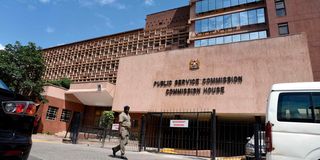
The Public Service Commission

The Public Service Commission (PSC) head office at Commission House in Nairobi.

Photo credit: File | Nation Media Group

Civil servants are in a race against time to declare their assets before the end of the year.

This is part of the biennial exercise to determine whether the wealth of government workers matches their salaries.

The Public Service Commission (PSC) on Tuesday informed civil servants that it would open applications for civil servants to declare their income, assets and liabilities from November 1, 2023 to December 31, 2023.

The PSC trained all human resource managers of all public institutions in August to prepare them for the exercise, which is conducted every two years.

All public servants in ministries, state departments and state enterprises are required to submit a declaration of income, assets and liabilities for themselves, their spouses and dependent children below the age of 18.

“For the general information of public officers under the jurisdiction of the Public Service Commission, this year’s biennial declaration of income, assets and liabilities will be filed between November 1, 2023 and the deadline is December 31, 2023,” the PSC said.

The declaration of assets is a requirement under the Public Officer Ethics Act of 2003. The Act requires public officers to declare their assets within 30 days of entering public service and within the same period after leaving public service.

In January, the PSC instructed human resources managers to take disciplinary action against public officers who fail to declare their assets. According to the law, workers who fail to declare their assets or provide false information could be fined Sh1 million, imprisoned for a maximum of one year or both.

“Each public officer is personally responsible for the completeness and accuracy of the information submitted to the Commission,” the PSC said.

It added: “Public institutions are advised to commence and complete disciplinary action against public officers who would have failed to comply in accordance with human resources policies and procedures from January 2, 2024, and inform the Commission of the sanctions taken by January 31, 2023.”

Losing Sh2 billion a day to corruption

The latest round of asset declarations comes at a time when Kenya's civil service has become a cesspool of corruption, prompting former President Uhuru Kenyatta to declare in 2021 that the country was losing Sh2 billion a day to corruption.

Last week, civil service chief Felix Koskei said the government would commission a study to verify Mr Kenyatta's claim, adding that an unnamed donor was willing to fund the study.

“The claims may be true or false, I alone cannot substantiate the claims but we have a donor who is willing to fund the study to establish the exact number we are losing per day and a report will follow,” Mr Koskei said.

He said the Kenya Kwanza government would not tolerate corruption and warned civil servants against engaging in corrupt dealings as they would be dealt with without mercy.

Despite the requirement to declare assets, a PSC report for the financial year to June 2022 showed that a third of new recruits to the civil service failed to declare their assets.

During the period, 176 state entities recruited 7,567 civil servants, but only 4,885 submitted their first financial declarations. The report also showed that of the 7,503 public servants that left the service, only 6,528 submitted final declarations, leaving 13 per cent unaccounted for.

Investigative agencies such as the Ethics and Anti-Corruption Commission monitor the declaration of income, assets and liabilities of public officers, which it uses to track down those involved in shady dealings where their declared assets match their salaries and other sources of income.

Businesses and consultants are required to disclose details of contracts for the supply of goods and services and their value.