Happening Now: NTV KENYA LIVE | Senate Proceedings
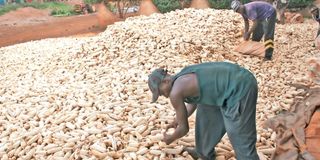
Men spread out harvested maize to dry in Kibwezi. Food wastage and post-harvest losses have been cited during harvesting, drying, threshing and winnowing, sorting, packaging, storage, transport and marketing.

Kenya loses between 20 per cent and 36 per cent of its maize harvest in storage facilities across the country. The devastating waste forces the nation to import grain while 15 million citizens – 28 per cent of the population – face food insecurity daily.
A new study by the World Resources Institute (WRI) Africa reveals that a staggering 70 per cent of all maize losses occur during storage, where poor drying techniques, early harvesting, pest infestation, and deadly aflatoxin contamination destroy what could feed millions.
For most Kenyans, maize isn't just a crop – it is survival. Whether as ugali, porridge, or roasted cobs sold on the streets, maize feeds the nation. Yet the cruel mathematics of waste mean that up to one-third of the country's maize harvest rots in storage while Kenya spends billions importing grain from Uganda, Tanzania, and Mexico.
"For the government, losses of staples like maize in storage undermine efforts to ensure national food security," the report states, highlighting how preventable waste at storage facilities directly threatens the country's ability to feed itself.
The research, conducted by WRI Africa, FOLU Kenya, and Jomo Kenyatta University of Agriculture and Technology (JKUAT), exposes a broken post-harvest system where farmers' hard work disappears in poorly managed storage facilities. The losses occur despite available solutions like hermetic bags, metal silos, and natural insecticides that could dramatically reduce waste.
The problem is particularly acute for smallholder farmers who lack access to proper storage technology or cannot afford the upfront costs of improved facilities. Many are forced to sell immediately after harvest when prices are lowest, or watch helplessly as their stored grain succumbs to pests and moisture.
The maize storage crisis is part of a broader food waste emergency that sees Kenya lose 30-40% of all food produced annually, equivalent to economic losses of Sh72 billion (approximately US$578 million). This waste occurs even as more than a quarter of all Kenyans struggle to find enough food daily.
Fresh fruits suffer even worse losses, with mangoes losing between 17 per cent and 56 per cent of production, mostly at retail and wholesale levels. Avocados fare slightly better but still lose 15-35 per cent of their harvest, with domestic markets suffering higher losses than export channels. Even bananas lose 7-11 per cent of production, with retail identified as the most critical loss point.
The fishing industry presents a tale of two lakes. While Lake Victoria's tilapia suffers manageable losses of 2-4 per dent, Lake Turkana loses a devastating 34 per cent of its catch. The small but nutritionally important omena (silver cyprinid) typically loses 6-7.5 per cent of catch, but this can spike to 80 per cent during storms when proper drying becomes impossible.
"For ordinary Kenyans, food loss and waste may seem like a distant issue – largely due to limited awareness of its scale and impact. Yet, its consequences are deeply felt across society," the report observes.
For potato farmers, losses of 19-23 per cent during harvesting, transport, and retail stages directly impact incomes. Poor harvesting techniques and inadequate storage facilities mean farmers lose money while consumers pay higher prices for the potatoes that do make it to market.
"For smallholder farmers, food losses directly affect yields, incomes, and sometimes daily survival," the report emphasises, underlining how waste ripples through rural communities already struggling with climate change impacts.
The research has also identified practical solutions already working in some areas. "Hermetic storage bags and metal silos can dramatically reduce maize losses. Improved cold storage and sprout suppressants can save potato harvests. Plastic crates, fruit fly traps, and digital marketing platforms can reduce fruit losses," the researchers said.
For fish, improved drying racks, cold chains, and better hygiene practices offer pathways to significant loss reduction.
Dr. Susan Chomba, Director of Vital Landscapes at WRI Africa, sees transformation as achievable. "By providing reliable data, strengthening policies, mobilising finance, and fostering entrepreneurship, we are turning food loss and waste into food security, green jobs, and climate resilience across Kenya and the region," she said.
Despite Kenya's commitment to UN Sustainable Development Goal 12.3 and the African Union's Malabo Declaration, the country lacks robust measurement systems, coordinated policy frameworks, and incentives for loss reduction. The recent launch of the Post Harvest Management Strategy (2024-2028) marks progress, but implementation remains slow.
The report recommends integrating food loss tracking into national statistics, promoting uptake of post-harvest technologies, and developing policies that support food donations and recycling.
With 15 million Kenyans facing food insecurity while the country wastes enough food to feed millions more, the mathematics of waste has become a national emergency.
"If Kenya could halve food loss and waste by 2030, it could inject KES 36 billion back into the economy while cutting 7 million tonnes of carbon emissions," the report says.
"For maize alone, fixing storage losses could reduce import dependency while ensuring farmers benefit from their labour rather than watching it rot in poorly managed facilities," it adds.