Antony Maina remembers it like it happened yesterday.
It was April 1988. He was a teenage young man just stepping off a matatu at Bulbul, Ngong, only to be met by the chief, who forced him to buy a Sh5 Kanu membership card.
At the time, Kenya was a one-party state under President Daniel Arap Moi, and chiefs wielded unimaginable power.
But nothing compares to the day he was roughed up by Kanu Youth Wingers —the chief’s enforcers— who made him dig a trench under their watchful eyes.
“These Kanu youth wings wore red clothes, and they were dreaded vigilante groups used by the youth to reign terror and to harass. And, I’ve been a victim of their actions,” he told the Nation.
It has been more than three decades since this happened, yet the memories still burn.
For Maina and many others with such extreme experiences, the return of the all-powerful chief is a chilling reminder of the terror they endured.
And now, it’s happening again.
The government reversed a policy that, since 2018, had stripped chiefs of direct control over police officers.
Last year, President William Ruto identified this as a major hurdle in law enforcement.
He directed the Interior Ministry to fix it, paving the way for a new police unit: the National Government Administration Police Unit (Ngapu).
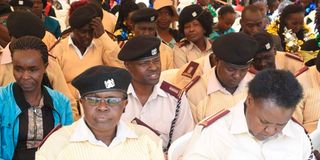
This unit will serve assistant chiefs, chiefs, assistant county commissioners, deputy county commissioners, and county commissioners —all under the umbrella of National Government Administration Officers (NGAO).
It was operationalised on Tuesday, May 6, with the appointment of Charles Mutuma, who will become the unit’s first Commandant.
A career officer in the Administration Police Service, Mr Mutuma now holds the rank of Assistant Inspector General.
He is a two-time graduate of Kenyatta University, holding Master’s degrees in Security Management and Police Studies and Leadership and Security Management. He is currently pursuing a PhD in Security Studies at the same institution.
According to the Interior Ministry, Mutuma brings “a wealth of experience and a high reputation for professionalism”- qualities that informed his elevation to lead the unit.
He will report directly to the Deputy Inspector General (APS) and oversee deployment and operations aligned with national security priorities.
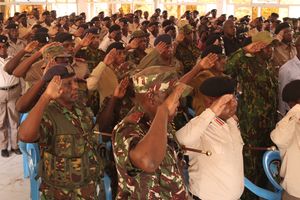
The unit’s rollout began with the deployment of 6,000 officers, drawn from the Administration Police Service (AP), to various parts of the country.
The NGAPU structure will mirror the current AP hierarchy, with commanders at regional, county, sub-county, divisional, and locational levels reporting up to the unit’s headquarters in Nairobi.
Eventually, the force will expand to 19,000 officers following a two-phase recruitment of an additional 13,000 personnel, an initial plan released by the Ministry of Interior and National Administration showed.
With this, chiefs are poised to reclaim power reminiscent of the KANU era, when they ruled with an iron fist.
Back then, chiefs were untouchable.
They ruled their territories like feudal lords, with vigilante groups —KANU Youth Wingers— at their disposal.
For many, the return of powerful chiefs stirs deep-seated memories of both order and oppression.
For many with these dark memories of such times, the word “chief” doesn’t just mean authority —it represents control, surveillance, and, for some, unrelenting brutality.
Historian James Gatama recalls the pivotal role chiefs played in Kenya’s governance. “During colonial times, they were the enforcers of British rule,” he explains. “Some secretly supported the Mau Mau rebellion, but many were outright collaborators.”
But not all chiefs had divided loyalties. Many were feared for their ruthless enforcement of colonial rule.
“There were chiefs who tormented their people,” says Gatama. “They collected taxes violently, enforced forced labour, and even held their courts. They were the law.”
When Kenya gained independence, chiefs retained their power. “Under Jomo Kenyatta, they remained untouchable. Some were even more powerful than district officers,” Gatama says.
During Moi’s era, chiefs had their police officers who carried out arrests on their orders. They controlled land allocations, decided who benefited from settlement schemes, and even forced young men into the National Youth Service. Refusing meant jail time. Resistance was futile.
Now, with the revival of a powerful chiefdom, emotions are running high.
Mzee Barisa Iyesa Thise, 70, from Shirango village in Ganze, Kilifi, fears history is repeating itself.
“We suffered under powerful chiefs,” he says. “They had armed police officers. They oppressed us. And now, we’re going back to that?”
“If you abandon something bad, why go back to it? Many innocent people will suffer again.”
He argues that if chiefs must have police officers, they should at least be from the local community.
“Back then, chiefs were posted to areas they didn’t belong to, and that’s why they were ruthless. They had no ties to the people they ruled over.”
For Mr Paul Ndunda, a resident of Kisumu, having the police work alongside chiefs is both a return to the dark days and a restoration of fading order.
In those days, a visit from the chief and his men meant one of two things: resolving a dispute or someone getting flogged. There was no in-between.
"Those who were arrested would be given a good beating so that they would not think about engaging in criminal activities again," says Mr Ndunda.
He recalls that some offenders sustained serious injuries from these punishments, while others were detained at the chief’s camp for up to a month. The chiefs, he explains, handled petty offenders —poultry thieves, drunkards, and those caught fighting— subjecting them to corporal punishment instead of formal prosecution.
"We could have random announcements of when the chief was in office and ready to attend to cases or when he was out on fieldwork," he adds. Unlike today, when even minor cases end up in court, chiefs once decided most disputes, decongesting jails and delivering swift justice.
"I feel like it was also a good idea because the courts were left for serious offenders like murderers or those reported for assaults," he notes.
The chiefs’ proximity to the people meant they responded swiftly, patrolling day and night. "During that period, crime rates drastically reduced. I cannot compare it to today, where chiefs are considered 'powerless' by the locals," he says.
Still, Ndunda acknowledges that Kenya’s Constitution will now dictate how chiefs operate, preventing past abuses.
But now, as before, does their return promise security or rekindle fear? Only time will tell.
Reporting by Daniel Ogetta, Maureen Ongala and Angeline Ochieng’