Mr Anthony Njoroge, 37, was earning Sh35,000 per month in the United Arab Emirates. However, this was not enough to support him, his wife and their three children.
A similar feeling of inadequacy was shared by his friend Lawrence Mbugua Ndung'u, 33, who worked in Turkey.
Anthony learned of security jobs in Russia, which would pay up to Sh300,000 monthly. He latched onto the idea and informed Lawrence.
They had to pay Sh70,000 each, provide passport copies and take medical tests before traveling to Russia. The two friends quit their jobs, travelled back to Nairobi and paid the agency fees.
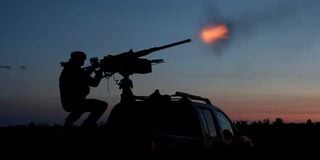
Some Kenyans have been recruited to fight for Russia in Ukraine.
Photo credit: Pool
While in a Great Wall Apartments unit in Athi River, where they met several other Kenyans waiting to take up their new jobs, Lawrence learnt that everyone under that agent was to be recruited into the Russian military.
“I went on with the arrangement because I had nothing else to do after resigning from my job in Turkey,” Lawrence told investigators who uncovered a suspected human trafficking ring luring Kenyans into joining the Russian military.
He watched at least 13 Kenyans depart for Russia as he waited for his turn. Their measurements for the military uniforms they would receive in Russia were taken on September 23.
He returned home to collect some personal belongings that he wanted to take with him to Russia. A day later, police raided the apartment and took all the occupants into custody.
The recruits in waiting were released after interrogation on condition that they report to the Directorate of Criminal Investigations (DCI) to assist with investigations. The seven individuals arrested on September 24 have denied being lured by human traffickers.
They insist that they were not radicalised, coerced or offered anything illegal. They say they are simply job seekers who are willing, hopeful and desperate for a life-changing pay.
After weeks of formal requests, the Daily Nation obtained the confidential statements recorded by the seven after their arrest at Athi River’s Great Wall estate.
A review of the testimonies reveals a consistent pattern: High commission fees, medical tests in private clinics, sudden relocation into shared apartments, vague job descriptions and hints of possible military deployment.
Former Kenyan athlete Evans Kibet.
Photo credit: Pool
At the centre of the DCI investigation are two recruitment agencies: Shepard Talent and Global Face Recruiting Agency, which have previously facilitated security jobs abroad.
Festus, a representative from Global Face, told Daily Nation that Kenyans travelling to Russia “did it out of their own free will.”
“The company opened opportunities for security jobs in Russia and clients willingly applied,” he said.
Mr Kevin Moenga, a security analyst and founder of Antenks Auto Techs Agency, says statements recorded by police raise questions on how many Kenyans are fighting for Moscow in the Ukraine war.
“How many more Kenyans are already on the same path — unseen, uncounted, and one decision away from the battlefield thousands of kilometres from home?” Mr Moenga posed.
The security analyst warned that until it becomes clear how Kenyans end up on the Russia-Ukraine frontline, recruiters will likely keep outwitting police and others trying to stop the scheme.
Mr Boniface Ndarwa, a potato farmer from Nyandarua, said he knew nothing about the Russia–Ukraine war. His mother, Cecilia Mumbi, had heard of a well-paying job — about Sh250,000 per month — through a close friend.
To qualify, he says, he had to pay Sh200,000 in commission and undergo medical tests at a facility in Muthaiga. His mother paid the first Sh15,000.
“When I arrived, I found three people. Later, three more joined,” he said.
As they prepared breakfast on September 24, 2025, detectives stormed the apartment, confiscated their Identity cards and passports, and instructed them to report to DCI headquarters.
Mr Ezra Rotich, 36, is a qualified airport operations expert who survived on construction jobs. In July 2024, a colleague told him about promising overseas opportunities — military or construction — with pay of up to Sh180,000. Then came a bigger offer. An agent told him he would undergo 45 days of training abroad and earn between Sh900,000 and Sh1.2 million.
“Gilbert asked me to pay Sh50,000 for medication, accommodation and a visa,” he said.
At a health facility in Muthaiga, he found that his details had already been forwarded. He later went to Great Wall apartments in Athi River.
In 2024, Mr Stephen Obira Ongenge met a recruitment agent who had previously sent people overseas. On September 12, 2025, she informed him of an opportunity at a Russian military camp.
The agent demanded Sh160,000, split into two instalments. After paying the first Sh80,000, he was escorted to the Great Wall.
Mr Nixon Augala, a 38-year-old plumber who had worked in Kenya and Somalia, was linked up with the recruiters by a friend. He was asked to pay Sh80,000 and was also taken to the Athi River apartment where he was later arrested.
Mr Dennis Thiong’o was among those waiting to travel to Russia. Desperate to earn more than his bar attendant job could give, he found the recruitment agency through an advertisement on TikTok.
After medical tests, he was told he had qualified — but needed to pay a Sh200,000 commission.
Lacking funds, he turned to his partner, who raised the money.
On September 23, 2025, he was accommodated at Great Wall Apartments, He was told that he would earn Sh250,000–Sh300,000 plus a Sh1.2 million commission.
Two days later, Dennis was among those arrested and later released.
The Ministry of Foreign Affairs told Reuters last week that more than 200 Kenyans have joined the Russian military, stating that the group arrested on September 24 had been misled on the nature of the jobs promised to them.
The recruitment of Kenyans and other individuals from emerging economies into the Russian military has drawn mixed reactions from across the world, with the process raising concerns about whether some have been duped with false job and education promises.