President William Ruto has criticised his administration’s opponents for what he termed unfair comparisons of fuel prices in Kenya with those of neighbouring countries.
Following a recent review of fuel prices in Kenya due to disruptions linked to the crisis in the Middle East, Kenyans have accused the President of presiding over high fuel costs, with some motorists near border towns reportedly crossing into neighbouring countries to refuel.
Kenyans have also questioned why landlocked countries such as Uganda, South Sudan, Rwanda and Burundi which rely on the Port of Mombasa for fuel imports are selling fuel at lower prices than Kenya.
Currently, Kenyan motorists pay Sh206.97 per litre of petrol and Sh206.84 per litre of diesel, making it the highest fuel price in the region.
In comparison, motorists in Rwanda pay about Sh203.17 per litre of petrol and Sh194.52 for diesel, while in Tanzania fuel costs Sh189.81 per litre of petrol and Sh189.11 for diesel. In Uganda, petrol costs Sh184.55 per litre and diesel Sh174.10, while Ethiopia has the lowest prices in the region at about Sh109 per litre for petrol and Sh115.70 for diesel.
President Ruto defended the pricing, saying Kenya’s economy cannot be compared with those of its neighbours because it is performing better.
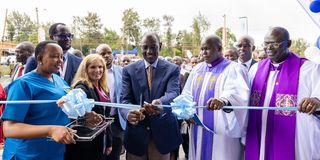
He spoke at a church service at Karen Africa Gospel Church (AGC) on Sunday,
“Kenya is a middle-income country, our neighbours are least developed countries. There is a big difference. If you want to compare Kenya fairly with others, compare Kenya with other middle-income countries. That is where you will get the figures right. Middle-income countries like Kenya have possibly higher prices than Kenya or the same,” President Ruto said.
He further noted that Kenya invests heavily in road maintenance and infrastructure development compared to neighbouring countries.
“Our fuel supports transport infrastructure. I want Kenyans to know that we have 20,000 kilometres of tarmac to maintain, and we have 6,000 kilometres of tarmac under construction. If you add the number of kilometres in Uganda, Tanzania, DRC, Rwanda, Burundi and South Sudan, it is not 20,000 kilometres,” he said.
“The 20,000 kilometres we have in Kenya is more than all the tarmac in all the other seven countries in the EAC combined. That is what we are maintaining. The 6,000 kilometres we are constructing at the moment in Kenya is equivalent to all the tarmac in our neighbouring countries that has been built over 60 years.”
Dr Ruto’s remarks come amid mounting pressure from young people and opposition leaders calling for a reduction in fuel prices, warning of nationwide protests over the high cost of living.
Kikuyu MP and National Assembly Majority Leader Kimani Ichung’wah dismissed threats from Democracy for the Citizens Party (DCP) leader Rigathi Gachagua, saying protests would not lower fuel prices.
“When I hear many people threatening to bring Nairobi to a standstill, I wonder how that helps. How does threatening chaos help bring fuel prices down? It will only aggravate the situation,” Mr Ichung’wah said.
During the same event, Interior Cabinet Secretary Kipchumba Murkomen said politicians had become a security threat by allegedly using youths to cause unrest.
“They are called mheshimiwa or potential mheshimiwa, but every day they plan how to recruit goons and gangs to terrorise people. Many are doing so because of a bankruptcy of ideas. We have made a firm decision that we will not condone the use of young people as goons,” Mr Murkomen said.
He added that security operations targeting criminal gangs would continue in Nairobi and other towns, citing recent arrests in the city and in Kitale.