President William Ruto has unveiled an ambitious new infrastructure agenda, outlining plans to dual 21 key roads and tarmac an additional 28,000 kilometres across the country.
He also confirmed that the long-delayed extension of the Standard Gauge Railway (SGR) from Naivasha to Kisumu, and eventually, to Malaba, will commence in January 2026.
In his third State of the Nation address on Thursday, President Ruto further announced that his administration will pursue public–private partnerships to modernise Jomo Kenyatta International Airport (JKIA), as well as the ports of Mombasa and Lamu, beginning next year.
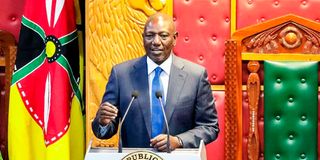
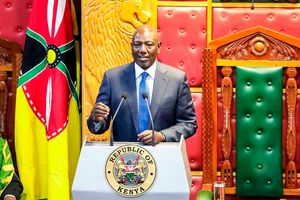
President Ruto's third state of the nation address
Despite Kenya’s strained fiscal position and growing external debt obligations, the President insisted that the newly proposed National Infrastructure Fund and the Sovereign Wealth Fund will provide sustainable financing for these large-scale developments.
“We cannot continue funding essential infrastructure through unsustainable borrowing or burdening taxpayers with additional taxes. But neither can we afford to postpone these imperatives without risking our future,” he said.
He added that the National Infrastructure Fund will rely heavily on reforms contained in the Government-Owned Enterprises Bill, 2025, which he is expected to sign into law. The Bill seeks to repeal 14 Acts of Parliament establishing various state corporations—most of them loss-making—and convert them into commercially viable enterprises.
According to the President, the Ministry of Roads and Transport has already mapped out 2,500 kilometres of highways for dualing and 28,000 kilometres of roads to be tarmacked over the next decade.
Proceeds from privatisation
President Ruto described the National Infrastructure Fund as a strategic mechanism to secure long-term investment in national development. He noted that, historically, proceeds from privatisation — such as those from Kenya Airways, KenGen, Kenya Re, and Safaricom — were absorbed into routine government expenditure instead of building lasting public assets.
Under the new model, he said, all privatisation proceeds will be ring-fenced, preserved, and invested in new infrastructure and wealth-generating ventures.
For every shilling invested from privatisation, the government expects to attract ten shillings from pension funds, sovereign partners, private equity, and development finance institutions.
He cited Australia’s Future Fund, Singapore’s Temasek and the UAE’s Mubadala as examples of commercially run public investment funds that have grown national wealth and supported transformative projects.
The President also reported that his administration built 555 more kilometres of roads than planned in the year to June, after clearing a backlog of contractor debts.
Data from the State Department for Roads shows that KeNHA, Kura, and KeRRA jointly completed 761.25 kilometres of roads against a target of 206.35 kilometres.