President William Ruto has announced plans to seek formal guidance from the Judiciary on the extent to which the government can implement its manifesto without breaching constitutional boundaries, signaling a shift toward institutional dialogue.
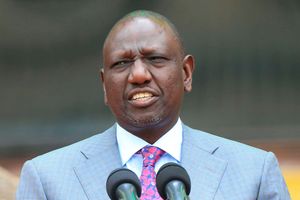
Speaking on Wednesday at State House, Nairobi, during the swearing-in of 15 new Court of Appeal judges, Ruto said the move aims to prevent recurring clashes between the Executive and the courts over policy execution.
Ruto reaffirmed his administration’s commitment to the rule of law while acknowledging growing friction caused by court decisions that have stalled flagship government programs central to his electoral agenda.
“I will be approaching the court to help me understand the place of a manifesto—the policy document upon which a government is established—since we want to shift our political discourse from individuals to policies,” he said.
He explained that during elections, voters choose not only a presidential candidate but also endorse a manifesto as a policy blueprint.
“Going forward, we will seek structured advisory guidance from the Judiciary to ensure policy implementation proceeds within clear constitutional guardrails,” Ruto said, emphasizing that the goal is cooperation rather than confrontation.
President William Ruto congratulates Lady Justice Rachel Chepkoech Ngetich during the swearing -in of newly appointed judges of the Court of Appeal at State House, Nairobi on January 28, 2026.
Photo credit: PCS
His remarks come against the backdrop of repeated judicial interventions that have suspended or nullified government initiatives, including housing levies, tax measures, hiring of advisers, and procurement decisions, citing procedural and constitutional flaws.
Addressing the newly sworn judges, Ruto noted that while courts must remain independent, democratic governance inevitably produces tension when judicial rulings affect major public policy choices with far-reaching consequences.
“It is the nature of democracy that we will not always agree with every court decision,” he said.
“On some occasions, I have questioned rulings that appeared to impede critical public policy priorities.”
State investments in the justice system
However, he clarified that his criticism does not amount to defiance, stressing that his government has consistently complied with court orders and pursued legal appeals where dissatisfied.
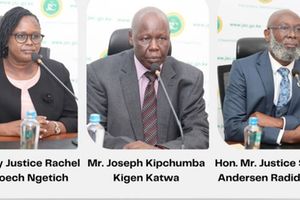
The swearing-in ceremony, one of the largest single appointments to the Court of Appeal in recent history, provided Ruto with a platform to balance critique with reassurance on judicial independence.
Chief Justice Martha Koome, Deputy Chief Justice Philomena Mwilu, and several Cabinet Secretaries were in attendance.
“I reaffirm, without qualification, that this administration respects and will continue to protect the independence of the Judiciary,” Ruto said, adding that courts remain the ultimate custodians of the Constitution and individual rights.
President William Ruto poses for a group photo with newly appointed judges of the Court of Appeal during the swearing -in ceremony at State House, Nairobi on January 28, 2026.
Photo credit: PCS
He argued that seeking judicial advisory opinions would allow early constitutional scrutiny of government programs, reducing costly delays, policy reversals, and uncertainty for investors and the public.
His comments come amid sustained debate over the separation of powers, with critics accusing the Executive of pressuring the courts, while government officials argue that judicial overreach has hindered development.
Mr Ruto cited significant state investments in the justice system as evidence of goodwill, including expanded judicial staffing, increased budgetary allocations, and improved welfare for judges.
As of December 2025, the Court of Appeal was handling more than 14,000 pending cases—a backlog Ruto said undermines access to justice and public confidence.
The appointment of 15 additional appellate judges, he explained, aims to expedite dispute resolution and strengthen jurisprudential consistency amid rising litigation over governance disputes.
He also disclosed that the Judicial Service Commission (JSC) will next week begin recruiting 20 High Court judges.
At the same time, Ruto challenged the Judiciary to deliver decisions that uphold constitutional fidelity while considering the realities faced by ordinary Kenyans. “With expanded capacity and improved resourcing, Kenyans rightly expect faster case resolution and coherent jurisprudence,” he said.
Legal analysts suggest Ruto’s proposal for judicial advisory opinions could mark a turning point if pursued through established constitutional mechanisms rather than informal consultations.
The Constitution permits the Supreme Court to issue advisory opinions to state organs—a tool previously used on matters of devolution and electoral processes.
While Ruto did not specify which court he would approach, he stressed the intention is to entrench predictability, mutual respect, and constitutional compliance in governance.
“Without the rule of law, no policy, no program, and no government can endure,” he said, calling it an “immutable principle” guiding his administration.