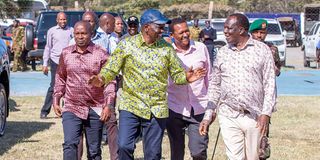
President William Ruto and his deputy Kithure Kindiki are on Monday expected to meet over 12,000 young people drawn from Kajiado and Kiambu who will benefit from the governments’ National Youth Opportunities Towards Advancement (Nyota).
The two have stepped up their effort to woo the crucial Gen Zs into their fold ahead of the 2027 elections through various youth-tailored programmes.
From the empowerment programmes championed by Prof Kindiki targeting boda boda riders, mama mboga, State House meetings with grassroots mobilisers, President Ruto seems to be getting his groove back on the young people population.
From the National Youth Opportunities Towards Advancement to Hustler Fund, which helps the youth to access credit, Digital Job and Opportunity Platforms (Kuna form and ICT hubs), Internship and Labour Mobility Initiatives, ClimateWorx and Labour-Intensive Programmes, Asset and Equipment Support Events and Linking Youth to Public Procurement, the government has been leaving nothing to chance when it comes to youth affairs.
The Gen Zs are expected to have a significant impact on the 2027 Presidential elections, as witnessed in their recent action of speaking out against repressive government policies and leading the anti-finance Bill 2024
The Gen Zs are emerging as a serious voting bloc that any Presidential candidate cannot ignore as the clock ticks towards the 2027 general elections.
Through the Nyota programme, President Ruto and his deputy have acknowledged that the youthful population hold the key to the country’s economic transformation, and failure to utilise energy will result in a restless population that is a national security and political risk
While it is accepted that it is not possible to give every youth a white collar job, the government has resorted to other innovative programmes and policies that will help the youth get opportunities to earn an income.
This includes activities such as entrepreneurship, digital jobs, and local jobs through the affordable housing and market infrastructure programmes.
Nyota is targeting 820,000 youths who will receive direct capital injection of Sh22, 000 and a Sh3, 000 savings bringing the total allocation to Sh25, 000 per youth in the first phase.
The government hopes that the targeted 82,000 youths will open businesses and create at least one job each
Speaking in Machakos when he presided over one of the Nyota programs, Prof Kindiki said the program is a fulfilment of the campaign promise made by President Ruto during campaigns.
“Nyota perfectly fits in the Bottom Up Economic Transformation agenda that will take Kenya forward and make it a first-world country within a generation as promised by the President,” Prof Kindiki said.
“We are creating jobs and opportunities for the young people of Kenya, so they provide us with the human capital that will help us transform our country through a knowledge and entrepreneurship-led economic setup for our country,” he added
Youth empowerment and development remain a cornerstone of the Government’s Bottom- Up Economic Transformation Agenda (Beta)
According to the draft Budget Policy Statement (BPS) by the National Treasury, the government has provided youth-friendly services to 1,177,480 young people, including 72,623 beneficiaries of subsidised Sexual and Reproductive Health (SRH) services, and trained 94,298 youth in leadership and governance.
Additionally, 56,350 youth were equipped with life skills, while 3,943 talents were identified and nurtured in arts, innovation, and creative industries.
“To promote economic empowerment, 28,003 youth entrepreneurs accessed loans totalling KSh 553 million, enabling them to expand business ventures, and 3,537 youth were facilitated to secure employment opportunities abroad,” reads the treasury document.
The government says it trained 218,902 youth in business skills and 24,507 youth specifically on entrepreneurship techniques.