President William Ruto has officially launched the candidature of Justice Njoki Ndung’u for election as a judge of the International Criminal Court (ICC), describing her as not only an accomplished jurist but also a representative of a generation of Kenyan constitutional reformers.
Dr Ruto said the Supreme Court judge was among those who helped guide Kenya through one of the most consequential democratic transitions in the nation’s history.
“This is not about a person; it is about our nation, Kenya. We must never adulterate such occasions,” he said.
President Ruto emphasized that Kenya was presenting to the international community not just a candidate with legal expertise, but a jurist shaped by Africa’s constitutional struggles, democratic transitions, human rights movements, and institutional rebuilding.
He highlighted Justice Ndung’u’s 15 years of distinguished Supreme Court service and her lifelong contributions to constitutionalism, gender justice, and the protection of the vulnerable.
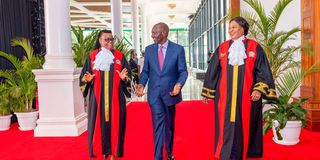
President William Ruto, Chief Justice of Kenya Lady Justice Martha Karambu Koome and Honourable Justice Njoki Ndung’u (right) at State House, Nairobi.
Photo credit: PCS
“This is Justice Njoki Ndung’u’s aspiration and calling. Kenya’s role is to ensure that the international community recognises her immense value and benefits from her experience, integrity, and contribution to the advancement of justice,” he said.
If elected, Justice Ndung’u will serve at the Hague-based court from 2027 to 2036.
The launch was attended by Chief Justice Martha Koome, Prime Cabinet Secretary Musalia Mudavadi, Supreme Court judges, other judicial officers, and former ICC judge Joyce Aluoch, who served on the ICC Trial Division between May 2009 and March 2018.
President Ruto said presenting Justice Ndung’u’s candidature affirms her enduring belief in a rules-based international order, judicial independence, and the principle that justice must remain fair, impartial, and accessible to all nations.
“We support a court that commands confidence not through coercive authority, but through the quality, fairness, and credibility of its decisions,” he said.
Highlighting Africa’s central role in global conversations on conflict, accountability, displacement, democratic transition, and peacebuilding, Dr Ruto said Africa cannot remain merely the subject of international justice but she must help shape international justice.
President William Ruto, Chief Justice of Kenya Lady Justice Martha Karambu Koome (extreme left) and Prime Cabinet Secretary Musalia Mudavadi applaud Honourable Justice Njoki Ndung’u (right) after he unveiled her election bid as Judge of the International Criminal Court, 2027-2036 at State House at State House, Nairobi.
Photo credit: PCS
“The majority of cases before the ICC have involved African situations, African communities, and African victims seeking justice. It is therefore both appropriate and necessary that Africa has strong, principled, and highly qualified representation on that bench.”
President Ruto outlined Justice Ndung’u’s career, noting her fidelity to justice, constitutionalism, and human dignity.
“From her early years prosecuting serious criminal offences as a State Counsel and her role in shaping Kenya’s constitutional transformation to distinguished service at the Supreme Court of Kenya, her career has consistently been defined by courage, intellect, and commitment to justice,” he said.
He recalled her work on the Committee of Experts that drafted Kenya’s 2010 Constitution, helping rebuild the country’s constitutional order around accountability, inclusion, institutional checks, and democratic renewal. He said that experience is vital for ICC work, which is not only about punishment.
President Ruto also highlighted her legislative contributions, including leading reforms on sexual and gender-based violence through Kenya’s Sexual Offences Act of 2006 and helping develop the Maputo Protocol, a key African human rights instrument protecting women’s dignity and rights.
They also encouraged more Kenyans to apply for international positions to extend the country’s influence on the global stage.