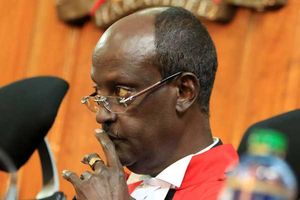
Kenya has nominated Supreme Court judge Njoki Ndung’u for election to the International Criminal Court (ICC), opening the door for a potential third succession at the top court before the 2027 General Election.
Justice Njoki’s nomination has been formally communicated to ICC court, which will hold elections for new judges in December, 2026.
While the court is based at The Hague in the Netherlands, the elections will be conducted in New York during the 25th Assembly of States Parties.
The gap from her potential exit from the Supreme Court would follow the vacancy left by one of its first five Judges appointed in 2012, Justice Mohamed Ibrahim, who died on December 17, 2025 – just 14 days before turning 70 and hitting the mandatory retirement age for judges.
It would also precede the retirement of Deputy Chief Justice Philomena Mwilu, who turns 70 on April 15, 2027 which will be barely three months to the General Election.
Kenya’s elections have a symbiotic relationship with the Apex Court. Only Presidents Jomo Kenyatta and Mwai Kibaki did not face court petitions challenging their election wins.
Former President Daniel Arap Moi’s victories in the 1992 and 1997 General Elections were preserved by the High Court following petitions challenging the outcomes.
President Uhuru Kenyatta’s 2013 win was preserved by the Supreme Court. In 2017, the Supreme Court nullified his win, but dismissed petitions challenging his victory in the repeat exercise.
History suggests that a presidential election petition will be more likely than not in 2027, hence shining a spotlight at the only body mandated to determine presidential election outcomes – the Supreme Court.
In the past, filling Supreme Court vacancies has taken two to three months. Former Chief Justice David Maraga is the only Supreme Court judge whose recruitment was done in a month.
His successor Martha Koome, her deputy Philomena Mwilu and Justices William Ouko and Isaac Lenaola were hired within three months of vacancies being advertised.
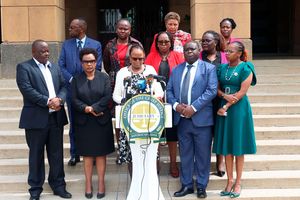
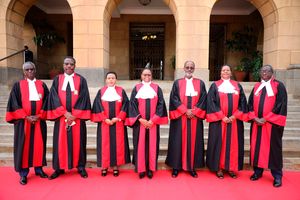
Supreme Court judges (from left) Isaac Lenaola, Dr Smokin Wanjala, Philomena Mwilu, Chief Justice Martha Koome, the late Mohamed Ibrahim, Njoki Ndung'u and William Ouko.
Photo credit: File | Nation Media Group
Former Chief Justice Willy Mutunga, and Justices Ndung’u, Kalpana Rawal, Philip Tunoi, Jackton Ojwang, Smokin Wanjala, and Mohamed Ibrahim were hired two months after vacancies at the Supreme Court were announced.
If elected, Justice Njoki will become only the second Kenyan to join the ICC bench after Joyce Aluoch, who sat at The Hague-based court between 2009 and 2018.
Her exit would also leave Justice Smokin Wanjala as the only member of the class of 2012, which was the first group of Supreme Court judges under the 2010 Constitution.
A diplomatic note from Kenya’s embassy in The Hague addressed to ICC said: “President William Ruto nominated Hon. Lady Justice Njoki Ndung’u as Kenya’s candidate for election as a Judge of the Court.”
While an ICC election win for Justice Njoki would trigger celebration of another Kenyan jurist on the international stage, it would set the stage for a second succession at the Supreme Court in months.
It would also leave the seven-judge bench with six judges, meaning that pending the recruitment another judge would have to be dropped from hearings to comply with the uneven-number rule.
According to the constitution, the Supreme Court shall be properly constituted for the purposes of its proceedings if it is composed of five judges.
President Ruto is defending his seat against an opposition outfit led by his former deputy Rigathi Gachagua.
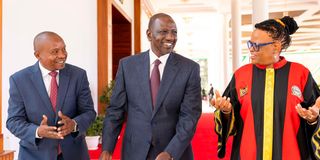
President William Ruto with his deputy Prof Kindiki Kithure and Chief Justice and President of the Supreme Court of Kenya Martha Koome during the swearing -in of newly appointed judges of the Court of Appeal at State House, Nairobi on January 28, 2026.
Photo credit: PCS
Following his death, the Judicial Service Commission advertised the vacancy left by Justice Ibrahim at the Supreme Court on January 27.
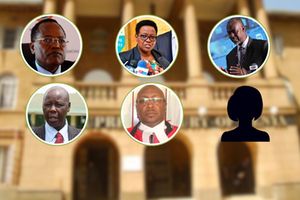
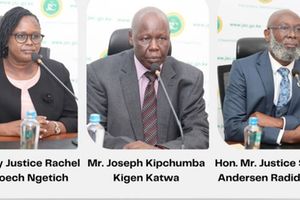
Justice Katwa Kigen, one of the 15 new Court of Appeal judges who took office on January 27, is among six candidates who have thrown their hats in the ring to take up the current vacancy in the Apex Court.
High Court judge Joseph Sergon has also applied for the position. He was among the unsuccessful during the JSC’s hiring of Court of Appeal judges which saw Justice Kigen join that bench.
Justice Sergon was also among the candidates in the 2021 recruitment process which saw Martha Koome become Kenya’s first woman Chief Justice, as former Court of Appeal President William Ouko also joined the Apex Court.
Justice Francis Tuiyott has also applied for the Supreme Court judge vacancy, alongside former Independent Policing Oversight Authority chairperson Ann Waceke Kiratu Makori and advocate Lilian Wanjiku Wachira.
Should the ICC election in December go Justice Njoki’s way, the JSC will have to initiate recruitment with barely eight months to the General Election.
And on April 15, 2027, Deputy Chief Justice Mwilu will turn 70, automatically triggering her retirement and a third recruitment at the Supreme Court, with barely three months to the General Election.
Deputy Chief Justice Philomena Mwilu.
Photo credit: File | Nation Media Group
The ICC election will determine judges who will serve a nine-year term between 2027 and 2036 at the world’s permanent court for genocide, war crimes and crimes against humanity.
There are six seats available on the court’s 18-judge bench. So far only seven candidates have been nominated, including Justice Ndung’u, with the nomination period scheduled to close on March 29, 2026. These vacancies arise because one-third of ICC judges are replaced every three years, each serving a non-renewable nine-year term.
State parties to the Rome Statute elect ICC judges through the Assembly of States Parties, the court’s governing body composed of countries that ratified the treaty.
Each state party may nominate one candidate, after which governments campaign diplomatically before a secret ballot vote requiring an absolute majority of participating states.
The process also balances geographical representation, gender parity and legal expertise to ensure the bench reflects different legal systems and global perspectives.
In accordance with the legal framework of the Rome Statute, candidates must demonstrate high moral character, proven competence in criminal law or international law, and qualifications required for the highest judicial office in their countries.
The framework also allows allegation of misconduct against any candidate to be reported confidentially ahead of the elections, no later than May 31, 2026, to the Independent Oversight Mechanism (IOM), a subsidiary body of the Assembly.
For purposes of due diligence procedure, the framework says misconduct refers to human rights violations; incidents in the workplace or in connection with work of harassment, including sexual harassment, abuse of authority, discrimination and bullying; as well as other ethical or legal breaches of a serious nature such as fraud or corruption.’
Under the ICC election rules set by the Assembly of States Parties, candidates are nominated under two professional categories — List A, for jurists with established competence in criminal law and criminal procedure, and List B, for experts in international law, including international humanitarian and human rights law.
Kenya has nominated Justice Ndung’u under List A, reserved for candidates with recognised experience in criminal law and criminal procedure.
She is competing against several other nominees for the ICC judgeship, including Yoshimitsu Yamauchi of Japan, Nangela Deo John (Tanzania) and Guénaël Mettraux of Switzerland, according to the official nominations list for the 2026 election.
List B contains candidates with expertise in international law, including international humanitarian law and human rights law. They include Ankumah Evelyn (Ghana), Muzigo-Morrison Rosette (Uganda) and Olarte Bácares Diana Carolina (Colombia)
During elections, states must also observe minimum voting requirements to maintain balance on the bench. These rules ensure that the court retains adequate numbers of judges from each list, while also safeguarding equitable geographical representation and gender balance among judges from the court’s regional groups.
Justice Ndung’u’s statement of qualifications says she has served more than three decades in criminal justice, legislative reform, human rights advocacy and judicial leadership.
“Overall, Judge Njoki S. Ndungu’s extensive experience in criminal law, legislative reform, gender justice, humanitarian protection, and judicial leadership demonstrates a profound commitment to accountability, the protection of vulnerable populations, and the advancement of victim-centred justice,” reads the statement.
It notes she has participated in landmark decisions shaping Kenya’s criminal jurisprudence while safeguarding “fair trial rights, evidentiary standards and protection of constitutional rights of accused persons.”
Justice Ndung’u has served on the Supreme Court since 2011, giving her final appellate authority over criminal matters in Kenya’s highest judicial forum.
Before joining the bench, she worked as a state prosecutor, appearing before magistrates courts, the High Court and the Court of Appeal in serious criminal cases.
Her nomination also highlights her legislative record, including sponsoring Kenya’s Sexual Offences Act of 2006, which strengthened protections for survivors and accountability for perpetrators. She served as a National Rainbow Coalition (NARC)-nominated Member of Parliament between 2003 and 2007.
The documents say the law transformed the country’s legal framework for sexual violence and expanded evidentiary standards and survivor protections.
Justice Njoki Ndung’u.
Photo credit: File | Nation Media Group
“Ndung’u’s judicial service at the highest court, her prosecutorial experience, her legislative leadership in criminal law reform, and her international work on sexual violence and accountability demonstrate her deep and established competence in criminal law, consistent with the requirements of Article 36(3)(b) of the Rome Statute,” says the statement.
Her career also includes work with the African Union, humanitarian agencies and civil society groups addressing gender violence, refugee protection and accountability for serious human rights violations.
In her submission, Kenya describes Ndung’u as a jurist of “high moral character, impartiality and integrity” with experience across judicial, legislative and international institutions.
The government also argues her work on gender-based crimes aligns closely with offences prosecuted by the ICC under the Rome Statute.
ICC judges play a crucial role in interpreting international criminal law, issuing arrest warrants, conducting trials and delivering judgments on the gravest crimes under international law.
Their rulings shape global accountability standards and influence how states investigate atrocities, protect victims and prosecute perpetrators of mass violence.
For member countries, nominating candidates is both diplomatic and strategic because representation on the bench strengthens their voice in the development of international criminal justice.
Kenya has previously participated in ICC judicial nomination processes, though its earlier candidates did not ultimately secure election to the court. In 2023 election cycle it had nominated Court of Appeal Judge Wanjiru Karanja but she dropped out of the race in October 2023.
The December elections will fill several vacancies created as sitting judges complete their nine year nonrenewable terms.
The Supreme Court in Nairobi.
Photo credit: File | Nation Media Group
Diplomatic lobbying among the court’s 120 plus state parties is expected to intensify in the months before voting begins.
Successful candidates must obtain an absolute majority of votes and meet strict requirements on regional representation and gender balance.
If elected, Justice Ndung’u would join a panel of 18 judges responsible for hearing cases involving genocide, war crimes and crimes against humanity.
Her supporters argue her long judicial career and experience in victim centred justice would strengthen the court’s work on accountability and survivor protection.
Kenya told the court that her professional record reflects “deep engagement with the legal challenges associated with prosecuting serious crimes under international law.”
The nomination now places the Supreme Court judge on an international campaign trail as governments weigh experience, regional balance and judicial philosophy.
The outcome will determine whether Kenya finally secures representation on the influential court’s bench.