With his sights set on the next General Election, President William Ruto is backing an ambitious development charter he hopes will transcend successive administrations and transform the country’s economic fortunes.
With one year left of his first term in office, Dr Ruto is advocating for a new plan to take the nation forward beyond Vision 2030, a long-term national development plan launched in 2008 by President Kibaki. The plan aimed to turn Kenya into a newly industrialised, middle-income country.
Dr Ruto announced that the formal launch of the national conversation on Kenya’s Future Beyond Vision 2030 will be on August 12.
He is seeking to shift national planning away from government manifestos and towards a constitutional blueprint that will survive elections and successive administrations.
Christened the ‘People-Driven National Development Charter’, it is intended to shape Kenya’s economic, social and political direction beyond 2030.
In a national address on Thursday July 30 evening, President Ruto set the country on course for what could become its most ambitious national planning undertaking since the 2010 Constitution was enacted. He unveiled plans for a new long-term development strategy to succeed Vision 2030.
Unlike previous government development plans, Dr Ruto said the proposed charter should breathe life into the development aspirations enshrined in the Constitution, becoming a national consensus that transcends political administrations and election cycles, and not merely replacing Vision 2030.
Although Vision 2030 still has four years remaining, the government argues that preparing its successor cannot wait until the current blueprint expires.
President Ruto announces new Economic blueprint to succeed Vision 2030
The Head of State emphasised that the new charter must belong to the people rather than the government.
Before unveiling the proposal, he said he had consulted former leaders, politicians, business executives, scholars, faith leaders, professionals, civil society representatives and young people, insisting that no government could legitimately define Kenya’s future alone. The president argued that Kenya had failed to capitalise on three significant waves of global industrialisation that had transformed countries once comparable to Kenya. “Kenya was present at all of these major developments, but we did not take full advantage of them,” he said.
“In 1965, Kenya and South Korea each had a GDP per capita of approximately $110. Today, South Korea’s exceeds $36,000, whereas ours is just $2,400. That’s a multiple of fifteen,” he said.
“The first wave unfolded between the 1960s and the 1980s. It involved the East Asian Tigers — South Korea, Singapore, Taiwan and Hong Kong — which transformed themselves into prosperous, high-income, industrialised economies.”
The second, he noted, occurred in the late 1970s.
“China, together with Malaysia, Thailand, Indonesia and Mauritius, embarked on bold economic reforms that lifted hundreds of millions of their citizens out of poverty and transformed their economies into globally competitive manufacturing and investment hubs,” Dr Ruto noted.
The third wave, he noted, began in the early 1990s, when Vietnam, India, Bangladesh, and Cape Verde embraced reform, expanded exports, attracted investment, and fundamentally changed the trajectory of their economies within a generation.
“In 1980, when China began its economic reforms, its GDP per capita stood at around $200. Kenya’s was then at $450. China has overtaken us and now has a GDP per capita exceeding $14,000. That’s a multiple of six compared to ours,” he said.
When Vietnam embarked on economic reforms in the early 1990s, he said the country’s income per person was roughly half of Kenya’s.
“Today, Vietnam’s GDP per capita is approximately $5,000, which is more than double Kenya’s. Bangladesh has followed a similarly remarkable path. Even more sobering is the fact that we are now being challenged by countries much closer to home.”
“Ghana’s GDP per capita is about $3,200, which is roughly 30 per cent higher than ours. Meanwhile, Zimbabwe has recovered to a GDP per capita of about $3,000 after enduring decades of profound economic hardship, which is now slightly higher than ours,” the president said.
However, President Ruto observed that Africa is entering what could become the most significant wave of global economic transformation yet.
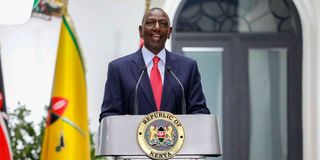
President William Ruto arrives at State House, Nairobi, on Thursday, July 30, 2026, to deliver a special National Address.
Photo credit: Dennis Onsongo | Nation
With its young population, growing consumer markets, plentiful renewable energy resources and valuable minerals, Africa presents a once-in-a-generation opportunity, he said.
Kenya, he said, should not merely aim to participate in that transformation, but to lead it. However, the president argued that the country’s future should not be left to politicians alone.
“It must be imagined, shaped and built by each and every one of us,” Dr Ruto said.
“Our responsibility under the Constitution is far greater: to craft a new national development charter that gives effect to the development imperatives enshrined in the Constitution, and to decide together what kind of Kenya we want to build over the next generation and beyond,” he said, insisting that this process must rise above partisan politics.
“This national conversation must transcend electoral cycles and unite us around a shared destiny,” he said. “It must be forged through a genuinely people-driven, citizen-centred and future-focused national process that draws upon the collective wisdom, experience, imagination and aspirations of the Kenyan people, while remaining open to the very best ideas the world has to offer,” Dr Ruto said.
“It was in light of this spirit that I invited Prof Hiroyuki Hino, Prof Anyang’ Nyong’o, and their distinguished colleagues to start considering Kenya’s future beyond Vision 2030. Last week, I had the honour of receiving their proposals on strategic guidelines for Kenya’s long-term national transformation.”
The President announced that the process will formally begin on August 12, when the government will launch a nationwide public participation exercise, bringing together political leaders, professionals, businesses, civil society, universities, faith organisations, and young people.
Conceived through an extensive consultative process between October 2006 and May 2007, followed by further nationwide consultations in 2007, the Vision 2030 was aimed at transforming Kenya into ‘a globally competitive and prosperous country with a high quality of life’ by 2030.
The blueprint envisaged Kenya becoming a newly industrialised, middle-income country through sustained economic growth, social transformation, and democratic governance.
It was built around three pillars: economic, social, and political.
Rather than dismissing Vision 2030 as a failed project, the president praised it for changing Kenya’s development mindset, while acknowledging that many of its goals remain unachieved.
However, Kenya’s adoption of long-term development plans did not begin with Vision 2030.
After independence, Kenya adopted Sessional Paper No. 10 of 1965 on African Socialism and its Application to Planning in Kenya. This document became the country’s first comprehensive economic policy framework.
This document set out plans for a mixed economy, in which both the State and private enterprise would play complementary roles in driving development. It emphasised rapid economic growth, investment, agricultural productivity, industrial expansion, and the efficient allocation of resources, all the while advocating social justice and equal opportunity.
Although successive governments interpreted its principles differently, the Sessional Paper No. 10 shaped Kenya’s economic direction for decades.
The late Daniel Arap Moi’s Kanu administration introduced various national development plans and district-focused planning frameworks, and the Kibaki government replaced fragmented planning with the more comprehensive Vision 2030.
Now, Dr Ruto appears keen to leave his own mark on Kenya’s long-term planning by initiating what could become the country’s fourth national development framework since independence.
However, unlike previous plans, he argues that the new charter should derive its legitimacy directly from the Constitution, rather than from the priorities of any particular administration.
He contends that constitutional provisions guaranteeing healthcare, housing, education, water, food security and social protection already establish the country’s development obligations.
He argues that what Kenya lacks is a nationally agreed framework that translates these rights into measurable targets and binding national commitments.
A recurring weakness of Kenya’s development planning has been policy discontinuity. Every administration introduces new flagship programmes reflecting its own political agenda.