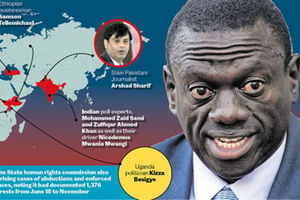
They all thought that Kenya was a safe haven, following its historical protection of politically persecuted individuals. They were wrong.
In the last four years, at least 50 foreign nationals have been abducted or killed on Kenyan soil following behind-the-curtain deals that threw them to the wolves.
Tanzanian activist Maria Sarungi.
Photo credit: Pool
On Monday, Tanzanian journalist Maria Sarungi maintained that her Sunday abduction by four armed men was at the instigation of her home country as she joined the growing list of foreign nationals in Kenya at risk of persecution.
Tanzanian activist Maria Sarungi speaks after abduction in Nairobi
Ugandan opposition leader Kizza Besigye.
It is not clear why he was charged in a Ugandan military court for a crime allegedly committed in Kenya.
Interestingly, President Museveni and his wife, Janet, first met at the Hilton Hotel in Nairobi when both were staying away from their home country on account of dictator Idi Amin.
In 1972, Janet was as a go-between for President Museveni and Britain-based lawyer John Kazoora. Their interaction blossomed into marriage.
National Resistance Movement
They moved to Dar-es-Salaam. But President Museveni moved Janet and their children to Nairobi in 1981 when he led the National Resistance Movement in the Bush War, a coup that overthrew Tito Okello and saw him take the reins at State House.
Kenya was still very friendly to foreigners and mostly guaranteed their safety regardless of differences with their governments. Things have not been the same recently.
Turkish nationals Mustafa Genç, Abdullah Genç, Hüseyin Yesilsu, Necdet Seyitoglu, Oztürk Uzun, Alparslan Tascı and Saadet Tascı are among 45 foreign nationals abducted in the last three months alone.
Genç, Yesilsu, Uzun and Tascı were all refugees under the UN’s protection but they were flown to their home country and have since been jailed.
Mr Uzun was issued with a refugee identification card in January, 2024 while Mr Mustafa’s ID was issued in July, 2023.
Mr Tasci got his refugee identification card in October, 2020 and Mr Huseyin’s was processed in January, 2021.
They have been critical of President Reccep Tayip Ergogan, and were supporters of the Gulen movement, a community of people that promotes tolerant Islam. President Erdogan in 2016 declared the Gulen movement a terrorist organisation.
Three years earlier, Selahaddin Gulen was treated in similar fashion. Abducted, transported to Ankara and jailed. Selahaddin is a nephew of Fethullah Gulen, founder of the Gulen movement.
Fethullah died in October, 2024, barely three days after four members of his movement were abducted and repatriated to Turkey.
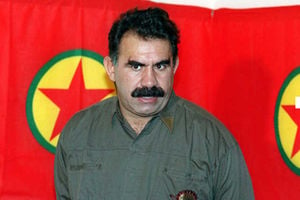
Kurdish nationalist leader Abdullah Ocalan.
Photo credit: File | Nation Media Group
Another Turkish national, Abdullah Ocalan, was also abducted in 1999 after being pursued by the administration of President Suleyman Demirel.
The rendition of the four Turkish nationals was a joint effort between Turkish intelligence officers and Kenya’s security agents.
Just months before they were picked up in Nairobi, Kenya signed a deal with Turkey that will see the latter supply military equipment.
Around the same time, Kenya signed the military deal with Turkey, a group of Ugandan opposition members had travelled to Kisumu for a training course.
They are members of the Forum for Democratic Change (FDC), the party through which Mr Besigye contested Uganda’s presidency four times.
At the time of their arrest, the Uganda Police Force (UPF) threw the ball to its Kenyan counterpart.
The UPF claimed that Kenyan security personnel alerted it of covert activities by the 36 Ugandans, and which may have been aimed at overthrowing President Museveni.
“They were engaged in covert activities that are suspected to be subversive, drawing the attention of Kenyan security forces. We are collaborating closely with our Kenyan counterparts to thoroughly investigate this matter,” UPF communications officer Rusoke Kituuma said in a statement at the time.
Just over a year before the FDC members were deported, Rwanda’s activist Yusuf Ahmed Gasana was abducted from his home in Nairobi by unidentified individuals.
At the time, his family was informed that Mr Gasana was moved to Rwanda and held in a detention facility.
He was vocal about refugee rights. He helped several refugees seek legal recourse for violation of their rights, even against the Kenyan government.
Morris Mabior Awikjok Bak.
Photo credit: Courtesy | HRW
His stay in Kenya was meant to be short, as he was told that the country’s good record with refugees and asylum seekers would guarantee safety.
But his life ended after Kenyan police officers shot him and maintained that it was a case of mistaken identity.
The officers claimed that they thought he was in a stolen vehicle they were tracking – a Mercedes Benz van. Mr Sharif was in a Toyota Landcruiser.
For Samson Teklemichael, uniformed police officers stopped his vehicle in Kilimani on November 19, 2021.
He was bundled into a police vehicle. The few videos taken by witnesses would be the last anyone would see of Mr Teklemichael, who was a strong critic of the Ethiopian government.
With the abduction of Kenyans critical of their own government also on the rise, President William Ruto’s administration has come under censure over enforced disappearance and its complicity in some of the cases.
Amnesty International pointed out the irony of the abduction of both local and foreign nationals in a country that recently bagged a seat in the UN Human Rights Council.
“This is a very dangerous precedent for Kenya considering Kenya recently ascended to a seat in the UN Human Rights Council. It is a dangerous precedent for Kenya considering it hosts many expatriates in this country,” Roland Ebole, an Amnesty International researcher, said.
“Kenya is the third largest UN hub in the world and when foreign nationals do not feel protected and secure, it is really dangerous.”