When bullets cut short the life of prominent advocate Mathew Kyalo Mbobu last week , they silenced a man whose career had long walked a tightrope between brilliance and controversy. Shot dead by unknown assailants as he drove home, Mbobu’s violent end is the culmination of a life lived on the edge—between the corridors of justice and the shadows of risk.
At the University of Nairobi, where he was a law lecturer, Mbobu was a scholar—the author of Law and Practice in Kenya whose cover page is a chilling irony—the yellow ribbon of a crime scene. For clients and students who went through his pupilage, Mbobu was a fortress: confident, formidable, always impeccably dressed in tailored suits that whispered of money and power. He was the ultimate.
Yet beneath the polish was a man who lived dangerously close to the edge—gambling with trust, juggling millions in client funds, and making enemies in places where grudges could kill.
His reputation was a paradox: precise and commanding in the courtroom, yet elusive when tested against truth. He thrived on high-stakes deals, but his wake was littered with lawsuits, quarrels, and whispers that rendered his name as formidable as it was fragile.
In recent years, Mbobu found himself navigating a storm of litigation, client complaints, and persistent allegations of impropriety. Still, he clung to routine, driving the same route home through Nairobi’s clogged traffic, as though predictability could shield him from the dangers that shadowed his steps.
By the time the gunmen struck, Mbobu was perhaps a man under siege—though he had reported no threats to police or to friends. Investigators say nothing was stolen, and the assassin simply melted into the night on a waiting boda boda.
Several cases were openly known about him. In 2022, he secured what should have been his crowning deal: the sale of two prime parcels in Karen worth Sh250 million. The buyers wired the full sum into his account, entrusting him as custodian. But trust quickly frayed. Mbobu released only Sh153 million to his client. The balance—Sh97 million—remained with him.
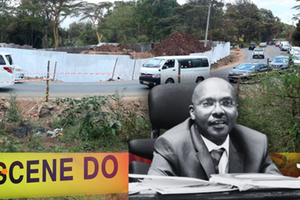
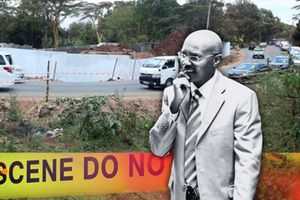
Vehicles on Magadi Road in Nairobi on September 10,2025, near the spot where lawyer Kyalo Mbobu was shot dead while driving on September 9, 2025.
Photo credit: Evans Habil | Nation Media Group
Cornered, Mbobu sought refuge in deflection, alleging that the disputed funds had been “misappropriated” by his partners at Kyalo and Associates—an odd claim, given that he was the firm’s sole proprietor. The complainant, Corat Africa, countered that Mbobu had personally pledged to settle both the principal amount and the mounting penalties.
Corat further dismissed his argument that he was entitled to hold a lien over the funds, noting that even if such a claim were valid, it could never justify the staggering Sh97 million in question. Mbobu, for his part, insisted he was entitled to withhold part of the money as security for legal fees and costs.
The High Court, however, was unconvinced. Six months ago, it ordered Mbobu to retain Sh8.7 million as security and to remit the balance (Sh88.3 million) to Corat Africa. By May, after a string of delaying manoeuvres, the court lost patience, branding him “indolent” and “intent on abusing the court process”. What emerged from the case was a lawyer, ambitious enough to secure deals worth hundreds of millions, yet reckless enough to sabotage them through dishonesty. He understood the law deeply, yet bent it to justify what was plainly unethical.
After controversial businessman Jacob Juma forged land documents, he turned to Mbobu to defend him. It was a typically audacious move from Juma, the flamboyant businessman whose empire was built on bluster and brinkmanship. The case concerned a multimillion-shilling, seven-acre tract in Loresho, near the Kenya School of Government—a prize Juma claimed as his own, though the paperwork told a murkier story.
In court, Mbobu fought to legitimise Juma’s claim. But the alliance soured when the lawyer presented a bill of Sh5.5 million in legal fees. Juma balked, insisting the figure should have been Sh1.25 million. The quarrel exposed the fragility of their partnership—and there was no justification for the inflated fee. The High Court would later cut to the heart of the matter: “There is nothing to demonstrate how Jacob Juma (deceased) became the registered owner of the property.”
Like Juma, who was gunned down in 2016, Mbobu lived in the same shadows in risky ventures. And like Juma, his life would end in a hail of bullets. But Mbobu’s appetite for high-stakes risk was not confined to disputed client funds or quarrels over inflated legal fees.
Court records reveal he had once drawn two parallel sale agreements for the same Thika property—a manoeuvre designed to help his client dodge stamp duty and mislead a bank about the true value of the transaction.
In his own submissions to the High Court in 2009, he admitted to preparing one contract reflecting a price of Sh10 million and another at Sh20 million. The lower figure was presented for registration, ensuring reduced duty payments, while the higher, “unofficial” deal was used privately by the parties.
The court was unsparing. Justice Lesiit condemned the move as a blatant attempt to “deny the government payment of the required stamp duty” and ruled that no advocate could be allowed to profit from such an arrangement. The decision underscored a darker reality: for all his legal brilliance, Mbobu was willing to bend the very law he taught, not simply for his clients’ gain but in ways that corroded public trust. “It is a principle of law that a contract made to defeat the ends of justice being met cannot be enforced. The applicant (Mbobu) cannot, therefore, seek to be paid instruction fees on either of these agreements because the one for Sh10 million is false and the one for Sh20 million is not the official agreement the parties presented for registration or stamping. It is an unofficial document.”
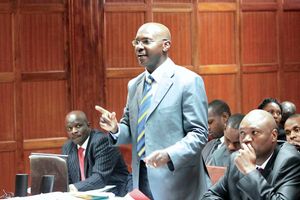
Lawyer Kyalo Mbobu.
Photo credit: File | Nation Media Group
Mbobu’s world was one of debts and dwindling options. Four years ago, he took a shylock to court in a case that exposed his financial struggles. In January 2024, Mbobu had reached out to a shylock and borrowed Sh11 million with a 15 per cent interest per month, flat, with a further 5 per cent per week in penalties should a single instalment falter.
To redeem his lifeline, the lawyer signed away the title of his land, surrendering the ground beneath his feet as collateral. By the time he had paid Sh26 million in repayments, the shylock was demanding nearly Sh70 million – compounded by penalties. The shylock saga revealed a man scrambling to stay financially afloat with each gamble pushing him closer to the edge. The applicants term the same excessive.
Before he lost his reputation, Mbobu was already fiercely protective of it. In 2005, he dragged the ex-wife of a client to court, accusing her of defamation after she suggested that he was responsible for the delay in concluding a divorce case. The court examined the circumstances carefully.
The judge noted that the remarks in question had only been communicated to a small circle of people, many of whom dismissed the woman as a misguided litigant, even a scorned figure speaking out of venomous fury rather than reason. Because of this, the harm could not be said to have spread widely or caused lasting damage to Mbobu’s professional standing.
The judge acknowledged, however, that the words did subject Mbobu to embarrassment, humiliation, and ridicule, especially within the corridors of the court where his peers and clients might have been present. Still, the court found that the damages sought—Sh20 million—were entirely out of proportion to the actual harm.
Lawyer Kyalo Mbobu was brutally shot dead by two assailants on a motorbike in an attack that detectives have ruled out as a robbery. The well-planned attack, which involved eight gunshots, suggests that it was a premeditated assassination.
Photo credit: Evans Habil, File | Nation
An award of that magnitude, the judge ruled, would be outrageous given the limited nature of the publication and its fleeting consequences. Instead, judgment was entered in Mbobu’s favour with a more measured award: Sh1.5 million in general and aggravated damages, along with an injunction preventing repetition of the defamatory remarks.
Mbobu’s violent death echoes the shadows he chose to inhabit, where money, power, and law intersected dangerously. Like Jacob Juma before him, Mbobu’s brilliance and audacity could not shield him from the risks he courted.
The finality of those gunshots leaves behind a legacy as conflicted as the man himself—part scholar, part schemer; precise in law, yet elusive in truth. In the hush that followed his last breath, what remains is the cautionary tale of a lawyer who reached for greatness but walked too close to the edge, until the edge finally gave way.