President Uhuru Kenyatta’s refusal in 2020 to appoint 41 judges – even with court orders directing that he does so – was a potent mix of politics, espionage and Executive hardball that taxpayers are paying for years later.
At the time, Mr Kenyatta cited an intelligence report that indicated that some of the 41 nominees were not fit for the positions. To date, that intelligence report and its contents remain a secret that only a handful of people know about.
One of the nominees, Harrison Okeche, died in October 2020, three months after the Judicial Service Commission’s (JSC) sent his name to Mr Kenyatta for appointment to the Environment and Land Court (ELC).
The refusal has now proven to be an expensive blunder, as taxpayers bear the financial brunt of Mr Kenyatta’s decision.
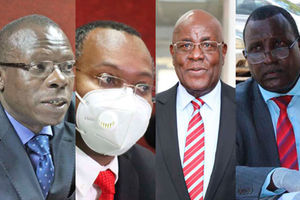
Last week, petitions by 22 judges who were nominated to the ELC sailed through, bringing the total awards stemming from the former president’s 2020 decision to Sh175 million.
That amount does not include legal bills that taxpayers will also have to refund to the successful petitioners.
The 22 judges were awarded a total of Sh55 million for violation of their rights after waiting for 21 months to be sworn in.
In October, 2024, another six judges, four recommended for the Court of Appeal and two for the ELC, sued the Attorney-General and were awarded Sh120 million after being kept waiting for about three years.
The petitions have been successful for a number of reasons, the main one being the doctrine of legitimate expectation. The law does not give the president discretion in appointing those nominated by JSC. On the part of the judges, it was not far-fetched for them to expect their appointment to be confirmed and then sworn in. Therefore, their 21-month wait, in the eyes of the law, was a violation of their rights.
In its judgment last week, the High Court ruled that Mr Kenyatta’s unproven assertions, coupled with his prolonged refusal to appoint the judges, gravely damaged their self-worth and professional standing by portraying them as unethical and unworthy of office.
“The unwarranted stigmatisation by the Respondent exposed them to public ridicule, with phrases being coined such as the one described by Justice Lilian Gathoni referring to the whole cohort of 41 nominees as ‘Ali Baba and the forty thieves,” said the court.
In an earlier decision, the court highlighted that judges Aggrey Muchelule, Weldon Korir, Prof Joel Ngugi and George Odunga of the appellate court, along with Evans Makori and Judy Omange of the ELC, had their appointments gazetted on September 13, 2022 and sworn in the following day after a three-year wait.
They had argued that the president’s inaction violated their constitutional rights and fundamental freedoms. They stated that the issue was not an employer-employee dispute but a constitutional violation since the Constitution did not give the president an option or discretion in appointing judges.
Their exclusion, they said, left them in an awkward position and anxious, unsure of what was happening and when they would be appointed.
The court agreed with them, noting that once the process of nomination of persons to be appointed as judges was complete, the president’s mandate was limited to putting in place mechanisms to appoint them.
The president, the court said, could not purport to process, vet, approve or disapprove the nominees.
The court further noted that the AG failed to explain why the president did not appoint the judges, despite the Constitution limiting the president’s mandate to appointing judges in line with JSC recommendations.
“The President’s refusal, inaction or omission to appoint the petitioners as judges of the Court of Appeal and the ELC was not based on any law and it thus violated the Constitution and the petitioners’ rights and fundamental freedoms,” said the court.
According to the judgment, in a country where citizens often believe whatever the president says, the judges endured a difficult period. The four appellate judges continued serving in the High Court, while the two others remained as a magistrate and Registrar of the High Court.
“They suffered mental and psychological anguish, a serious violation of rights and fundamental freedoms by the person holding the highest office in Kenya,” said the court.
The court said that there can be no worse violation than when the president of a democratic country makes public statements and innuendos casting aspersions on the suitability of officers recommended by the constitutionally mandated body.
“It is even more critical and a grave matter in situations where the persons have been recommended for appointment to serve in positions as sensitive as those of judges of superior courts, where holders of those offices are expected to be the custodians of the constitution, justice and the rule of law,” added the court.
In the recent decision, the judges said they suffered public humiliation and prolonged uncertainty due to the president’s conduct. They explained that they had resigned from their previous organisations following the JSC’s recommendation, only to endure 21 months of hardship and uncertainty.