The seizure comes barely a year after the interception of a vessel carrying methamphetamine worth Sh8.2 billion in the Indian Ocean, raising questions about the scale of the trade and the use of East African maritime and land corridors by suspected international traffickers.
The two incidents have also brought into focus Kenya’s vulnerability as a possible transit point for narcotics destined for other markets.
The latest recovery followed a cross-border investigation that began in Tanzania, where authorities arrested a suspect in possession of a separate consignment of suspected narcotics. Information obtained from the suspect led Kenyan investigators to two locations in Kwale County.
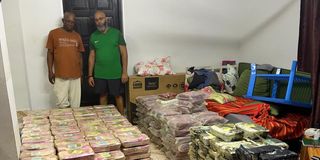
According to a police statement, officers first traced the residential premises of a suspected accomplice in Shirazi Village, Kingwede Shirazi Location. Further interrogation and tracking led the multi-agency team to Ganja La Simba Village in Kinondo Location, Msambweni, where they arrested a third suspect and recovered 454 kilogrammes of suspected narcotics valued at Sh3.6 billion.
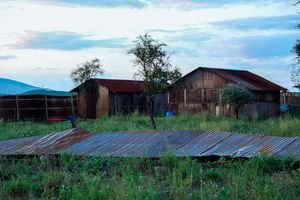
The two remote villages are located about 24 kilometres apart. Both lie close to the Indian Ocean, raising suspicions by investigators that the cross-border trafficking may have been enabled through the use of small boats or dhows disguised as fishing vessels. Two motor vehicles and a motorcycle were also seized during the operation.
The three suspects comprise two Tanzanian nationals and a Ugandan woman. They were taken into custody as investigators pursued leads into the suspected international trafficking network.
Suspects arrested after a drug bust in Kwale County.
Photo credit: Pool
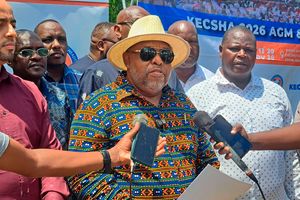
Director of Criminal Investigations (DCI) Mohamed Amin confirmed the arrests and recovery, describing the operation as part of efforts to dismantle transnational organised crime networks.
According to the DCI, the operation began on November 5 2026, when Tanzanian authorities arrested the first suspect with 259 kilogrammes of suspected narcotics, believed to comprise methamphetamine and cocaine.
The suspect was subsequently handed over to Kenyan authorities at the Lungalunga-Horohoro border crossing, where investigators took over the case.
The 454 kilogrammes recovered in Kwale are suspected to be methamphetamine, although their exact composition is yet to be established through analysis by the Government Chemist.
Police Recover 454kg of suspected narcotics worth Sh3.6 billion in Kwale.
Photo credit: Pool
Police said the operation was conducted through a multi-agency framework under the direction of Inspector General of Police Douglas Kanja. Regional security bosses declined to provide more details on the operation, as sources within the police services said Mr Kanja and Mr Amin are expected to issue comprehensive statements on Monday.
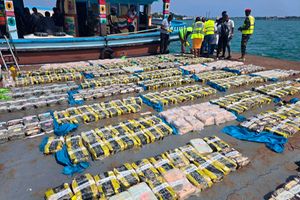
The latest interception brings renewed attention to a major maritime drug trafficking case involving a consignment of methamphetamine worth Sh8.2 billion seized in the Indian Ocean in October 2025. The Kenya Navy intercepted the vessel, MV Mashallah, carrying more than 1,024 kilogrammes of crystalline methamphetamine with a purity of 98 per cent.
The drugs were concealed in black polythene bags wrapped in yellow tape and labelled “100 per cent roasted and ground Arabica coffee”.
The interception, about 630 kilometres east of Mombasa, outside Kenya’s Exclusive Economic Zone and in international waters, triggered a complex multi-agency investigation involving six Iranian crew members, suspected international trafficking networks and questions over Kenya’s jurisdiction to prosecute offences committed beyond its maritime boundaries.
Police Recover 454kg of suspected narcotics worth Sh3.6 billion in Kwale.
Photo credit: Pool
Five of the six Iranians accused of trafficking meth when they appeared at the Shanzu Law Courts on October 28, 2025.
Photo credit: Wachira Mwangi | Nation Media Group
In 2014, another vessel, the MV Amin Darya, was intercepted with liquid and solid heroin worth Sh1.3 billion. Although its crew were initially sentenced to life imprisonment, the High Court later overturned the convictions after identifying inconsistencies in the evidence, including uncertainty over the vessel’s location at the time of interception.
Interior Cabinet Secretary Kipchumba Murkomen linked the 2025 seizure to extremist-linked supply chains, saying the government remained vigilant in protecting Kenya’s maritime borders. The drug worth Sh8.2 billion was destroyed in August at the Bamburi Cement factory.
During the destruction, Mr Murkomen said Kenya had strengthened its anti-narcotics architecture by elevating the former Anti-Narcotics Department into the National Anti-Narcotics Bureau.
The move, he said, had also resulted in an increase in personnel from about 200 officers in the former department to 405 staff in the new bureau.
"Today we are sending a statement not only to the users but to drug barons. We have made it clear that all drug barons and traffickers, the government will seize all their assets and use the funds for rehabilitation and other drug preventive measures. We have to make crime very punitive and painful to drug dealers," said Mr Murkomen.
Most recently, US court records revealed how regional operatives in East Africa were allegedly recruited to facilitate dealings involving one of Mexico's most powerful drug cartels.
While investigators have not established a connection between the Kwale seizure and global cartels, the 2025 indictment filed in the United States District Court for the Eastern District of Virginia provides a glimpse into how East African nationals have allegedly been involved in facilitating international criminal networks.
The US case centres on a Bulgarian arms trafficker, Peter Dimitrov Mirchev, and Kenyan national Elisha Odhiambo Asumo, Ugandan Michael Katungi Mpeirwe and Tanzanian Subiro Osmund Mwapinga.
Coincidentally, Asumo was to be sentenced after pleading guilty to drug trafficking charges earlier this year.
Elisha Asumo who has been linked to the Jalisco New Generation Cartel (CJNG).
Photo credit: Pool
According to prosecutors, the four allegedly conspired to supply military-grade weapons to Mexico's Cartel de Jalisco Nueva Generacion (CJNG), a powerful criminal organisation accused of trafficking cocaine into the United States.
The indictment alleges that the conspiracy operated from at least September 2022 and involved the use of fraudulent arms documentation obtained through East African connections.
Asumo was identified as a Kenyan national who allegedly had a longstanding relationship with Mirchev and sourced end-user certificates and delivery verification protocols from African countries through bribery.
Mpeirwe, a Ugandan national who prosecutors said had connections to his country's government, allegedly worked with Asumo to acquire the documents, while Mwapinga, a Tanzanian national, was also involved in obtaining the paperwork.
The documents were intended to conceal the actual destination of military-grade weapons by falsely identifying the Tanzanian military as the intended recipient.
Prosecutors allege that the group obtained a Tanzanian end-user certificate authorising the importation of 50 AK-47 assault rifles for the country's military. The weapons were subsequently exported from Bulgaria in July 2024, allegedly with the intention that they would be received by the CJNG.
The indictment further alleges that after the weapons were received, Asumo obtained a delivery verification protocol falsely indicating that the Tanzanian military had received them.
One of the most significant details in the indictment concerns a meeting in Cape Town, South Africa, in March 2023, whereby prosecutors allege that Asumo and Mwapinga discussed the possibility of using East Africa as a transhipment point for cocaine.
The allegation raises questions about the region's potential role in the movement of narcotics between producing countries and international consumer markets.
The same Mexican cartel had been linked to a methamphetamine production lab which was discovered in Namanga, also close to the Kenya-Tanzania border in 2024.
The US identifies CJNG as a transnational organisation with a presence in nearly every part of Mexico and contacts across the Americas, Australia, China, and Southeast Asia.
Kenya has occasionally been in the spotlight for being exploited for international drug trafficking due to its porous borders and prime location on the East African coast that enables transportation to Latin America, Southwest Asia, Europe and Arabian countries.
In a regional report published in July 2025, the United Nations Office on Drugs and Crime (UNODC) stated that hard drug consignments intercepted in Kenya between 2020 and 2024 were destined for countries including Australia, Canada and Italy, with Jomo Kenyatta International Airport in Nairobi identified as a key trafficking point.
UNODC also identifies growing involvement of Mexican criminal cartels, including the Sinaloa Cartel and Jalisco New Generation Cartel, in African heroin and methamphetamine trafficking networks. The report highlighted the use of dhows and other maritime routes to move drugs, particularly methamphetamine, towards Europe, Australia and New Zealand.
Reporting by Brian Ocharo, Karim Rajan and Valentine Obara