Kenya is steadily becoming a methamphetamine hotspot, evolving from a transit point to a manufacturing hub as drug users seek a new high.
Reports by multiple governments and the United Nations, seizures of massive methamphetamine consignments and the discovery of a mega lab in Namanga — linked to Mexican cartels — have raised fears over the expanding network of one of the world’s most addictive synthetic drugs.
A United Nations Office on Drugs and Crime (UNODC) report released last month states that methamphetamine is approaching “global ubiquity” and East Africa is one of the regions experiencing increased trafficking and growing domestic use.
The report says meth manufacture, once largely concentrated in southern Africa before spreading to West Africa, particularly Nigeria, is now beginning to take root in East Africa, signalling a significant shift in Africa's illicit drug landscape.
"In Africa, methamphetamine manufacture was initially limited to Southern Africa and subsequently took root in West Africa, particularly Nigeria, and there are now also indications of its emergence in East Africa," the report noted.
Those findings follow a 2024 National Authority for the Campaign against Alcohol and Drug Abuse (Nacada) which showed that up to 8.5 per cent of university students in Kenya are abusing methamphetamine.
Although southern Africa remains the continent's largest meth market, UNODC says treatment data increasingly points to rising consumption in East Africa, indicating that the region is no longer simply facilitating the movement of the drug, but is developing its own user population.
The report links this trend to expanding trafficking routes stretching from Afghanistan and other parts of South-West Asia across the Indian Ocean into Africa.
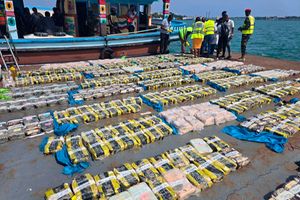
Packages of substances weighing 1,035.986 kilograms suspected to be methamphetamine valued at Sh8.2 billion at the Mombasa Port on October 25, 2025.
Photo credit: Pool
"In addition to domestic manufacture in South Africa, trafficking is conducted from South-West Asia across the Indian Ocean to Southern Africa, likely contributing to emerging or increasing use in East African markets," it stated.
For Kenya, those findings reinforce concerns that have been building over the past several years as the country repeatedly features in major international anti-drug investigations.
Kenya’s strategic location on the East African coast, well-developed ports, international airports and extensive road network connecting neighbouring countries have made Kenya attractive to transnational criminal organisations moving narcotics between Asia, the Middle East, Europe and Africa.
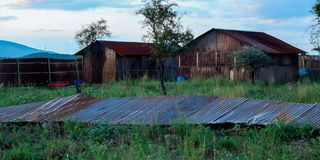
The country's vulnerability was laid bare in 2024 when authorities dismantled the first confirmed large-scale methamphetamine manufacturing laboratory in Namanga, Kajiado, linked to a Mexican drug cartel.
According to the International Narcotics Control Strategy Report released by the US Department of State in March 2025, the laboratory was discovered near the Kenya-Tanzania border and was linked to the notorious Cartel de Jalisco Nueva Generación (CJNG).
The report described the operation as the first confirmed large-scale methamphetamine production facility established by a Mexican cartel in Kenya.
"A major accomplishment in 2024 was the multiagency seizure of a large-scale methamphetamine production lab in Namanga, Kenya, in September. The lab was linked to the Mexican Cartel de Jalisco Nueva Generación (CJNG) and was the first confirmed large-scale operation by a Mexican cartel operating in Kenya," the report stated.
Barely a month later, Kenyan authorities arrested a suspected CJNG operative attempting to leave the country for Mexico following intelligence shared by the United States Drug Enforcement Administration (DEA).
Although investigators never established how long the laboratory had been operating or whether its products were intended for local consumption or export, the discovery fundamentally altered perceptions of Kenya's role in the international narcotics trade.
Rather than simply serving as a transit corridor, Kenya had become a location where foreign criminal organisations were willing to establish manufacturing infrastructure.
Unlike cocaine or heroin, methamphetamine does not depend on seasonal crop cultivation. It can be manufactured throughout the year inside clandestine laboratories using synthetic precursor chemicals, making production easier to relocate whenever law enforcement agencies intensify crackdowns.
UNODC says organised criminal groups have become increasingly sophisticated, exporting production expertise across continents while constantly identifying new trafficking routes and emerging markets.
Packages of substances weighing 1,035.986 kilograms suspected to be methamphetamine valued at Sh8.2 billion at the Mombasa Port on October 25, 2025.
Photo credit: Pool
Globally, methamphetamine seizures have been increasing by an average of about 13 per cent annually. While Myanmar remains the dominant producer supplying East and South-East Asia, Afghanistan has rapidly emerged since 2019 as another major production hub serving neighbouring regions and increasingly distant markets. As such, Kenya's experience reflects a much broader transformation in international organised crime.
The US report also painted a worrying picture of the country's capacity to respond. Despite Kenya having comprehensive anti-narcotics legislation, traffickers continue exploiting weaknesses in enforcement and governance.
"Drug trafficking continues to be one of the drivers of corruption in Kenya. Despite a stringent anti-narcotics and anti-corruption legal regime, prosecution and conviction rates remain significantly low. Political will to fight corruption also remains a challenge," the report said.
The country's history demonstrates how deeply entrenched international trafficking networks have become.
The Akasha brothers—Ibrahim and Baktash—remain among Africa's most notorious drug traffickers after being extradited to the United States in January 2017, where they received lengthy prison sentences for conspiring to traffic heroin and methamphetamine while bribing Kenyan officials to frustrate investigations.
Their Pakistani associate, Asif Hafeez, alias "Sultan", later pleaded guilty in a Manhattan court to supplying heroin, methamphetamine and hashish destined for the United States.
More recently, Kenya recorded one of its largest-ever methamphetamine seizures after authorities intercepted a stateless dhow carrying 1,024 kilogrammes of crystalline methamphetamine approximately 630 kilometres east of Mombasa in October 2025.
The narcotics, valued at Sh8.2 billion, were concealed inside packages labelled as roasted Arabica coffee and were found to be 98 per cent pure following analysis by the Government Chemist.
Makeshift perimeter wall for a methamphetamine laboratory in Olelopo village, Namanga, Kajiado County on March 19, 2025.
Photo credit: Lucy Wanjiru | Nation
The vessel, crewed by six Iranian nationals, was intercepted during Operation Bahari Safi involving the Kenya Navy, Directorate of Criminal Investigations, Kenya Coast Guard Service, Anti-Narcotics Unit, National Intelligence Service and several other agencies, assisted by regional partners.
Interior Cabinet Secretary Kipchumba Murkomen described the operation as evidence of Kenya's determination to confront transnational organised crime.
This seizure also illustrated another challenge confronting Kenyan authorities: successful interception does not always translate into successful prosecution.
In 2014, another vessel, MV Amin Darya, was intercepted on the high seas carrying 377 kilogrammes of solid heroin, 33,200 litres of liquid heroin and 2,400 litres of heroin mixed diesel worth Sh1.3billion. The foreign nationals arrested on the vessel were tried and convicted. However, in 2025, the High Court overturned the convictions and freed the nine crew members, ruling that the destruction of the ship and cargo undermined the integrity of the prosecution's evidence.
The judgment highlighted the legal complexities surrounding narcotics seized in international waters, where jurisdiction often becomes central to criminal proceedings.
In the latest methamphetamine case, prosecutors are expected to rely not only on Kenya's domestic anti-drug laws but also on international treaties, including the United Nations Convention on the Law of the Sea and the 1988 Vienna Convention against Illicit Traffic in Narcotic Drugs and Psychotropic Substances, which permit states to intercept stateless vessels involved in drug trafficking on the high seas.
While methamphetamine presents the newest and perhaps fastest-growing threat, it is only one part of a rapidly evolving drug landscape across Africa.
The continent, the UNODC report noted, is increasingly serving as both a transit corridor and an expanding consumer market for multiple illicit substances.
Cannabis remains Africa's most widely available drug. The report says Africa now accounts for more than half of all cannabis herb seized globally, underscoring the scale of cultivation and trafficking across the continent.
Cannabis trafficking, once largely regional, is becoming increasingly intercontinental, with stronger links to international supply chains and growing availability of high-potency products.
An Indonesian police officer shows synthetic drug methylenedioxy-methamphetamine also known as ecstacy during a press conference in Jakarta on November 5, 2019.
Photo credit: File
Cocaine is also establishing deeper roots, with UNODC reporting that increased trafficking has helped create domestic cocaine markets in West, Central and East Africa. Shipments destined for Europe continue passing through West and North Africa, while maritime routes from South America have expanded into Southern Africa. The report also noted that crack cocaine use, previously concentrated in West Africa, is also spreading eastwards.
Another emerging concern is the appearance of synthetic opioids. The report identified nitazenes, highly potent synthetic opioids, as ingredients in the dangerous street drug known as "kush", which has been linked to deaths in Sierra Leone, Liberia, Guinea and the Gambia. Health authorities fear the drug could spread further across the continent if trafficking networks continue expanding.
Alongside illicit narcotics, Africa is also grappling with growing abuse of pharmaceutical medicines. Tramadol, codeine, benzodiazepines, pharmaceutical opioids, pregabalin, gabapentin and barbiturates are increasingly being misused in many countries, adding another layer to an already complex public health challenge.
The UNODC warns that enforcement alone cannot solve the problem. As larger quantities of methamphetamine pass through Africa, more of the drug inevitably leaks into local markets, creating new populations of users and increasing demand for treatment, rehabilitation and mental health services.
For Kenya, the convergence of these trends presents a daunting task. The country sits at the crossroads of global trafficking routes connecting Asia, the Middle East, Europe and Africa while simultaneously confronting the emergence of domestic methamphetamine production, expanding consumption and increasingly sophisticated criminal syndicates.
The recent dismantling of a cartel-linked meth laboratory, the interception of billion-shilling meth shipments in the Indian Ocean and the UN's assessment that East Africa is becoming an emerging methamphetamine market all point to one conclusion: Kenya's fight against narcotics is no longer simply about stopping drugs at its borders, but about preventing a synthetic drug epidemic from taking deeper root within its own communities while confronting an increasingly global and sophisticated criminal enterprise.