It has been a bad year. The shilling was battered, and the taxes went up. President William Ruto’s regime has so far not disappointed in disappointing, and everyone has mastered the art of blame-shifting.
There are a few lessons that we can learn from Mwai Kibaki, who steered the country through the global crisis of the 1970s and would later clean up the mess left by the Kanu regime. The blame game is not a new phenomenon in Kenya.
In the years that followed independence, Jomo Kenyatta politicians could sit back, and blame colonialism to deflect blame from themselves. That was until they crafted their scandals and policies.
For his part, President Daniel Moi blamed the Mt Kenya elite and went about restructuring their wealth. While Mwai Kibaki inherited a dead economy from President Moi, he never used it to justify the success or failures of his government.
This could be because he had learned some critical lessons as he steered the Jomo Kenyatta economy through the turbulence that followed the Yom Kippur Wars, the increase in oil prices, and the devaluation of the sterling pound.
Today, the ‘we-inherited-empty-coffers’ mantra is the excuse that President Ruto projects to his supporters, who are disappointed by his dismal performance.
It is important to point out that at independence in 1963, the Kenya pound — a currency that was not in circulation but used in budget-making — was at par with the British pound. One Kenya pound was then equivalent to Sh20 and the British sterling pound.
One thing that Kenya Kwanza needs to know is that the strength of the Kenya shilling is determined by many things – some external and others internal. The internal are simply our bad manners and confidence in our leaders. We also have to live with the mistakes of our forefathers. Regionally, and had we retained the East African shilling, our economies would be on another level. The East African shilling was a stable currency and was used across Yemen until it was replaced in 1965 by South Arabian dinar. Where would the EAC be today with its own single currency?
There was a time that Finance ministers of Kenya, Uganda and Tanzania would stand to international pressure as they did in 1967 when they decided they would not devalue the East African shilling to which the currencies of the three nations were tied. Today, they wouldn’t try the same and are hopelessly disunited.
I'm a student of Kibaki, Ruto says, defending tax policy
By then, they had refused to follow British Prime Minister Harold Wilson’s decision to devalue the British pound against the dollar – a move that had rocked the world’s money market. They had further understood that Britain was doing it for selfish interests, and the most important was to boost its exports and staunch the flow of imports. By then, the British pound was then worth EASh17 rather than the previous Sh20 parity.
A day after Britain devalued the sterling, Central Bank of Kenya Governor Duncan Ndegwa closed all banks as concerns rose since most foreign currency reserves were held in pounds sterling. The shilling held steady with prudent balancing from Finance Minister James Gichuru and Ndegwa. Imports were controlled, and bureaucratic tapes limited the issuance of foreign currency. Kenya’s foreign exchange reserves grew during the first six months of 1969 as exports rose faster than imports.
By the end of June 1969, Kenya’s foreign exchange reserves were $134 million, up from $100 million at the start of the year and $88 million in 1967.
One of the most significant moves made by Kibaki was on October 8, 1971, when all East African currencies switched allegiance from the pound to the dollar. The move, however, caused a three per cent devaluation at the time. On December 22, 1971, Mwai Kibaki, the Minister for Finance and Economic Planning, devalued the shilling by 7.89 per cent against the dollar. While the international financial crisis had left Kibaki in a quandary, he was still in charge. Everyone respected Kibaki as the best economist in town – and that is what was required at the Treasury. The decisions he took were also respected. For instance, he, in December 1971, ordered the Central Bank to give out no foreign currency for businesses wanting to buy goods that could be made in Kenya. Kibaki hoped this would reduce inflationary pressure, reduce imports, and protect foreign exchange reserves. Kibaki also believed that local banks were over-lending and wanted to check the further growth of loans.
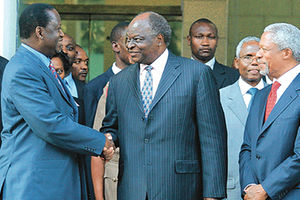
Late President Mwai Kibaki (right) and then Agriculture Minister William Ruto during a past event held at Bwayi Primary School in Moi's Bridge, Uasin Gshu District on March 11, 2009.
Photo credit: Jared Nyataya | Nation Media Group
Only after the 1973 Yom Kippur War did Kenya think it was vulnerable to external factors. Though subject to price swings, coffee still contributed 22 per cent of its exports and was supplemented by income from tea, livestock, and tourism. While the dollar was exchanging at Sh7 in 1974, a move by the Organisation of Petroleum Exporting Countries (Opec) to increase fuel prices by 10 per cent saw the government increase the same by 25 per cent. Thus, although Kenya suffered because of the first oil crisis, much of the effect was cushioned by the coffee boom and its buoyant effect on the economy.
Duncan Ndegwa, the CBK governor, had proposed that to survive, Kenyans had to reduce consumption and ‘if necessary, by cutting out weekend travelling’.
“We cannot go on borrowing to keep on importing goods. We have to maintain a certain amount of respect for our foreign exchange reserves to get the confidence of the investors both in the public and the private sectors,” said Ndegwa.
And that is something we can pick from Ndegwa. We are still wasting our taxes with irrelevant imports. We have taken more loans than we could manage – but still behave as if we have no loans.
We remember the tricky balancing act Kenyatta’s Minister for Commerce and Industry, Dr Gikonyo Kiano, used to protect the local manufacturers. He announced a raft of measures to protect the local manufacturers. The most important was restricting imported goods if the equivalent were manufactured locally. Which nation imports toothpicks and school pencils?
We have also had good times. The coffee boom of 1975 to 1977, when the global prices of the commodity almost turned Kenya into a paradise, thanks to frost in Brazil. The year 1977 was good for Mwai Kibaki as Finance minister. He summarised it thus: “The economy has been booming once more, many people have had plenty of money to spend.”
A new set of billionaires was born, and most rural shopping centres thrived. But we could have managed coffee better after that. We never respected the farmer. A crop that in 1977 made the balance of payments record a surplus of Sh2.2 billion for the first time since independence was neglected. Farmers who had made the foreign exchange reserves reach a record of Sh2.7 billion were ignored.
Because of the coffee boom, the GDP increased by 7.3 per cent in real terms, while the number of people in paid employment increased by 5.3 per cent. On the other hand, the money supply went up sharply by 47 per cent. Inflation rose from 8.7 per cent in 1976 to 16.1 per cent in 1977.
The situation was managed so poorly that by October 1981, Kenya devalued its currency. Kibaki was accused in Parliament of devaluing the currency to please the IMF and the World Bank. Kenya was then seeking $150 million in loans from the IMF.
Though Kibaki lost his Finance portfolio under Moi, he would later leave his mark as he managed the economy in his style. Much of it was that the market had confidence in him. He spoke less and understood the terrain.
To all my readers, I am wishing you a Merry Christmas