The government’s plan to upgrade a 52-kilometre road connecting Nyeri and Nyandarua counties through the Aberdare Forest will remain suspended after the Environment and Land Court declined the State’s request to dismiss a case that stalled the project.
A three-judge bench comprising Justices Lucy Gacheru, Bernard Eboso, and James Olola rejected a request by the State-owned Kenya National Highways Authority (KeNHA) to strike out the case over claims that it was in the wrong forum.
The judges rejected KeNHA’s argument that the dispute does not concern constitutional violations and should have been lodged at the National Environment Tribunal in the first instance, not in court.
“Apart from the issue of the Environmental Impact Assessment (EIA) licence, the petition raises various constitutional issues. The issues raised in the petition touch on the violation of various constitutional rights, such as the right to a clean and healthy environment, depletion of tree cover, climate change, and threats to biodiversity, among others. Those issues cannot be adjudicated by the tribunal. It is the Environment and Land Court which is conferred with jurisdiction to deal with the same,” the judges ruled on Tuesday.
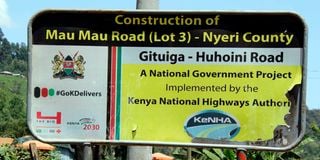
Plans for the implementation of the Sh4.4 billion project, known as Mau Mau Lot 4: Ihithe-Ndunyu Njeru Road, traversing the Aberdare National Park and the Aberdare Forest Reserve, were rolled out in 2009 as part of the Vision 2030 flagship projects aimed at attaining a sustainable, safe road network.
The implementation has been delayed due to ecological concerns raised by civil society groups and environmental conservationists.
The tussle, as reflected in court papers, pits the government’s push for economic development against the petitioners’ demand for environmental protection.
The dispute escalated in January 2024 after President William Ruto insisted that his administration would proceed with the upgrading and expansion of the road and open it for public use.
The case was filed by the East Africa Wildlife Society, Kenya Forest Working Group, Africa Centre for Peace and Human Rights, and lawyer Lempaa Suyianka.
They petitioned the court to issue a permanent injunction restraining the government from proceeding with the planned road construction.
An aerial view of Gituiga-Huhoini Road which forms part of the Mau Mau Road in Nyeri county.
Photo credit: Joseph Kanyi | Nation Media Group
They are also seeking a declaration that development in water towers should be limited to eco-tourism and research, and that in parks and conservancies like the Aberdare National Park, changes to any other use should not be permitted except for conservation purposes.
According to them, apart from the loss of biodiversity, the road construction will also violate the forest inhabitants’ right to cultural heritage and worsen the impact of climate change.
However, in its opposition to the petition, KeNHA denied the allegations and filed a preliminary objection, arguing that the dispute was in the wrong forum. It asked the judges to strike it out.
KeNHA contended that the petition had been “camouflaged as a claim relating to constitutional violations, when in reality, it is a challenge against the Environmental and Social Impact Assessment (ESIA) report and the Environmental Impact Assessment (EIA) licence”.
It also stated that, contrary to the petitioners’ assertions that the road would alter and destroy the Aberdare ecosystem forever, the project would have limited environmental impact. KeNHA argued that the project would not change the ecosystem as alleged by the petitioners.
“In line with the government’s Vision 2030, KeNHA commenced construction of the project, termed the Mau Mau Road, in line with the country’s objective of attaining a sustainable, safe road network. The key objectives of Vision 2030 cannot be achieved if flagship projects are not implemented,” KeNHA’s Assistant Director of Environmental Safeguards, Mr Adams Mureithi, told the court.
The court heard that public participation had been conducted and that, prior to the commencement of the project, environmental experts had examined it and identified its potential impacts.
Asking for the dispute to be struck out, Mr Mureithi explained that the case is a direct challenge to the Environmental Impact Assessment licence issued to KeNHA by the National Environment Management Authority (Nema) in January 2024, giving the project the green light.
“All the issues raised were fully addressed through the mitigation measures set out in the Environmental Impact Assessment Study Report, as well as the conditions attached to the report. All the issues raised in the petition can be adjudicated upon by the National Environment Tribunal. The petitioners have not exhausted the remedies provided under the law,” he stated.
However, the conservationists argued that the issues raised in the petition go beyond the jurisdiction of the National Environment Tribunal, hence the court is the appropriate forum to adjudicate them.