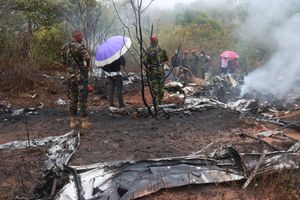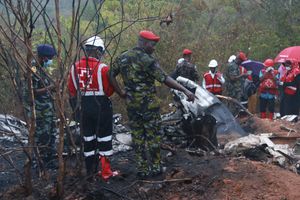
The debris of a plane that crashed in Kwale on October 28, 2025.

A preliminary investigation into last month’s plane crash at Tsimba Golini in Kwale County has revealed that the aircraft likely flew into rising terrain due to poor weather conditions.
According to the report released by the Aircraft Accident Investigation Department (AAID) under the Ministry of Transport's State Department for Aviation and Aerospace Development, the investigators found that the Cessna 208B operated by Mombasa Air Safari crashed approximately eight to nine minutes after taking off from Ukunda Airport.
The plane was headed to Kichwa Tembo in the Maasai Mara on a flight carrying eight Hungarian nationals, two Germans and a Kenyan pilot. The journey was expected to take about two hours.
The AAID report states that the aircraft took off at 8:25am under Visual Flight Rules, conditions where pilots rely on visual cues rather than instruments, but the weather deteriorated rapidly after departure.
“At the time of the accident, Instrument Meteorological Conditions existed in the area. The region was experiencing low clouds and decreased visibility caused by heavy fog and rain,” reads part of the preliminary report.
The report indicates the aircraft disappeared from radar approximately eight minutes after takeoff. Multiple attempts to contact the pilot, including by air traffic control and another aircraft flying in the area, went unanswered.
The wreckage was later found in a forested hillside in Tsimba Golini, approximately 8.75 nautical miles from the airport. According to investigators, the aircraft struck the ground at high speed and a steep angle.
“The aircraft impacted the slightly sloped terrain in a high-energy nose-down attitude,” the report states.
It further notes that the front section of the aircraft was driven 2.2 metres into the soil and the impact triggered a post-crash fire that destroyed much of the wreckage. The main debris field measured 29 metres by 22 metres, with passenger belongings found as far as 54 metres from the crash site.
The report also states there were no signs of attempted emergency communication and the aircraft’s emergency locator transmitter, designed to alert rescue authorities automatically, did not activate.
Preliminary findings also rule out mechanical issues. The aircraft had a valid certificate of airworthiness, recent maintenance and no history of reported defects.
“The aircraft’s technical logbook indicated no accepted deferred defects,” the report notes.
The pilot, a 39-year-old Kenyan, was described as highly experienced with more than 6,900 flight hours, including 5,500 hours on the same aircraft type. The findings indicate that neither mechanical failure nor pilot competence is considered a contributing factor at this stage.
The aircraft was equipped with a ground proximity warning system, but it was recovered in a damaged condition and is expected to undergo further analysis overseas. The AAID emphasised that the investigation is ongoing and that its purpose is not to assign fault.
“The sole objective of the investigation shall be the prevention of accidents and incidents,” the AAID states.