The Sh8.2 billion methamphetamine seized in the Indian Ocean will be publicly destroyed after the suspects are charged in court, Interior Cabinet Secretary Kipchumba Murkomen has said.
The interception of the drugs has once again placed Kenya under the international spotlight as a narcotics transit hub exploited by cartels supplying markets across the world.
Interior Cabinet Secretary Kipchumba Murkomen during a church service in Kisumu, on October 26, 2025.
Photo credit: Alex Odhiambo | Nation Media Group
During a church service in Kisumu on Sunday, Mr Murkomen said the operation demonstrated the government’s commitment to combating drug trafficking and other illicit activities along Kenya’s maritime borders.
“You have seen, through the determination of President William Ruto, supported by our army, police and Coast Guard, that we have successfully intercepted drugs linked to ISIS, operated by Iranians near our waters,” he said. “Those drugs will be taken to court together with the six Iranians, and thereafter we shall destroy them in the open.”
Mr Murkomen reaffirmed that the government remains resolute in its fight against narcotics and other substances that threaten public health and safety. “As a nation, we have resolved to stand firm against drugs, illicit alcohol, and all other vices eroding the lives and dignity of our people,” he said.
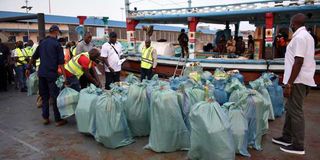
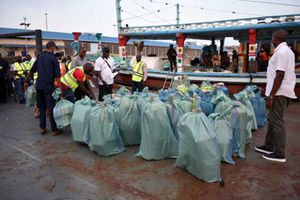
The dhow, christened MV Mashallah, was seized with more than 1,000 kilogrammes of methamphetamine—a synthetic drug whose long-term use can cause malnutrition, severe weight loss, and psychological dependence.
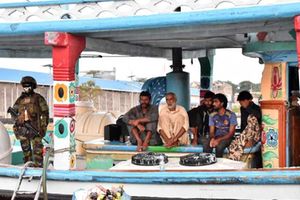
Some of the six Iranian crew members under tight security after a seizure of narcotics aboard an Iranian Vessel worth Sh8.2billion some 650 km off the shore of Mombasa.
Photo credit: Wachira Mwangi | Nation Media Group
Authorities did not disclose the destination of the shipment, though it is believed the drugs were intended for distribution within the region. The stateless vessel, crewed by six Iranians, was intercepted by an international multiagency team about 630 kilometres east of Mombasa and escorted to the Port of Mombasa for further processing.
Kenya’s territorial waters
Following the arrests, attention now shifts to the courts, where the State will seek to secure convictions based on evidence gathered from the vessel. Kenya’s territorial sea extends 12 nautical miles, about 22 kilometres from its coastline, where the country enjoys full sovereignty and its laws apply in entirety. The State will, therefore, need to prove the exact point of interception and whether it occurred within Kenya’s territorial waters.
In June, the State lost a Sh1.3 billion heroin case against seven foreigners : Yousuf Yaqoob, Yakoob Ibrahim, Saleem Muhammad, Bhatti Abdul Ghafour, Baksh Moula, Pak Abdolghaffer, and Muhammed Saleh. It failed to establish the precise location and nationality of the vessel, MV Amin Darya (also known as Al Noor), at the time of interception.
One officer testified that the ship was six nautical miles within Kenyan waters, while another claimed it was 203 nautical miles offshore and that it took a navy vessel eight hours to reach it from Lamu.
The High Court ruled that the vessel was outside Kenya’s 12-nautical-mile territorial sea, within the 220-nautical-mile exclusive economic zone. The ship bore no flag, carried two names, and had conflicting documents, leaving its status uncertain.
Eleven years later, Kenya faces a similar challenge: an unregistered, stateless dhow intercepted 630km from its coastline, a position lying outside Kenya’s exclusive economic zone, hence in international waters under the United Nations Convention on the Law of the Sea (UNCLOS).
In the MV Amin Darya or Al Noor case, the High Court held that Kenya had acted within its rights under international law, saying a stateless vessel engaged in drug trafficking on the high seas is subject to the jurisdiction of any state.
Kenya will rely on domestic and international laws to prosecute the six Iranians. Under international law, it is entitled to intercept and prosecute stateless vessels engaged in drug trafficking at high seas. The 1982 UNCLOS permits any state to board and seize a vessel without nationality.
Kenya will now rely on domestic and international laws to prosecute the six Iranians, given that the dhow was seized beyond its territorial waters. Under international law, Kenya is entitled to intercept and prosecute stateless vessels engaged in drug trafficking on the high seas. The 1982 UNCLOS permits any State to board and seize a vessel without nationality, while the 1988 Vienna Convention against illicit drug trafficking authorises countries to take action against stateless ships suspected of smuggling narcotics.
These provisions grant Kenya legal authority to act even beyond its territorial waters or Exclusive Economic Zone.
The dhow, crewed by six Iranians, was seized in a joint operation involving the Kenya Navy, the Directorate of Criminal Investigations, the Anti-Narcotics Unit, the Kenya Coast Guard Service, the Kenya Revenue Authority, the Port Police, the National Intelligence Service, and the Kenya Ports Authority Police.
Kenya Navy Deputy Commander Brigadier Sankale Kiswaa said the dhow was intercepted during Operation Bahari Safi under the Regional Coordination of Operations Centre and the Safe Seas Africa framework.
The vessel had ignored calls to stop before being boarded by naval officers. It was later escorted to Mombasa by KNS Shupavu, assisted by a Seychelles Coast Guard patrol aircraft.
Director of Criminal Investigations Mohamed Amin said the 1,024 kilogrammes of crystalline methamphetamine were concealed in black polythene bags wrapped with yellow tape labelled “100 per cent roasted and grounded Arabica coffee.” Tests by the Government Chemist confirmed the drug to be 98 per cent pure.
Mr Amin commended regional cooperation in combating transnational drug trafficking, noting that the operation was part of intensified efforts to secure Kenya’s maritime borders.
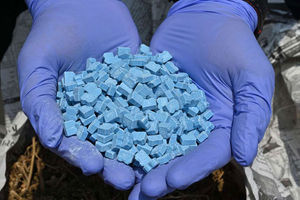
Methamphetamine belongs to a group of drugs known as amphetamine-type stimulants and is commonly manufactured in illegal laboratories. It is sold as a powder, tablet, or crystal resembling glass shards and can be swallowed, sniffed, smoked, or injected.
This is the second-largest narcotics haul in Kenya’s history, after 1.1 tonnes of cocaine worth Sh6 billion were seized by police in Nairobi and Malindi in 2006.