The recruitment of 10,000 police officers planned in September could be derailed by a power struggle that has rocked the National Police Service Commission (NPSC).
A vicious supremacy battle between Inspector-General of Police Douglas Kanja and NPSC, in which he is a member, has snowballed into a national crisis that has split the commission into two factions, threatening the upcoming police recruitment.
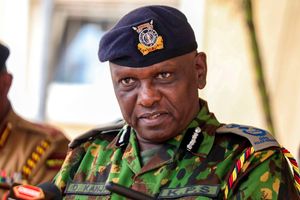
Inspector-General of Police Douglas Kanja.
Photo credit: File | Nation Media Group
One faction has the uniformed commissioners led by Mr Kanja, while the other has civilian commissioners, led by the chairman, who insist the police chief must now surrender all human resource functions, including the Sh60 billion police payroll as well as the roles of hiring, promoting and transferring officers.
Dr Amani Yudo Komora, who was appointed last week, is the new NPSC chair. He replaced Mr Eliud Kinuthia, whose term expired.
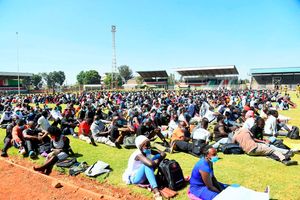
At the centre of the latest conflict is the upcoming recruitment that the commission wants conducted under a new system that requires online applications and shortlisting of prospective candidates.
The Nation has established that this new method of recruitment has prompted an advisory by the National Security Council, a high-level organ chaired by the President.
The Security Council reportedly advised that the new system be suspended and that the hiring follow the traditional system where youths turn up in recruitment centres without online applications.
But the commission on August 11, 2025, kicked off a nationwide public hearing on the proposed system.
Given the deteriorating relations at the commission, the urgent intervention of either President William Ruto or Interior Cabinet Secretary Kipchumba Murkomen will be needed to at least get the police recruitment underway.
Interior Cabinet Secretary Kipchumba Murkomen, flanked by senior government security officials, addresses the media at Harambee House in Nairobi on June 26, 2025.
Photo credit: Bonface Bogita | Nation Media Group
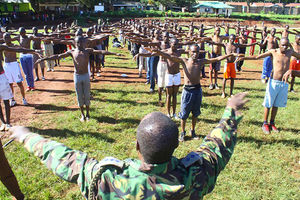
NPSC has invited written and oral memoranda on the new recruitment regulations that now seek to make it mandatory for candidates to apply online after which only shortlisted candidates will be invited to recruitment centres for physical fitness tests. The successful candidates will thereafter report to police training colleges.
Whereas some civilian commissioners of NPSC have been pushing for this online system, the unformed commissioners and another group of civilian commissioners have opposed it.
Apart from the Inspector-General and the two deputies, other members of the commission appointed by the President include a person who is qualified to be appointed as a High Court judge, two retired senior police officers and three persons of integrity who have served the public with distinction.
Critics of the new system claim an avalanche of online applications would be another avenue for corruption and nepotism. But supporters of the new system say it will promote transparency and curb bribery that plagues the on-field recruitment.
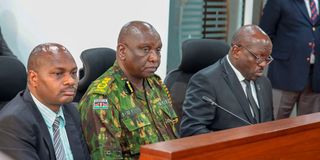
The uniformed commissioners who include Mr Kanja, his two deputies Gilbert Masengeli and Eliud Lagat, as well as the Directorate of Criminal Investigations boss Mohammed Amin, have opposed the new guidelines.
Deputy Police Inspector-General Gilbert Masengeli.
Photo credit: File | Nation Media Group
This faction claims the system was being railroaded without being discussed and agreed on during commission meetings.
“We have just seen communication on issues that as a commission, we have never sat and agreed on. There are no minutes to show who attended the meeting that ratified these new recruitment guidelines,” said one commissioner, who spoke on condition of anonymity.
“You cannot have one person driving an agenda and forcing the decision on other commissioners,” said another civilian member of the NPSC.
The infighting at the NPSC has been amplified in a series of letters between the police boss and the office of the NPSC CEO Peter Leley.
In a letter dated August 6, sent to the IG and copied to other top government officials, Mr Leley wrote that the commission had withdrawn all powers that had been delegated to the IG touching on human resource management.
The letter cited the constitutional mandate of the commission, a recent directive by the National Assembly’s Public Accounts Committee (PAC) and the recommendations of a task force on police reforms chaired by retired Chief Justice David Maraga.
The letter is copied to Auditor-General Nancy Gathungu, Treasury Principal Secretary Dr Chris Kiptoo, National Assembly Clerk Samuel Njoroge and Bernice Lemedeket, who is the Secretary, administration/accounting officer, National Police Service.
Mr Leley wrote: “In view of the foregoing, and in full compliance with the Constitution, parliamentary committee resolutions and the task force recommendations, the commission hereby withdraws with immediate effect, all instruments of delegation on any human resource management functions previously assigned to the office of the Inspector-General and the secretary administration/accounting officer.”
“Going forward, the commission shall directly execute its mandate as per the Constitution,” added the letter by Mr Leley.
This letter, coming after the IG vowed he would not surrender the police payroll to the commission, has further complicated the operations at the commission.
This is after some commissioners disowned the resolution, saying it had not been discussed and agreed on at any of the commission meetings.
“Let anyone show us the minutes where the commission deliberated this matter and agreed on the withdrawal of the powers,” said a commissioner, who also did not wish to be quoted discussing internal police matters in public.
On August 4, Mr Kanja vowed not to hand over the Sh60 billion annual police payroll to the NPSC despite an order by the PAC.
PAC had directed the IG to surrender all human resource functions, including the police payroll, to the commission following a heated session in which MPs sided with the independent body.
That order followed PAC’s scrutiny of the Auditor-General’s report for the financial year ending June 2023.
The query revealed that it was impossible to know the effectiveness of the NPSC’s strategic plan for 2019-2022 and, in effect, whether the payroll report submitted by senior police officers is accurate.
When the timeline of the strategic plan lapsed in 2022, the NPSC had still not accessed the police payroll.
Article 245 of the Constitution states that the Inspector-General “shall exercise independent command over the National Police Service, and perform any other functions prescribed by national legislation”.
But article 246 establishes the commission that it states shall “recruit and appoint persons to hold or act in offices in the service, confirm appointments, and determine promotions and transfers within the National Police Service.”
To Mr Kanja, the police payroll is an operations function, and he has vowed to defy a parliamentary order to surrender it to the NPSC.
The police chief has accused PAC of issuing an order he deems in conflict with his role as the highest-ranking police officer.
“The Constitution is clear that no one should give directions to the IG on matters of operations. The payroll being an operations tool, such directives cannot be honoured,” Mr Kanja said.
Mr Charles Kanjama, a constitutional lawyer, told the Nation in an earlier interview that the IG was the right person to take charge of the police payroll.
“Look at the Judicial Service Commission, the Parliamentary Service Commission and even the Public Service Commission. None of these hold the payroll of the institution that they oversight,” Mr Kanjama said