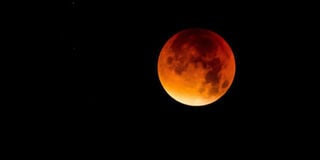
Kenya will on Sunday evening witness the ‘blood mood’ that is expected to last 82 minutes, and the government is tapping into it by launching a new tourism product.
As some parts of the world like America will be basking under the midday sun, their side of the globe will be blocking sunlight from reaching the moon. The Earth’s shadow will register itself on its natural satellite and it will be seen as a blood moon in Africa, Asia, Australia and parts of Europe.
The blood moon is due to a phenomenon called a total lunar eclipse. It happens when the Earth stands in the way of the moon getting sunlight. However, the Earth doesn’t stop all the light. It “steals” the blue rays of the sunlight through its atmosphere but the red rays somehow pass and land on the moon. Those red rays give the moon, which is 384,400 kilometres away, its “bloody” appearance.
In Kenya, if you miss the total eclipse, another chance will arise on December 31, 2028. This is according to America’s National Aeronautics and Space Administration (Nasa’s) database of eclipses between 2021 and 2030. The last total lunar eclipse visible in Kenya, it says, happened in May 2022.
The next total lunar eclipse will happen on March 3, 2026, but it won’t be visible in Kenya.
According to the Kenya Space Agency (KSA), the total eclipse will start at 8.30pm and end at 9.53pm. However, between 6.28pm and 11.55pm, the moon will “not be itself” as it will be going in and out of the Earth’s shadow. It will change shades over that time, getting at its reddest when the eclipse peaks at 9.12pm.
The Kenya Tourism Board will take advantage of the blood moon to launch a new product. Starting Sunday night, Kenya will be venturing into astro-tourism, aiming to attract people who travel the world to have a glimpse of heavenly phenomena.
“Astro-tourism is an emerging niche market that combines stargazing, astronomy education and the experience of pristine night skies,” said a statement from the Kenya Tourism Board.
The Tourism ministry has chosen Samburu as the site for launching the astro-tourism product, and this will be done during the blood moon.
“The launch coincides with a total lunar eclipse dubbed ‘blood moon’,” the statement said. “With minimal light pollution, clear equatorial skies, and unique landscapes, Samburu presents an unparalleled opportunity to showcase Kenya’s celestial wonders.”
The statement went on: “Tourism and Wildlife Cabinet Secretary Rebecca Miano will lead participants including international visitors in the event set to take place at Sopa Lodge in Samburu National Reserve. The launch of astro-tourism experience will drive tourism to new and less-explored regions like Samburu thereby expanding Kenya’s tourism footprint beyond traditional safari circuits.”
The ministry will also have moon-viewing events at the Waterfront in Karen, Nairobi; the Landing in Nanyuki; the Ileret Campus of Turkana Basin Institute; and Fort Place Grill in Kabete, Kiambu County. The Kenyatta International Convention Centre (KICC) will host a blood moon watching experience. According to a banner seen by the Nation , the watching will happen at the KICC courtyard and entry will be free
The Kenya Space Agency notes that the eclipse will be visible throughout Kenya and that it is safe to look at the moon with naked eyes.
“Unlike solar eclipses, no special glasses or filters are required to watch a lunar eclipse. It is completely safe to view with the naked eye. For a closer and more detailed view of the red moon, binoculars or a telescope can be used, but they are not necessary to enjoy the event,” it notes in a post on its website.