Integrity and impartiality concerns on Tuesday dominated the Judicial Service Commission’s (JSC) interviews for a Supreme Court judge, with candidates put to the test over disclosures, past conduct and political links.
Court of Appeal judge Katwa Kigen faced pointed questions over his past representation of President William Ruto and its potential implications on a possible 2027 election petition, while former Independent Policing Oversight Authority (IPOA) chair Anne Waceke Makori was faulted for failing to submit a mandatory wealth declaration.
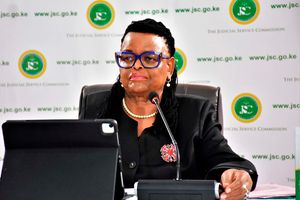
Former IPOA chairperson and lawyer Anne Waceke Kiratu Makori during JSC interviews for the position of Supreme Court Judge on April 28, 2026.
Photo credit: Billy Ogada | Nation
A third candidate, High Court judge Joseph Sergon, confronted complaints over alleged judicial misconduct in a Sportpesa case and handling of a politically sensitive case concerning Wiper Patriotic Front.
Justice Joseph Kiplagat Sergon during JSC interviews for the position of Supreme Court Judge on April 28, 2026.
Photo credit: Billy Ogada | Nation
The exchanges underscored rising concern within the panel, chaired by Chief Justice Martha Koome, over whether candidates can command public trust at the apex court ahead of a potential 2027 election presidential election dispute.
Chief Justice Martha Koome chairs the ongoing JSC interviews for the position of Supreme Court Judge at the Milimani law courts on April 28, 2026.
Photo credit: Billy Ogada | Nation
The issue of a possible 2027 presidential election dispute surfaced early at the panel, framing much of the questioning. Commissioners pressed Justice Kigen on fears that his previous legal work for President Ruto could undermine public confidence in his independence if he sits on an election petition.
Justice Fatuma Sichale told him Kenyans had raised concerns he “may not remain impartial” in such a scenario.
“They are concerned and expressing misgivings over your connections to President Ruto and who is likely to be a candidate in 2027 elections. They fear that if you succeed in becoming a Supreme Court judge and there is a presidential petition challenging 2027 polls, you are likely not be impartial,” Justice Sichale stated.
However, Justice Kigen acknowledged representing Dr Ruto including at the International Criminal Court, but insisted it would not affect his judgment.
“I will be objective and neutral in the discharge of my duties,” he said, dismissing the concerns as “ill-informed.”
He added that mechanisms such as recusal exist, but maintained he should be judged on his competence and integrity not his ties to past clients when he was in the private practice.
“My relationship with the President has never taken away my objectivity,” he said, urging the Commission to “look at what I stand for: integrity, fairness and justice...I will apply the law fairly and objectively.”
He joined the Judiciary in 2026 as a judge of the Court of Appeal, with his short stay and desire to rise to the apex court attracting questions from the JSC panel.
The line of questioning reflected the stakes surrounding the vacancy, which arose following the death of Justice Mohamed Ibrahim in December 2025. The Supreme Court is the final arbiter of presidential election disputes.
Justice Kigen, who hails from Elgeyo Marakwet County and identified himself as Keiyo, also faced queries over his quick move to seek promotion barely months after joining the Court of Appeal. He said eligibility, not tenure, should guide the process.
“I am here to be evaluated on my competence,” he said, citing 30 years of legal practice and appearances before superior courts, including international tribunals.
He was also questioned about same-sex relationships and how he would interpret constitutional provisions on marriage and non-discrimination.
He responded that while the Constitution recognises the possibility of a same-sex family, it does not permit same-sex marriage under Article 45.
Lawyer Anne Waceke Makori's interview for position of Supreme Court judge
Earlier, Anne Waceke Makori, an advocate of 30 years from Nyamira County who identified herself as a Kikuyu, opened the interviews by defending her public service record.
She cited her tenure at IPOA as evidence of her grounding in accountability and constitutional governance.
However, her session was marked by sharp scrutiny over both compliance and technical knowledge. CJ Koome told her the Commission could not find her wealth declaration, a mandatory requirement for candidates.
Ms Makori said the omission was an oversight and asked to submit the documents later. The request was declined, with the Chief Justice stressing adherence to rules.
The panel also pressed her on constitutional provisions, including Supreme Court jurisdiction and presidential election procedures. She struggled with specific questions on timelines and the proper respondent in presidential election petitions.
At one point, she said the Independent Electoral and Boundaries Commission was the respondent, prompting correction from Justice Njoki Ndung’u that it is the president-elect.
Ms Makori defended her candidacy, saying her experience outweighed gaps in courtroom exposure.
“I am the best suited candidate,” she said, adding she would rely on collegial learning at the court.
She acknowledged though she was an advocate, she had not appeared before the Court of Appeal or Supreme Court, but said she had handled matters at the High Court.
“Where there are gaps, I will learn.”
She also addressed public complaints alleging domineering leadership and political influence in recruitment at IPOA. She denied the claims, saying she was firm but not domineering and had no audit queries during her tenure.
The interviews form part of a competitive process to fill the vacancy. The successful candidate will help restore the court to its full bench of seven judges.