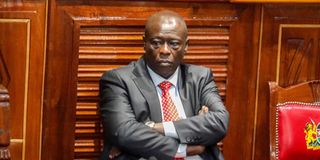
The Supreme Court has dismissed former Deputy President Rigathi Gachagua’s request to suspend ongoing High Court proceedings related to his impeachment, ruling that it lacks jurisdiction to halt cases pending before lower courts.
Simultaneously, the court rejected the National Assembly’s application seeking to strike out Gachagua’s cross-appeal challenging the Court of Appeal’s refusal to order High Court judges to recuse themselves from the impeachment case.
The apex court’s decision to reject the competing applications ensures that the constitutional dispute over judicial authority and presidential impeachment remains alive, as judges both at the High Court and apex court weigh on the issues.
In its ruling delivered on Friday, the Supreme Court clarified that it could only issue stay orders concerning matters before the Court of Appeal, not cases still being heard by subordinate courts.
Mr Gachagua had sought to pause the High Court hearings pending the Supreme Court’s determination of an appeal filed by the National Assembly regarding Deputy Chief Justice Philomena Mwilu’s authority to constitute a bench.
His argument centred on whether Justice Mwilu could lawfully assign judges to hear impeachment petitions while Chief Justice Martha Koome was unavailable.
The impeachment case consolidates seven petitions filed by 41 individuals, three of which were assigned by Justice Mwilu—a decision later declared illegal by the Court of Appeal in July 2025.
Dissatisfied with this ruling, the National Assembly appealed to the Supreme Court, seeking to overturn the appellate court’s findings.
The Supreme Court building in Nairobi.
Photo credit: File | Nation Media Group
The contested bench—comprising Justices Eric Ogolla, Anthony Mrima, and Fredah Mugambi—had lifted conservatory orders blocking Gachagua’s removal in November 2024, paving the way for Prof. Kithure Kindiki’s swearing-in as Deputy President. Following the Court of Appeal’s decision, Chief Justice Koome formally reassigned the same judges to the petitions, rectifying the earlier procedural irregularity.
Mr Gachagua also filed a cross-appeal urging the Supreme Court to dismiss Parliament’s appeal for alleged abuse of process and to expunge additional documents from the appeal record.
He argued that the National Assembly had previously contested the legality of benches constituted by the Deputy Chief Justice in another constitutional case and could not now reverse its stance for convenience.
However, the Supreme Court ruled that Parliament’s appeal warranted full consideration rather than summary dismissal. The bench, led by Chief Justice Koome, emphasized that its jurisdiction was strictly defined by the Constitution and statute, limiting interim relief to appellate proceedings. Justice Mwilu was not involved in this ruling.
"The court can only grant an order staying further proceedings in the Court of Appeal and no other court below, specifically the High Court," the judges stated.
They further noted that the contested documents were integral to the appeal’s determination, having been referenced by both the High Court and Court of Appeal.
Gachagua had sought conservatory orders halting consolidated High Court petitions challenging various aspects of his impeachment. His cross-appeal raised jurisdictional concerns, including whether the judges overseeing his impeachment should have recused themselves and whether the entire process was flawed from inception.
The Supreme Court dismissed these arguments, reiterating that High Court proceedings fell outside its purview at this stage.
The impeachment saga traces back to October 2024, when the National Assembly voted in favor to remove Mr Gachagua under Article 145 of the Constitution.
Kibwezi West MP Mwengi Mutuse testifies during the impeachment trial of Deputy President Rigathi Gachagua at the Senate on October 17, 2024.
Photo credit: Dennis Onsongo | Nation Media Group
The motion, introduced by Kibwezi West MP Mwengi Mutuse, was later upheld by the Senate despite Mr Gachagua’s hospitalization preventing him from mounting a defense. President William Ruto subsequently nominated Prof. Kindiki as Deputy President, securing parliamentary approval.
As the impeachment unfolded, multiple petitions were filed in the High Court challenging the parliamentary process. The Kerugoya High Court initially issued conservatory orders halting Senate proceedings and Prof. Kindiki’s swearing-in. These petitions were later consolidated under Article 165(4) of the Constitution, necessitating a multi-judge bench.
Chief Justice Koome initially assigned a three-judge bench to hear related cases, but additional petitions emerged during her absence.
Deputy Chief Justice Mwilu then empaneled the same judges to hear the new petitions—a move later contested as unconstitutional. The bench ultimately lifted the interim orders blocking Gachagua’s removal, enabling Prof. Kindiki’s inauguration on November 1, 2024.
Petitioners challenged Justice Mwilu’s authority, arguing that only the Chief Justice could constitute benches under Article 165(4).
Former Deputy President Rigathi Gachagua and his legal counsel Paul Muite before the Senate in Nairobi during the second day of his impeachment trial on October 17, 2024.
Photo credit: Dennis Onsongo | Nation Media Group
The High Court dismissed this challenge, ruling that the function was administrative and could be delegated.
However, the Court of Appeal overturned this decision, declaring that bench empanelment was an exclusive constitutional mandate of the Chief Justice, exercisable by the Deputy Chief Justice only under exceptional, clearly justified circumstances.
This ruling prompted the National Assembly’s Supreme Court appeal seeking to validate Justice Mwilu’s actions. Gachagua’s cross-appeal contested other aspects of the appellate judgment, including the refusal to order the judges’ recusal. Before the substantive appeal could be heard, Mr Gachagua filed an omnibus application seeking to stay High Court proceedings, strike out Parliament’s appeal, and expunge documents. Parliament countered with its own motion to dismiss Gachagua’s cross-appeal.
The Supreme Court rejected both applications. On Gachagua’s bid to strike out Parliament’s appeal, the judges ruled that summary dismissal was only permissible where petitions were plainly defective or beyond the court’s jurisdiction.
"Determining whether the National Assembly’s position is barred by judicial estoppel would require extensive analysis," the court noted, adding that such an inquiry was premature.
The bench also declined to expunge documents, finding them relevant to the empanelment dispute. Parliament’s attempt to strike out Gachagua’s cross-appeal similarly failed, with the court affirming that his constitutional questions—including fair hearing and judicial bias—fell within its jurisdiction.
No costs were awarded, given the public interest nature of the case.