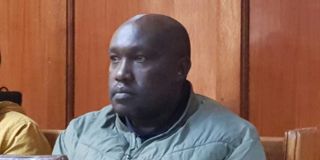
A suspected member of a cybercrime syndicate with two passports and eight national identity cards bearing his photo but with different names has been charged with siphoning over Sh52.5 million from a company’s bank account.
Albert Komen Kipkechem alias Jonathan Kiptum Barmasai, who is also implicated in a series of cyber-attacks that have led to financial institutions losing Sh100 million, was detained in police custody.
Mr Kipkechem faces two counts of irregularly accessing the computer system of Eclecities International and computer fraud.
The Director of Public Prosecutions, through prosecuting counsel Joyce Olajo, told the court that between June 6 and 20, 2025, he fraudulently occasioned an unlawful financial loss of Sh52,549,798 to Eclecities International through unauthorized access to their computer system.
However, Ms Olajo urged a senior principal magistrate to decline the bail plea, saying he is a flight risk.
Opposing the grant of bond, the prosecutor said the accused has two passports — a Kenyan and a DR Congo one — which makes it easy for him to slip through East African border posts with ease.
Ms Olajo said there are enough compelling reasons to deny the accused bond, noting that he has eight Kenyan identity cards all bearing his photo but with different names.
“The accused person faces criminal charges of irregularly accessing computer systems of a private company contrary to Section 15 (1) and 26 (1) (b) as read with Section 26 (2) (a) of the Computer Misuse and Cybercrimes Act, which attracts a harsh penalty,” Ms Olajo told the magistrate.
She added: “Although the accused is a Kenyan citizen, he is also a holder of a Democratic Republic of Congo (DRC) passport, making him a significant flight risk.”
Pressing for bail denial, the prosecutor said Mr Kipkechem is “implicated in a series of cyber-attacks resulting in massive financial losses to financial institutions totalling over Sh100 million.”
The court further heard that when police arrested the suspect, they recovered eight national identity cards bearing his photograph but “displaying different names and nationalities.”
Ms Olajo asked the magistrate to deny the accused bond, saying the existence of these fake identities makes it virtually impossible for state agencies to effectively monitor his movements.
The court further heard that the accused has proven that he has the capacity to travel or conduct financial transactions under aliases.
“That this discovery corroborates the prosecution’s fear that the accused is a high-level flight risk who would use these illicit documents to flee the jurisdiction of the court and evade the reach of law enforcers,” stated Ms Olajo.
A defence lawyer asked the magistrate to order that the accused be detained at Capitol Hill Police Station until March 12, 2026, to enable him to get instructions from the accused and then respond to the affidavit by Chief Inspector Andrew Ngowa.
CIP Ngowa, attached to the Economic and Commercial Crimes Unit at the Directorate of Criminal Investigations (DCI), swore the affidavit opposing the grant of bond, saying the “accused may abscond without trace given the numerous identification documents in his possession.”
The magistrate ordered the accused to be detained at Capitol Hill Police Station until March 12, 2026, when he will be returned to court for further directions.