Counties on high alert after Ebola confirmation
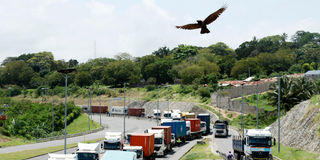
Long queues at the Kenya Ports Authority Miritini gates in Mombasa, in this photo taken on October 7, 2026. Members of the Kenya Heavy Commercial Vehicle Operators Society opposed Ebola screening at border checkpoints, saying it would lead to congestion.

The single confirmed Ebola case in Nairobi has prompted a chain reaction across the country, with counties stepping up surveillance, reopening isolation facilities and preparing health workers for possible cases.
The response is being shaped by the movement of people and goods across Kenya’s highways, borders, ports, airports and tourism centres, exposing the country’s interconnected transport and economic networks to the risk of a wider outbreak.
Mombasa County is stepping up surveillance at key entry points with screening of long-distance truck drivers expected to begin soon in a bid to contain the spread of the deadly virus. At the port city, the planned measures have highlighted the delicate balance between protecting public health and keeping critical regional trade corridors moving.
Mombasa is designated as one of 20 to 22 high-risk counties for Ebola in Kenya due to its critical role as a major transport corridor linked to regional trade routes from the Democratic Republic of Congo (DRC) and Uganda.
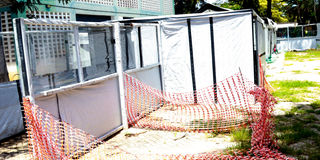
The dilapidated state of the Mombasa Ebola Isolation Centre, which was established 3 Months ago at the Port Reitz Hospital in Mombasa, in this photo taken on October 7, 2026.
An Ebola outbreak could therefore have consequences beyond public health, potentially disrupting supplies of food, fuel and industrial inputs across the region.
Officials said health workers have been placed on heightened alert at Port Reitz Sub-County Hospital, where arrangements have been made to handle suspected cases before infections can spread through one of Africa’s busiest transport networks.
Port Reitz Emergency Operation Centre manager Fatma Ali said the county has mobilised health workers and is coordinating with teams stationed at high-risk points, including the Port of Mombasa, Moi International Airport and major road corridors used by regional cargo transporters.
She said county health officials are working with the Ministry of Health and humanitarian partners to strengthen surveillance, improve early detection and ensure rapid reporting of suspected cases.
“We are working to expand public awareness campaigns to educate residents on Ebola prevention, encourage early medical attention for suspected symptoms and counter misinformation that could undermine response efforts,” said Ms Ali.
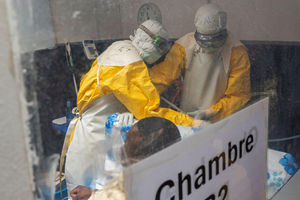
Healthcare workers have also undergone simulation exercises designed to replicate an Ebola outbreak, enabling them to practise patient isolation, contact tracing, sample collection and emergency response procedures.
However, a spot check by the Nation showed that one of the facilities designated to support the response is in a poor state. The isolation facility at Port Reitz appeared neglected and surrounded by overgrown shrubs near its entrance.
Long-distance truck drivers who frequently travel along the high-risk corridors also say they have not been sufficiently involved in preparedness measures.

Members of the Kenya Heavy Commercial Vehicle Operators Society, addressing the press, where they opposed Ebola Screening at the border points, saying the same will lead to congestion in this photo taken on October 7, 2026.
The Secretary-General of the Long-Distance Drivers and Conductors Association, Roman Waema, urged the government to work closely with them instead of imposing measures that could disrupt trade along the Northern Corridor.
“We are at risk. We learn a lot about Ebola in the media, though we make daily trips outside the country, including DRC Congo. We are asking government to involve us and help us to take the best measures to protect ourselves,” said Mr Waema.
Stakeholders in the sector said enhanced screening, health declarations and targeted medical assessments are necessary but should be coordinated to avoid unnecessary delays. Transport operators fear that poorly coordinated procedures could increase truck turnaround times and logistics costs along the Northern Corridor.
Many counties across the country have reactivated former Covid-19 isolation facilities into Ebola quarantine centres as part of measures to strengthen preparedness against a possible outbreak.
In Homa Bay, the County Director of Curative Health Services Amos Dulo said the facilities had been assessed and certified to accommodate people suspected of having contracted Ebola.
During the Covid-19 pandemic, the county government converted several hospitals into isolation centres to contain the spread of the virus. With the pandemic brought under control, the facilities were restored to their normal health services.
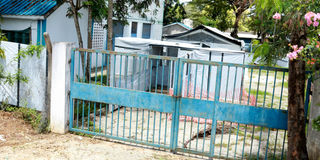
The dilapidated state of the Mombasa Ebola Isolation Centre, which was established three months ago at the Port Rietz Hospital in Mombasa in this photo taken on October 7, 2026.
They include Malela Hospital in Ndhiwa, Nyagoro in Rangwe, Pala Koguta in South Kabuoch and Ober in Kabondo Kasipul. Others are Nyangiela in Kasipul and Kandiege Hospital in Karachuonyo.
Homa Bay’s preparedness is particularly significant given its proximity to Uganda across Lake Victoria, where movement between the two countries is largely unregulated. The porous border provides an easy route for people moving in and out of the region, heightening concerns over the spread of infectious diseases.
However, health officials in the county said they were encouraging home-based care rather than isolation when conducting contact tracing, depending on the circumstances of individual cases.
In neighbouring Nyamira County, health officials are assessing the county’s level of risk, an exercise expected to guide the measures it will take to strengthen preparedness against Ebola.
“We are not a high-risk county; for now, we are assessing the situation. This will guide our next decision on the preparations we need to undertake for Ebola prevention,” said a top medical officer who requested anonymity.
The officer said Nyamira County Executive Officers were scheduled to meet later in the day, with Ebola preparedness expected to feature prominently on the agenda.
Elsewhere, the Moi Teaching and Referral Hospital (MTRH) in Eldoret, which serves patients from across Western Kenya as well as parts of eastern Uganda and South Sudan, has established a special isolation unit and a specialised emergency response team to handle suspected cases in the region.
According to the hospital management, the priority is to ensure that any suspected case reaching the facility can be isolated quickly and managed safely while preventing possible transmission within the hospital and to the wider community.
Long queues at the Kenya Ports Authority Miritini gates in Mombasa, in this photo taken on October 7, 2026. Members of the Kenya Heavy Commercial Vehicle Operators Society opposed Ebola screening at border checkpoints, saying it would lead to congestion.
The hospital’s chief executive officer, Dr Philip Kirwa, said the facility had equipped its World Bank-funded isolation unit to handle up to 24 suspected Ebola cases.
The hospital has also activated an emergency response team equipped with personal protective equipment (PPE) and other specialised gear to help contain the spread of the infectious disease and protect healthcare workers.
“The isolation unit also serves as an intensive care unit (ICU) and has state-of-the-art equipment to contain the spread of the virus and ensure the safety of healthcare workers,” Dr Kirwa said.
County officials in the Mt Kenya region said they are on high alert because the region is economically linked to Nairobi, and people from the capital city interact daily with those from the Mt Kenya, especially Murang’a, Kirinyaga, Nyeri and Embu.
In Kirinyaga, County Medical Director Dr Hesbon Gakuo said there is an isolation ward at Kerugoya Referral Hospital which can hold thirteen patients. He also said members of the public are being educated on the preventive measures and there is no cause for alarm.
Dr Gakuo advised the residents to report any suspected cases so that appropriate action can be taken.
“Anyone with fever, severe headaches, vomiting, diarrhoea or unexplained bleeding should visit hospital without delay,” said Dr Gakuo.
“We have activated our emergency teams, and we are prepared in case of any outbreak,” he added.
Dr Gakuo said they were working with local maize millers to monitor the movement of truck drivers who deliver maize, since they come from outside the region.
In Murang'a, emergency protocols for the Ebola outbreak were yet to be announced publicly by Wednesday afternoon. However, Murang'a County health chief officer Mr Eliud Maina told Nation that the disease surveillance team is collaborating with the national government to identify any threat.
County Commissioner Mr Hassan Bule said there was no cause for alarm and the government remained highly vigilant.
"So far we are not affected and there is no trail of risk heading out way," he said.
Nyeri Governor Mutahi Kahiga said he would issue Ebola response guidelines on Thursday.
Similar actions are being undertaken in the South Rift counties of Nakuru, Kericho, Nyandarua, Narok and Bomet.
Dr Joseph Sitonik, the Bomet County Executive Committee (CEC) member for Health, said the county had set aside isolation centres at Longisa County Referral Hospital and sub-county hospitals to handle any cases that may arise.
“Apart from having the isolation centres, our health officers are sensitising members of the public on high levels of hygiene that they have to maintain including avoiding long distance travels and frequent changing of vehicles, if they can avoid it,” Dr Sitonik said.
Ms Vivian Sereti Mpetti, the Narok County Executive Committee (CEC) member for Public Health and Sanitation, said the tourism hub is implementing public health measures including high levels of hygiene, while hotels have been asked to ensure they register their guests to ease cases of tracing if need be.
The Manager of the Nakuru Public Health Emergency Operations Centre (PHEOC), Moses Obiero, said the department had already sensitised Community Health Promoters (CHPs). He added that 36 selected faith leaders were also selected to help sensitise the community and faith congregants on Ebola while also helping to pick any suspected cases within the community.
According to Mr Obiero, they have also identified isolation facilities, with each sub-county having at least a holding area for the purposes of managing cases and suspected cases.
The preparedness measures come as the Government intensifies surveillance and screening at border points following confirmation of Kenya’s first imported case of Bundibugyo Ebola virus disease.
The Ministry of Health said the patient, a Kenyan citizen who had been living in the Democratic Republic of Congo (DRC), fell ill while in the DRC before travelling by road to Kampala and subsequently flying to Nairobi. He was later isolated and tested positive for the virus.
The World Health Organisation (WHO) declared the ongoing Bundibugyo Ebola outbreak in the DRC and Uganda a Public Health Emergency of International Concern in May, citing the potential for international spread.
The outbreak, which began in the DRC’s Ituri Province, has since spread to several other provinces. WHO reported 5,794 confirmed cases and 2,786 deaths by August 26, with Ituri remaining the epicentre.
The outbreak is caused by the Bundibugyo virus, a strain for which there are currently no approved virus-specific vaccines or therapeutics, according to WHO.
Follow our WhatsApp channel for breaking news updates and more stories like this.
Reporting by Anthony Kitimo, George Odiwuor, Ruth Mbula, Barnabas Bii, Mwangi Muiruri, George Munene and Vitalis Kimutai