Gaps in traffic-related laws are a leading contributor to the country's road carnage, with government data showing almost 5,000 fatalities were reported last year despite no mechanisms being employed to reduce accidents.
A document presented to the National Assembly's Transport and Infrastructure Committee by the Automobile Association of Kenya (AAK) notes that weak implementation of the National Transport and Safety Authority (NTSA) and outdated traffic fines have exacerbated the situation.
“The fragmentation of the NTSA powers and the inadequate and outdated penalties under the Traffic Act are hindrances to the enforcement of law and order,” the AAK document reads.
This, even as Ndia MP George Kariuki, who chairs the House’s Transport and Infrastructure Committee, noted that the greatest concern “to the committee and the entire country at large has been the alarming increase in road fatalities.”
In 2024, road deaths reached 4,748.
Beyond the tragic loss of life, Mr Kariuki notes that the economic impact of road traffic crashes is enormous, as it is estimated to cost approximately 5 percent of the country’s GDP, translating to about Sh450 billion annually.
“As a country, we also lack clear guidelines on post-crash response. Many victims of road carnage are abandoned at accident scenes because people fear liability challenges associated with accidents,” says Mr Kariuki.
The Ndia MP, however, notes that legislation “by itself” is not enough to address road carnage and that “it must be followed by compliance and enforcement by all the key players in the road safety sector.”
The wreckage of a 14-seater matatu that claimed thirteen lives in Kariandusi near Kikopey on Nakuru- Nairobi highway on September 28, 2025.
Photo credit: Boniface Mwangi | Nation Media Group
“Institutional compliance is ensured through various accountability mechanisms. Achieving adherence to safety measures requires a mix of education, enforcement and incentives,” says Mr Kariuki.
The committee adds that “our emergency response, particularly ambulance services, remains inadequate across the country, making it essential for citizens to step in and assist accident victims.”
Despite this, a parliamentary document notes that road traffic death data are grossly underreported in Africa, with estimated figures almost four times less than the official figures.
“Disaggregated data is vital for identifying critical areas requiring evidence-based interventions. As a country, we must strengthen our systems to improve the collection, analysis, and use of road safety disaggregated data to inform targeted and effective measures,” says Mr Kariuki.
Records from parliament show that the Ministry of Health incurs around Sh46.1 billion each year in expenses related to crash injuries, underscoring the “urgent need for strengthened partnerships and enhanced legislation to improve road safety across Kenya.”
During the launch of the National Road Safety Action Plan, 2024-2028, President William Ruto emphasised that road safety is a shared responsibility that requires an all-of-society approach, pointing out the need for strong collaboration across government agencies, private sector, civil society, law enforcement and the public.
Globally, it is observed that although Africa is the least motorised with 2.3 percent of vehicles, it has the highest number of accidents at 26.6 per 100,000 compared to other continents at 8 per 100,000.
The World Health Organisation report on Global Status on Road Safety 2023, indicates that Kenya has a fatality rate of 28.3 deaths per 100,000 population.
The data makes Kenya the fifth highest road fatality rate in the African region, just below Comoros at 29, Zimbabwe at 29.8, Guinea-Bissau at 30, and Guinea at 37 deaths per 100,000.
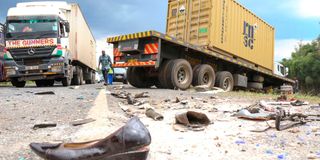
Members of the public at the scene of the crash involving a lorry and matatu on Eldoret-Kitale highway on January 3, 2025.
Photo credit: Steve Keter | Nation Media Group
A major challenge driving the rise in fatalities in the country is the Boda Boda sector, as per the report, which shows that in 2024, motorcyclists and their pillion passengers accounted for 33 per cent of the 4,748 road deaths.
If the trend persists, the sector will represent the largest share of road fatalities in the country, as it calls for urgent interventions.
Mr Kariuki noted that the committee is determined to ensure that the aspirations of the NTSA action plan, 2024-2028, aiming to reduce road fatalities by 50 percent by 2030, are achieved.
“The Transport and Infrastructure committee remains receptive to ideas and welcomes further engagement and discussions on safety measures and related issues to promote safer mobility across the country.”
The UN declared 2011-2020 and 2021-2030 as decades of action for road safety globally, aiming to halve by 2020 the number of global deaths and injuries from road traffic accidents.