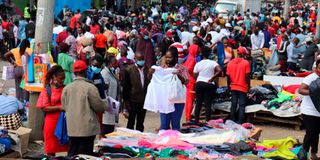
At the crack of dawn in Gikomba, Nairobi the largest mitumba market stirs. Smoke wafts from food stalls, bales land with a thud, and handcarts weave through tight paths as trader’s shout for early customers.
Here, thousands begin another day in an economy built on hustle. This is Kenya’s informal sector—now the country’s biggest employer, sustaining millions who have been locked out of formal jobs.
Kenya continues to face major unemployment challenges, with the overall rate estimated at 12.7 per cent in 2024. The youth bear the brunt of this crisis, with their joblessness soaring to 67 per cent in 2025, leaving thousands of graduates and school leavers struggling to find meaningful work.
Young people aged between 15 and 24 are particularly affected, with an unemployment rate standing at 13.4 per cent. Projections for this year indicate a modest rise in overall unemployment to 7.23 per cent, which translates to nearly 1.95 million Kenyans without jobs.
A man selling mitumba at Nairobi's Gikomba Market.
Photo credit: Dennis Onsongo | Nation Media Group
According to the KNBS Economic Survey 2025, the informal sector generated just over 700,000 new jobs in 2024, representing 90 per cent of all new employment opportunities outside small-scale agriculture. And despite differences in measurement across institutions, the consensus is clear: the informal economy contributes between 24 and 32 per cent of Kenya’s GDP—a massive share, driven largely by people who never imagined they would end up here.
Among them are thousands of graduates who roam the country every year with degrees but few or no job offers. Many now wake up and head to Gikomba, Kamukunji and Kariobangi in Nairobi but not in offices. Others have traded their certificates for boda bodas, cameras, or welding machines. For them, the informal sector has become both a refuge and a reminder of the shrinking promise of formal employment.
“Graduates come to us with their certificates because the formal job market has completely shut them out. Every year, we absorb hundreds of young people — some fresh from universities — because they have nowhere else to go. Jua Kali is carrying nearly 19 million Kenyans, yet the government has neglected it. Every year we absorb more than 800 new people,” said Tom Ogolla, the Secretary General Kamukunji Jua Kali Association.
Boda boda riders.
Photo credit: File | Nation Media Group
Yet even as the sector carries the weight of the country’s unemployment burden, Mr Ogolla says workers here are operating under crippling conditions. He notes that job security is almost non-existent: a carpenter, welder, or mechanic can show up at dawn and go home at dusk without earning a single shilling.
“Sometimes you end up in a day without doing anything tangible. Most live hand-to-mouth, relying on unpredictable orders and outdated machines as electricity transformers serving thousands routinely overload. Still, despite its enormous contribution to the economy, the Jua Kali sector remains largely neglected—its workers left to survive on resilience rather than support,” said Mr Ogolla.
Juakali artisan Milton Omondi making frying pans in his workshop in Nakuru in 2018.
Photo credit: File | Nation Media Group
The formal private sector, KEPSA notes, employs around 2.1 million people, with total formal jobs standing at about 3.3 million, including public sector and formally self-employed workers. But the number of formal jobs created each year remains far below the pace needed to absorb Kenya’s graduates, which explains why informal work dominates.
KEPSA says high costs of compliance, multiple licensing requirements, limited access to affordable finance, and regulatory complexity conspire to deter small enterprises from formalising.
“Kenya’s private sector continues to face mounting pressure from inflation, high energy costs, credit constraints, and currency volatility, all of which have slowed hiring and, in some cases, led to job losses, particularly in export-driven industries. KEPSA has cautioned that uncertainty surrounding the renewal of the African Growth and Opportunity Act (Agoa) alone could threaten more than 66,000 direct jobs in the country’s apparel and manufacturing sectors. Small and medium enterprises remain the most vulnerable, with more than half reporting reduced workforce capacity due to economic strain,” said Carole Kariuki, the Kepsa chief executive officer.
“On a broader scale, Kenya has an estimated 7.4 million micro, small, and medium enterprises (MSMEs), of which approximately 79 per cent operate informally, without registration or licensing. These informal enterprises account for roughly 80 per cent of total employment outside agriculture, underscoring their critical yet precarious role in sustaining livelihoods amid a sluggish formal job market,” she added.
KEPSA is working to bridge the gap between informal survival and formal opportunities. Through initiatives such as the Ajira Digital Programme, the Digital Skills and Employment Advancement Programme, and the Dual TVET and TVET-E Programmes. It aims to equip young people with practical, market-ready skills for emerging industries in technology, manufacturing, and green jobs.
In Gikomba, one of Nairobi’s busiest open-air markets, thousands of traders rely on daily sales to survive. Most operate without contracts, capital, or insurance. Fires, demolitions, and fluctuating supply prices can wipe out their earnings overnight, but the market remains a lifeline for families who depend on the day’s income to meet basic needs.
A man carries pillows on his head from Gikomba Market in Nairobi on April 29, 2020. Traders are paying dearly to replenish stocks following the mitumba imports ban in March this year.
Photo credit: Evans Habil | Nation Media Group
“Some days, I make enough to feed my family, other days, nothing. I never imagined I would end up here with my degree, but at least I can survive.
According to the KNBS, formal employment in manufacturing rose by 1.9 per cent in 2024 to 369,000, accounting for 11.5 per cent of total formal sector employment. This growth was largely supported by increased job creation within Export Processing Zones (EPZs).
Kenya Association of Manufacturers (KAM) noted that the sector’s output value also expanded by 4.4 per cent in 2024, up from 2.1 per cent in 2023, underscoring steady recovery and resilience. Moreover, manufacturing remains a major contributor to national revenue, accounting for at least 18 per cent of total tax collections — equivalent to over sh360 billion annually.
“Manufacturing offers opportunities to use both practical and technical skills, especially for graduates who now struggle in informal work. With technology transfer, automation, and industry-relevant training, young Kenyans can gain hands-on experience in high-demand skills such as digital machinery, mechatronics, and process optimisation,” said KAM Chief Executive, Tobias Alando.
James Mwangi welds together a stainless steel to make a sufuria at his workshop in Kamkunji's juakali open market on May 1st 2025.
Photo credit: Photo |Billy Ogada | Nation
The manufacturers’ lobby group boss said the most in-demand skills in today’s manufacturing sector are driven by technology and efficiency.
Top on the list are digital and automation skills — the ability to operate automated machinery, robotics, and Internet of Things (IoT)-enabled systems as factories rapidly modernise. He noted that maintenance and mechatronics expertise is now indispensable, with companies relying on technicians who can handle complex hybrid systems that blend mechanical and electrical engineering.
“We need targeted skills development, access to finance, and regulatory reforms so that young people can transition from precarious informal work to sustainable employment. Leveraging data to monitor production processes, identify inefficiencies, and improve output and efficiency,” Mr Alando added.
Meanwhile, in Kariobangi, hundreds of artisans hammer, grind, weld, and sculpt metal under the blistering heat. They build gates, furniture, metal boxes, wheelbarrows, and household items that power urban development.
Their skill is unquestionable; their resilience legendary. But the risks are high. Injuries are treated with first aid from colleagues, machines are often crude, and payments can take weeks or months.
“We keep the construction and manufacturing industry running, but we have no pension, no insurance, no guarantee of tomorrow. Everything I got all my skills here. My degree helps me with skills, but it hasn’t opened doors to a formal job yet,” said Brian Ogutu a mechanical engineering graduate working in a Jua Kali shed.
The boda boda industry tells a similar story. Stages across the country employ hundreds of thousands of young people, most of them school leavers and graduates unable to secure formal work. A rider may earn between Sh500 and Sh1,200 a day, but the income is unpredictable, and the risks—accidents, police crackdowns, and fuel price shocks—remain high.