Runda House Number 43 was a secure villa. It was, then, nondescript.
It had white stucco walls, four bedrooms, three bathrooms, and a tidy garage. The yard, on a half-acre, was bordered by pink bougainvillea and tall palms that fluttered in the Nairobi breeze. It stood in the middle of New Runda Estate, an upscale suburb where security guards patrolled its gates. The lawns were well manicured and the only sound at night came from crickets and distant traffic.
One of the many faces of Fazul Abdullah Mohammed aka Haroun Fazul, a key operative in the August 7th Nairobi bomb blast.
To the untrained eye, Number 43 was just another house occupied by an NGO worker and his young family. The man, known to neighbours as Harun Fazul, was quiet, well-dressed, and spoke fluent Swahili, English, and French. His wife kept to herself. The children sometimes played in the front yard. The landlord believed he was renting to a foreigner who worked in humanitarian aid, the kind of tenant anyone in Nairobi would be glad to have.
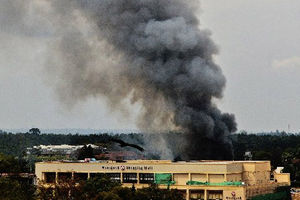
An aerial view of the US Embassy in Nairobi following the bombing on August 7, 1998.
Photo credit: File | Reuters
What no one knew—not the guards at the gate, not the neighbours who waved politely, not the authorities who never thought to look twice—was that House Number 43 was, in fact, a bomb factory. For three months, and following five years of careful infiltration, this peaceful villa became the final staging ground for one of al Qaeda’s most devastating attacks. The August 7, 1998 bombing of the US Embassy in Nairobi left 224 people dead, over 4,000 injured, and the world staring straight into the eyes of a rising jihadist movement.
But that morning’s carnage — though a turning point in Kenya’s history with terrorism — was only the end of the story. To truly understand the attack, you have to go back to when the terrorists first arrived in Kenya, cloaked in charm, business suits, and bearing fake passports. They posed as gemstone traders, fishmongers, and aid workers. You have to walk through the shadows they lived in, in a city that never saw the storm coming.
The al Qaeda network arrived in Kenya in 1993, under the guise of capitalism. They registered an innocuous-sounding business in Nairobi: Asma Limited, ostensibly an import-export firm. Its original director, Khalid Fawwaz, was a Saudi national and longtime associate of Osama bin Laden, the late Al Qaeda kingpin. But control of the company soon passed to Abu Ubaidah al Banshiri, one of al Qaeda’s most senior military commanders. He used a fake identity—Galal Fouad Elmeligy Abdeldaim—and operated undisturbed in Nairobi where he posed as a business baron.
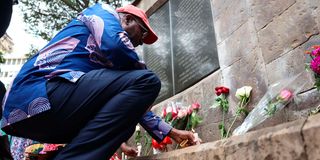
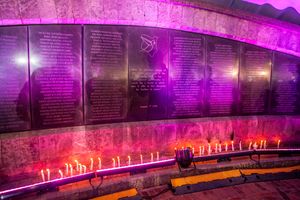
A visitor looks at the names of those who died during the bomb blast in Nairobi on August 7, 1998. Photo/FILE
The group’s objective was clear: revenge. The CIA-backed Operation Restore Hope in Somalia, which culminated in the notorious 1993 Black Hawk Down incident, had infuriated bin Laden and had vowed to hit American interests—especially those in East Africa. But the group had a problem. Money.
The Nairobi office of Asma Limited quickly drained its modest budget. To stay afloat, the firm sold the office furniture.
Though funds were low, the terrorists had patience and strategy. They brought in Mohammed Odeh, a Palestinian engineer turned jihadist, who arrived in Mombasa in 1994. Mohammed Odeh was no amateur.
Born in Saudi Arabia, he pursued an engineering degree at Far Eastern University in the Philippines, where he became immersed in radical Islamic activism. He spent hours consuming the fiery lectures of Abdullah Azzam, the Palestinian cleric and ideological architect of global jihad, who coined the term “al Qaeda”, or The Base, and served as Osama bin Laden’s spiritual mentor.
In his final year of university, Odeh abandoned his studies to join the Mujahideen in Afghanistan. There, he underwent rigorous military training in explosives, weapons, and guerrilla tactics before being deployed by bin Laden to Somalia. His mission: support warlord Mohammed Farah Aideed in a brutal insurgency against US Marines during the ill-fated Operation Restore Hope.
Eventually, Odeh relocated to Kenya, where he married a local woman. The wedding was a social gathering of the East African al Qaeda cell; Fazul Abdullah Mohammed—his closest comrade—was in attendance. Together, they would become the core architects of the 1998 US Embassy bombing in Nairobi.
In Mombasa, Odeh opened a fish trading business and received a gift from al Qaeda’s top brass: a six-foot, fiberglass fishing boat, capable of travelling between Somalia, Kenya, and Tanzania. By then, the security was not keen to flag such business.
Odeh became the link between the Coast and the capital. He supplied seafood to top outlets including Hotel Intercontinental and Hilton. Odeh and his associates, including Mustafa Ahmed, played the role of fish suppliers, delivering snapper and lobster to Nairobi’s best hotels. They were known in the city as “Mohammed the Fisherman” and “the gemstone guys.” They were seen at weddings, prayers, and dinner tables. No one suspected a thing. But in Nairobi, the operation needed a new face—someone who could walk into embassies, register companies, host dinner parties, and be above suspicion.
That role was given to Wadih El Haji. A Lebanese-American who studied at the University of Louisiana, El Haji came to Nairobi posing as a gemstone dealer travelling on a valid US passport. But in private, he was bin Laden’s top coordinator in East Africa.
Fluent in the ways of bureaucracy, he registered another front company: Tanzanite King. Then an NGO, Help Africa People, which offered food aid and medicine to the poor. He held meetings with aid workers and smiled at customs agents. Behind the curtain, he was wiring logistics, shuffling fake passports, and managing operatives like a CEO.
At the core of his inner circle was Fazul Abdullah Mohammed, the man who would later mastermind the Nairobi attack.
Fazul was different from the rest. Born in the Comoros, he was young, bookish and a trained computer technician who had a disarming charm. He had fought in Mogadishu in 1993, helping down US Black Hawks. Later, he returned home briefly, married a teenage madrasa student, and moved to Nairobi with his new wife. Using the cover of Help Africa People — the NGO registered by the Lebanese-American — Fazul travelled frequently. Riding aboard the region’s booming khat transportation network, he travelled between Khartoum, Mogadishu, and Nairobi.
By 1996, the cell was growing stronger. Another business was established—Taba Investments, linked to bin Laden’s Tanzanian operations.
That year, bin Laden transferred $7,000 to El Haji and Fazul—a modest sum that would purchase the first wave of TNT and detonators from contacts in Tanzania. The network was now militarising. The code words grew more creative. Bombs were "tools." Fake IDs were "goods." Grenades were "potatoes."
In 1996, tragedy struck: Banshiri, the group's top military man, drowned when the MV Bukoba ferry sank in Lake Victoria. Fazul flew to Mwanza under the guise of a Mercy International aid worker to identify the body and report back to bin Laden.
Now promoted, Fazul returned to Nairobi with a mission: build the bomb. But first, he needed a quiet place to do it.
In May 1998, Fazul and his associate, Sikander Juma, found what they were looking for, a secluded villa with high walls and a spacious garage. It was House Number 43, in Runda Estate. The landlord, a Kenyan woman named Tamarra Ratemo, was told that Fazul wanted to settle in with his family and host international guests. He signed the lease.
The bomb-making began soon after. Inside the villa, beneath an air of domestic normalcy, Fazul supervised the construction of two massive explosives, each weighing nearly one tonne. The ingredients—500 canisters of TNT, ammonium nitrate, aluminium powder, and fuel oil—were delivered under the cover of night in lobster crates and fishing boxes. An electrical expert named Abdel Rahman wired the devices. Another operative, KK Mohammed, handled the bodywork.
Outside, children cycled past on sunny afternoons. Neighbours waved. No one saw the nightmare taking shape inside the garage, but there were warnings.
In September 1997, a man named Jamal Ahmed walked into the US Embassy and said that seven men working for a local NGO were planning an attack. The CIA brushed it off. A second warning came two months later from Mustafa Ahmed, who named the embassy as a target for a car bomb. Again, the CIA called it a false lead.
Agents expected to get terror blueprints during a raid at El Haji’s home, but they only found documents for mosquito net donations and water tank deliveries. Fazul had cleared out the real files days earlier. The CIA had missed its chance.
In the first week of August 1998, Fazul rented a beige Toyota Dyna truck. Fazul, together with his team, began loading the bomb, piece by piece, under the dim lights of the Runda garage.
August 6: Abu Mariam, the regional commander, instructed all operatives to leave Kenya by nightfall. The bombing would happen the next day.
August 7, 1998, dawned bright and still. In the Dyna truck sat Jihad Mohammed Ali, also known as Azzam, and beside him, Mohammed al-Owhali, dressed in jeans, a white shirt, and a jacket concealing four stun grenades and a Beretta pistol.
A file photo taken on August 8, 1998 shows police workers removing the remains of the car-bomb used to destroy the US embassy in Nairobi, that killed 280 Kenyans and 12 Americans.
Photo credit: Alexander Joe | AFP
Trailing them in a smaller pickup was Fazul—the architect, “the ghost”, the man who would disappear after this day. As the Dyna approached the US Embassy, Al-Owhali stepped out to frighten the gate guard. But he had left his pistol in the truck. In confusion, he threw a grenade. The guard fled. The barrier stayed down.
At 10:30am, the bomb exploded. The blast cratered the street, shattered windows across several blocks, and collapsed a nearby building, burying dozens alive.
Al-Owhali was injured but alive. He sought treatment at a local clinic, posing as Khalid Salim, then tried to flee the country. At his hotel, he tossed the remaining bullets and grenade pieces into a window ledge. But it was too late. He was captured within five days.
Odeh, flying through Karachi, was stopped at immigration for having a freshly shaven face that didn’t match his passport photo. When asked; “Are you a terrorist fleeing Nairobi?” He panicked. That was the break.
El Haji was arrested in Texas. Odeh and Al-Owhali were tried in the US and sentenced to life. Fazul escaped—for a time. In 2011, he was killed by Somali forces during a raid in Mogadishu.
House Number 43 in Runda is just another villa again. Perhaps a diplomat lives there now. Or a family with school-age children and a Labrador. The sun still hits the garage in the morning.
They remember the whispers in Arabic and Swahili. The glow of soldering tools. The ticking of stopwatches. They remember a man named Fazul, who mixed explosives in silence while his toddler played in the next room.