Hunger exists on a spectrum. On the one end is food insecurity, where people are forced to adjust to fewer meals. As food becomes scarce, the body consumes its own reserves. The journey from hunger to starvation starts with a drop in energy levels, then the body breaks down fat, then muscle. Eventually, critical organs begin to fail .
From undernourishment, to acute malnutrition and finally starvation, the process reaches a point where the body can no longer sustain life. In Gaza today, thousands of children under five and pregnant or lactating women are experiencing acute malnutrition . In Sudan, conflict and restricted humanitarian access have pushed millions to the brink of starvation , with famine warnings growing more urgent by the day.
We asked nutritionists Ola Anabtawi and Berta Valente to explain the science behind starvation and what happens to your body when it’s deprived of food.
What is the minimum nutrition a body needs to survive?
To survive, people need more than clean water and safety. Access to food that meets daily energy, macronutrient and micronutrient requirements is essential to preserve health, support recovery and prevent malnutrition.
According to the World Health Organization (WHO), adults require different amounts of energy depending on age, sex and level of physical activity. A kilocalorie (kcal) is a measure of energy. In nutrition, it tells us how much energy a person gets from food or how much energy the body needs to function. Technically, one kilocalorie is the amount of energy needed to raise the temperature of one kilogram of water by one degree Celsius. The body uses this energy to breathe, digest food, maintain body temperature, and – especially in children – to grow.
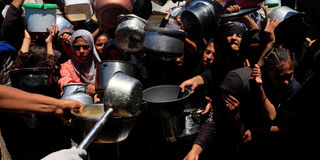
Palestinians wait to receive food from a charity kitchen, amid a hunger crisis, in Khan Younis, southern Gaza Strip, August 4, 2025.
Photo credit: Hatem Khaled | Reuters
resting energy expenditure: the energy used by the body at rest to maintain vital functions such as breathing and circulation physical activity: may vary during emergencies depending on factors like displacement, caregiving, or survival tasks thermogenesis: the energy used to digest and process food.
Resting energy expenditure usually forms the biggest portion of energy needs, especially when physical activity is limited. Other factors including age, sex, body size, health status, pregnancy, or cold environments also influence how much energy a person requires.
Energy needs vary throughout life. Infants require approximately 95kcal to 108kcal per kilogram of body weight per day during the first six months and between 84kcal and 98kcal per kilogram from six to 12 months. For children under the age of ten, energy needs are based on normal growth patterns without distinction between boys and girls.
For example, a two-year-old child typically requires about 1,000kcal to 1,200kcal daily. A five-year-old needs about 1,300 to 1,500 and a ten-year-old generally requires between 1,800 and 2,000 kilocalories per day. From age ten onward, energy requirements begin to differ between boys and girls due to variations in growth and activity, and allowances are adjusted based on body weight, physical activity and rate of growth.
For adults with light to moderate physical activity, the average daily energy requirement for men aged 19 to 50 is about 2,900kcal, while women in the same age group require roughly 2,200kcal per day. These values include a range of plus or minus 20% to account for individual differences in metabolism and activity. For adults over 50 years, energy needs decrease slightly , with men requiring about 2,300kcal and women around 1,900kcal daily.
In humanitarian emergencies, food aid provision needs to guarantee the widely accepted minimum energy intake to maintain basic health and function, which was set to 2,100kcal per person per day. This level aims to meet fundamental physiological needs and prevent malnutrition when food supply is limited.
This energy must come from a balance of macronutrients , with carbohydrates supplying 50%-60% (such as rice or bread), proteins 10%-35% (like beans or lean meat), and fats 20%-35% (for example, cooking oil or nuts).
Fat requirements are higher for young children (30%-40%), as well as for pregnant and breastfeeding women (at least 20%).
Palestinians wait to receive food from a charity kitchen, amid a hunger crisis, in Khan Younis, southern Gaza Strip, August 4, 2025.
Photo credit: Hatem Khaled | Reuters
In addition to energy, the body requires vitamins and minerals, such as iron, vitamin A, iodine and zinc, which are critical for immune function, growth and brain development. Iron is found in foods like red meat, beans and fortified cereals. Vitamin A comes from carrots, sweet potatoes and dark leafy greens. Iodine is commonly obtained from iodised salt and seafood. Zinc is present in meat, nuts and whole grains.
When food systems collapse, this balance is lost.
What physically happens when your body is starved?
Physiologically, the effects of starvation on the human body unfold in three overlapping stages. Each reflects the body’s effort to survive without food. But these adaptations come at great physiological cost.
In the first stage , which lasts up to 48 hours after food intake stops, the body draws on glycogen stored in the liver to keep blood sugar levels stable.
This process, called glycogenolysis, is a short-term solution. When glycogen runs out, the second stage begins.
The body shifts to gluconeogenesis, producing glucose from non-carbohydrate sources like amino acids (from muscle), glycerol (from fat), and lactate. This process fuels vital organs but results in muscle breakdown and increased nitrogen loss, especially from skeletal muscle.
By day three, ketogenesis becomes the dominant process. The liver starts converting fatty acids into ketone bodies – molecules derived from fat that serve as an alternative fuel source when glucose is scarce. These ketones are used by the brain and other organs for energy. This shift helps spare muscle tissue but also signals a deeper metabolic crisis.
Hormonal changes – including reduced insulin, thyroid hormone (T3), and nervous system activity – slow the metabolic rate to conserve energy . Over time, fat becomes the main energy source. But once fat stores are exhausted, the body is forced to break down its own proteins for energy. This accelerates muscle wasting, weakens the immune system, and increases the risk of deadly infections.
Death, often from pneumonia or other complications, typically occurs after 60 to 70 days without food in an otherwise healthy adult.
As the body enters prolonged nutrient deprivation, the visible and invisible signs of starvation intensify. Physically, individuals lose substantial weight, and experience muscle wasting, fatigue, slowed heart rate, dry skin, hair loss, and compromised wound healing. Immune defences weaken, increasing vulnerability to infections, particularly pneumonia – a frequent cause of death in starvation.
Psychologically, starvation creates profound distress. People report apathy, irritability, anxiety and a constant preoccupation with food. Cognitive abilities decline , and emotional regulation deteriorates, sometimes leading to depression or withdrawal.
In children, long-term effects include stunted growth and impaired brain development. Both can become irreversible.
During starvation, the body adapts in stages to survive. Initially, it uses glycogen storage for energy. As starvation continues, it begins to break down fat, and eventually, muscle tissue. This gradual shift explains both the physical weakness and psychological changes like irritability or depression.
But starvation does not stop at the individual. It fractures families and communities. As energy declines, people are unable to care for others or themselves. In humanitarian crises like Gaza and Sudan, starvation compounds the trauma of violence and displacement, creating a total collapse of social and biological resilience.
What are the steps to break the cycle?
After a period of starvation, the body is in a fragile metabolic state. Sudden reintroduction of food, especially carbohydrates, causes a spike in insulin and a rapid shift of electrolytes like phosphate, potassium, and magnesium into cells. This can overwhelm the body, leading to what’s known as refeeding syndrome , which may result in serious complications such as heart failure, respiratory distress, or even death if not carefully managed.
Standard protocols begin with therapeutic milks called F-75, specially designed to stabilise patients during the initial phase of treatment for severe acute malnutrition, followed by ready-to-use therapeutic food, a specially formulated peanut-butter paste or biscuit with the power to bring a malnourished child from the brink of death to full nutritional recovery in just four to eight weeks, oral rehydration salts, and micronutrient powders.
Airdrops are not part of food security. Survival requires sustained, coordinated efforts that restore food systems, protect civilians and uphold humanitarian law. Anything less risks repeating cycles of hunger and harm.
When food assistance falls short in quality or quantity, or when clean water is unavailable, malnutrition rapidly worsens.
By Ola Anabtawi - Assistant Professor Department of Nutrition and Food Technology, An-Najah National University
Berta Valente - PhD candidate in Public Health at the Faculty of Medicine, Universidade do Porto