Trust Summit calls for meaningful public participation to rebuild confidence
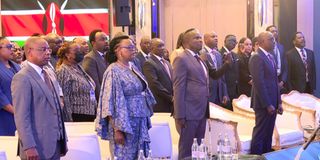
Front Row from left: Senate Speaker Amason Kingi, Chief Justice Marth Koome, Head of Public Service Felix Koskei, and PS State Department of Foreign Affairs Abraham Korir Sing'Oei during day one of Kenya’s inaugural Trust Summit in Nairobi.

Day one of Kenya’s inaugural Trust Summit in Nairobi focused on the need for meaningful public participation in government decision-making to build public trust.
Senate Speaker Amason Kingi, one of the keynote speakers, said public confidence in Parliament depended largely on how it discharged its legislative, oversight and representation mandates.
“How Parliament conducts its legislative mandate will either win or lose the trust of the public. Likewise, depending on how Parliament implements or undertakes its mandates of oversight and representation, it may either win public trust or lose it,” he said.


Mr Kingi questioned whether laws passed by Parliament reflected the day-to-day challenges faced by Kenyans, warning that legislation disconnected from citizens’ needs risked eroding public confidence.
“The moment Parliament passes laws that do not inform or correspond to the challenges of the people, that is the beginning of losing trust. The public must be at the centre of our legislative journey, our oversight journey and our representation mandate,” he said.
He said public participation was one of the core values introduced in the 2010 Constitution to address the exclusion of citizens from the legislative process.
The Constitution, he added, sought to change a system in which the government made decisions without necessarily involving the public.
Mr Kingi said the government derived its legitimacy from serving the people and risked losing it when it failed to meet their needs.
To strengthen public participation and rebuild trust, he said the Public Participation Bill had been passed by the National Assembly and was awaiting consideration by the Senate.
“The Public Participation Bill is now pending in the Senate. I believe that once the Senate resumes, we shall give it priority so that we can have a public participation law that provides a legal framework for involving citizens in policymaking and lawmaking,” he said.

Front row, from left: Erastus Ethekon, Senate Speaker Amason Kingi, Chief Justice Martha Koome, Head of Public Service Felix Koskei, PS for the State Department of Foreign Affairs Abraham Korir Sing'Oei.
The proposed law would establish guidelines to ensure public participation was meaningful rather than a procedural formality.
Mr Kingi said public bodies had previously issued notices for participation meetings as late as a day before the exercise, then proceeded regardless of whether citizens attended.
“Notice must be adequate. And whatever input citizens make into a Bill or policy must be incorporated into it,” he said.
During a panel discussion on public participation, freedom of expression and citizen engagement, other speakers called for broader consultation exercises.
They urged organisers to ensure people from different parts of the country were represented and that proposals submitted by participants were acted upon where appropriate.
The panellists also called on Parliament and government agencies to explain why proposals were rejected, saying this would help citizens understand how their views had been considered and strengthen trust in public institutions.
The Bill was sponsored in Parliament by Rarieda MP Otiende Amollo and Ainabkoi MP Samuel Chepkonga.
Its initial version proposed a fine of up to Sh500,000 for any state officer who failed to seek public views. However, MPs removed the penalty and instead opted for a provision allowing the High Court to invalidate laws passed without public participation.
The Constitution does not prescribe a minimum number of people who must participate in public consultation exercises. In cases where courts have invalidated laws for failing to meet public participation requirements, the focus has included the adequacy of the notice period rather than the number of participants alone.
The Senate is scheduled to resume sittings on November 3, 2026. Mr Kingi told the summit the Bill would be among the first items prioritised when the House resumes.
If approved by the Senate, the Bill will be forwarded to President William Ruto for assent.
Follow our WhatsApp channel for breaking news updates and more stories like this.