A tale is told in Greek mythology of Cassandra, the daughter of King Priam and Queen Hecuba of Troy, who was gifted and cursed at the same time by Apollo, the god of prophecy.
The princess was given the ability to utter true prophecies, but with a catch – nobody would ever believe her.
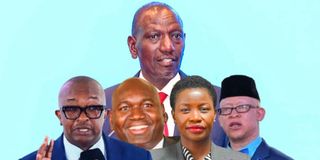
For years, the government has been at war with its own numbers, as a group of senior State bureaucrats and politicians dispute figures and information compiled by some independent taxpayer-funded oversight and accountability institutions.
And much like Apollo, that group of bureaucrats and politicians have attempted to bestow the same gift and curse on the independent offices by calling their compiled data a pack of lies aimed at casting the Kenya Kwanza administration in a bad light.
There is a growing trend by State officers, including President William Ruto , to discredit official data if it’s not flattering. The latest official to dismiss figures in a report by a State agency, under his own docket, no less, is Education Principal Secretary Julius Bitok.
Principal Secretary for the State Department for Basic Education Prof Julius Bitok addresses the participants at the 3rd KNEC Symposium in Nairobi on May 4, 2026.
Photo credit: Dennis Onsongo | Nation Media Group
On May 5, Prof Bitok disowned a report prepared and made public by the Kenya National Examinations Council (Knec).
While the report was published with a Knec letterhead, Prof Bitok claimed that it did not have any official backing.
The PS argued that the government had achieved a 98 per cent learner transition rate to Grade 10, but did not make public the source or methodology for arriving at that score.
Knec, whose report Prof Bitok disowned, is overseen by the Education ministry.
“They have no exact official backing. We are doing our own verification to get to the bottom of the matter. There is a possibility that some of those figures are being misinterpreted. If there are learners who have dropped out, we will work closely with NGAO structures to ensure they are brought back to learning,” Prof Bitok said.
Four days earlier, Housing PS Charles Hinga had disputed the Kenya National Bureau of Statistics (KNBS) data about the jobs created under the taxpayer-funded housing project.
Contradicted multiple claims
The genesis of the row was the Economic Survey 2026 released on April 29, which had revealed that the entire construction sector had created 77,000 jobs since 2023.
This included various sub-sectors like roads, dams, railways and the Affordable Housing Programme, among others.
The figure contradicted multiple claims by Dr Ruto and the Housing PS that the Affordable Housing Programme alone had created over 428,000 jobs.
Photo credit: Nation Media Group
When the Nation contacted Mr Hinga on the contradictory figures, he faulted KNBS, arguing that the statistics body did not dispute a survey procured by the State Department for Housing, which put the number of jobs at over 428,000.
Mr Hinga accused KNBS of malice, despite the fact that figures in the Economic Survey were derived from government institutions, including the State Department of Housing.
“KNBS does not know what they are doing. They were part of this report (the Grant Thornton survey). KNBS didn’t even consult the drivers of these programmes, so I read malice from them, and they need to be called out,” Mr Hinga said.
The survey Mr Hinga was referring to was prepared by Grant Thornton, a private tax advisory and consultancy firm with an arm in Nairobi.
The Principal Secretary, State Department for Housing and Urban Development, Charles Hinga, speaks during the Smart Cities Forum in Nairobi on October 30, 2025.
Photo credit: Wilfred Nyangaresi | Nation Media Group
President Ruto was also not amused by media coverage of the Economic Survey, which showed that Kenya’s real gross domestic product (GDP) – the value of all goods and services produced locally after factoring in inflation – had grown by 4.6 per cent.
That was the slowest growth rate in recent times, excluding the years in which the Covid-19 pandemic triggered a partial economic shutdown.
Speaking in Bomet on April 30, Dr Ruto dismissed the findings, insisting that his administration has achieved unprecedented economic growth since assuming office in 2022.
“You can have as much debate as you want. You can write as many headlines as you want. You can release as many reports as there are. But the truth will not change,” Dr Ruto said.
The report, in part, revealed a fraud scheme draining millions from the national insurer through fraudulent billing. Records reviewed by Ms Gathungu’s team showed how, in some instances, the same individual received four separate heart surgeries.
In other cases, the same woman had been recorded to have given birth 10 times on diverse dates within the same year.
When addressing a joint Parliamentary Group meeting of the UDA and ODM parties at State House on March 10, President Ruto dismissed Ms Gathungu’s findings as “propaganda”.
In October 2023, Controller of Budget Margaret Nyakang’o revealed that records showed that several State officers had received huge salary increments, which did not reflect in their bank accounts.
Ms Nyakang’o’s own salary had, as per the records, been tripled, yet she was not receiving the increments.
In December 2025, she was arrested for allegedly colluding with 10 other individuals to run a Sacco without a licence.
People’s Liberation Party leader Martha Karua, at the time, said the timing of the arrest indicated it was intimidation.
“Timing suggestive of harassment and intimidation, especially coming after her revealing testimony at Bomas. Those siphoning government money at Treasury are scot-free, but the whistleblower is under arrest,” Ms Karua wrote on social media platform X.
West Mugirango MP Stephen Mogaka successfully stopped Ms Nyakang’o’s prosecution after filing a case at the High Court, in which he linked the arrest to the Controller of Budget’s revelations.
That war is not new. For leaders in the Kenya Kwanza administration and the oversight and accountability institutions, they are simply the new cast in an ongoing play.
On October 18, 2016, President Uhuru Kenyatta was addressing an anti-corruption conference at State House when he tore into then Auditor-General Edward Ouko.
Mr Ouko was investigating the flow of money from the 2014 Eurobond borrowings, which Kenya had floated to finance infrastructure.
The Auditor-General could not find evidence that the money had been used as intended, yet hefty repayments were approaching at a time Mr Kenyatta’s administration was considering a second Eurobond.
The former President claimed that all the money had been put into intended use, without providing any evidence of the same, yet Mr Ouko’s office had made public evidence backing its investigation.
“Na huyu anasema anataka kwenda kuinterrogate (And this man here says he wants to interrogate) the Federal Reserve Bank of New York. Ngai! (My God!) Anyway, you know, you sit back and ask yourself, are we being serious in what we’re doing?” Mr Kenyatta said in part.
Four days later, it emerged that Mr Ouko was to be prosecuted, after investigation, alongside three senior managers in his office for allegedly inflating procurement prices for a vault from Sh18 million to Sh100 million.
Four months later, there was no evidence of Mr Ouko’s involvement with the tender or any wrongdoing, hence he was cleared by then Director of Public Prosecutions Keriako Tobiko.
Micro Small and Medium Enterprises (MSME) Development Principal Secretary Susan Mang’eni had also on June 19, 2025, attributed audit queries on Sh8 billion Hustler Fund spend to “dirty records”.
“The data used in the audit report contained a significant extraction error because the audit was not done in a live environment. We have since cleaned up the records, and all individuals sampled have verified identity cards and telephone numbers,” the PS said.
On Friday, government spokesperson Isaac Mwaura defended the President, stating that Dr Ruto receives data on a real-time basis, hence his information is more up to date than that of other institutions.
Government Spokesperson Isaac Mwaura addresses journalists at his office on Wednesday, November 15.
Photo credit: Pool
Dr Ruto, Mr Mwaura maintained, has the final word on such information.
“Data from other institutions may not be up to date, as this could have a one-year lag. It follows that the rule of thumb is to go with the figures that the President declares, as he is the final authority. He gets briefings from multiple sources beyond any other person or institution,” Mr Mwaura said.
Some of the oversight and accountability institutions, the government spokesperson added, have no access to critical information which could alter their findings.
“It is also true that some of the reports are made without reference to certain aspects of information that some of the office holders aren’t privy to. This is a great factor to consider,” Mr Mwaura further said.
Public Service CS Geoffrey Kiringa Ruku.
Photo credit: Dennis Onsongo| Nation Media Group
Public Service CS Geoffrey Ruku and State House communications officers did not respond to the Nation’s queries on the war of words and its impact on public trust and confidence in government institutions.
Institute of Economic Affairs (IEA) CEO Kwame Owino said in an interview that the taxpayer-funded oversight and accountability institutions draw their authority from legislation, and the information and findings they compile can be verified.
Mr Owino holds that politicians and some State bureaucrats should not take issue when oversight and accountability reports debunk their information, as they have the ability to contact the relevant authors directly.
“When the Office of the Auditor-General publishes its findings, the traceability is one thing that makes those offices more credible. The problem is the veracity we place on political statements. The transparency (reports by OAG, COB, and KNBS) is changing the discourse. Politicians get ahead of themselves when trying to impress Kenyans and throw figures around.
“The KNBS is a statistical agency established by law. It is not sufficiently funded to provide enough statistics that citizens need. We (IEA) have held KNBS to be credible. When you ask how they arrived at a figure, they will disclose the methodology and how they compiled the data. They have no political incentive to give wrong numbers. The statistical agency is not perfect, but it is highly valued, even across Africa,” Mr Owino said.
Curiously, as senior government officials disown data from the Auditor-General, Controller of Budget and KNBS, the three continue to receive stamps of approval from reputable global institutions like the World Bank, IMF, United Nations and others who routinely use their data in making decisions regarding Kenya.
For instance, the IMF in 2024, when doing a review with the aim of lending Kenya money, concluded that the Auditor-General’s office is broadly aligned with international standards.
The only fault in Ms Gathungu’s docket was delayed audit timelines, something that the Office of the Auditor-General has repeatedly blamed on insufficient funding from the national government.
“When there is a dispute in any ministry, the CS is the final authority on such a matter. He will give the position of his ministry as final. The same applies to the whole of government when the President communicates,” Mr Mwaura added.
Mr Owino argued that State officers who are dissatisfied with figures from other taxpayer-funded institutions have access to the heads of those bodies, hence can seek clarifications and engagement on disputed data.
“(For those disputing the data) The Office of the Auditor-General, KNBS and others are just a phone call away,” Mr Owino said, maintaining that the only solution to the intensified war of words is accountability.