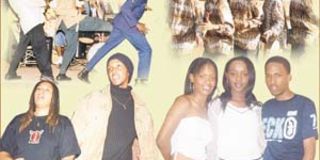
Going separate ways (clockwise from above): the Necessary Noise duo of Nazizi and Wyre, both of who are currently seeking solo careers: the comedy group, Redykyulass, who have performed as a group and as individuals; Kayamba Africa, some of whose members left to form Kayamba Fiesta; and Coca-Cola popstars Sema
Music groups appear to be getting increasingly prone to split-ups, with all or some members of renowned outfits going their separate ways.
The trend started with "Wasee wa Githurai", Mr Googz and Vini Banton, who were followed by K-South Flava, Kayamba Afrika, Circute and Joel, and the original Wakimbizi trio of Morris Masheti (Mariko), Henry Masheti (Filter) and Andrew Mbogho (Andre).
More recently, Lyrical Erico (Eric Waseka), Shanky Radics (Kevin Were) and Tyrical (Oscar Ivutsa) are said to have fallen out over ownership of the popular track, Bambika . And the relationship between Coca-cola popstar members Pam and Sanaipei is reportedly on the rocks, while Nazizi and Wyre are said to have temporarily parted ways to pursue solo careers.
The question is whether there is any strength (or weakness) in numbers. Are the break-ups mere publicity stunts, or is being a solo artiste better and more lucrative?
Opinion is divided. According to The Stage , an American entertainment publication, "bands are the most saleable commodity in the light entertainment industry and are also the breeding ground for many solo performers, duos and vocal groups".
Comedian KJ (John Kiarie) shares this view. He has performed alone, as well as with Nyambane (Walter Mong'are) and Tony Njuguna as Redykulass. Says he: "As a group, you have a higher bargaining power, are versatile and everybody in the group adds indispensable value."
For cohesion in a group to be sustained, all members have to be on an equal footing. Cracks in an "art-marriage" appear when some members of a group assume more responsibility and begin lording it over the rest.
A case in point is that involving music writer and rapper Andrew Mbogho (Andre), formerly of Wakimbizi. In an earlier interview with Review , he lamented exploitation by colleagues in the group, "I would only accompany them for the recording and for charity shows like Aids campaigns but whenever they were invited for serious performances, they would not inform me." He said he walked out "to make music alone after going through difficult times".
But making music alone is no easy task, as solo artistes will tell you."It is very challenging," says R&B crooner Harry Kimani. "You have to programme yourself for many tasks."
Thomas
But with the extra sweat comes what KJ calls, "the whole loot".
There are some advantages in being in a group. "As a group, you are better able to deal with stage fright. Besides, music is like business. You share ideas," says Angela Mwandada of the group Tatuu.
But what happens when differences arise? "We go by the majority," Mwandada says.
However, while groups spawn careers, the inverse can sometimes be true, such that a group's strength depends on a single member.
When Franco, leader of TP OK Jazz band died in 1989, a split resulting from a misunderstanding between his family and long-time band member Lutumba Simaro Massiya saw the musician quit to form Bana OK together with Josky Kiambukuta and Ndombe Opetum. But Bana OK never came anywhere near Franco's TP OK Jazz in terms of musical success.
Tanzanian band Super Volcano band suffered a similar fate. Following the death in 1979 of its founder, Tanzanian Mbaraka Mwinshehe, some members left and formed Orchestre Les Volcano. It was led by Charles Ray Kaabe. But not even the band’s most popular release, Hakuna Dawa Ya Mapenzi, could equal Kifo , the popular track by the original Orch Super Volcano. But perhaps the most remarkable break-up in the history of entertainment was that of the Beatles in April, 1970. The quartet of John Lennon, George Harrison, Paul Mc Cartney and Ringo Starr was so great together that, notes one entertainment commentator, "they became spectacularly mediocre apart". Lennon started taking drugs, McCartney could no longer write music while Harrison was sued for plagiarism.
So what the secret to keeping a group together? KJ says that their personalities have to complement each other. "We (Redykulass) started working on a common purpose even before we became friends. We appreciated each other’s talents even before we became friends and united for a common purpose."
Granted, there are artistes who’ve broken away from groups to pursue solo careers and achieved remarkable success. A good local example is hip-hop singer-turned-gospel artiste Bamboo (Tim Kimani), who started his music career with the group K-South. After breaking away, Bamboo launched a solo career that culminated in the release of the popular tracks Kapuka and Compe .
"I learnt a lot about the industry and gained experience while with K-South," he says. "While, it's true that I’ve achieved greater success as a solo artiste, I miss being in a group. I still receive a lot of backing from colleagues out there." He recently turned to gospel and is planning to launch his debut album this month.
Beyonce Knowles, lead singer of the all-girl group, Destiny's Child, had her most successful music run as a solo artiste. She stole the show at the 2004 Grammys, winning five of the coveted awards and tying the all-time record for most Grammys won by a female artist.
In an interview with Oprah Winfrey thereafter she said: "It feels good because sometimes you need that time to get to know yourself and to challenge yourself. When you're in a group, you depend so much on each other that sometimes you need to say, ‘I can do this,’ and know your strengths, what you need to work on and what you need to learn. Being in a group, you share the same likes and food and everything because you're with each other all the time."
The allure of going solo seems particularly pronounced among gospel musicians. Remember the 1980s and early 1990s, when choirs such as Muungano Choir, Kwaya Ya Uijilisti, St Joseph Migori and Prisons Choir ruled the air-waves? Not any more. Though they are still strong in their own right, the current fad is solo gospel artistes, as exemplified by Esther Wahome, Jemimah Thiong'o and Rose Muhando are solo gospel artistes who exemplify this trend.