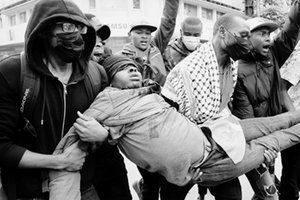
As Ian Opango’s family made the long journey from Kakamega to Nairobi on Tuesday, the grief in their hearts was heavy.
They were not just travelling to confirm how their 17-year-old boy died, but they were also mourning his grandfather, Henry Shikanda, who collapsed and died that same morning, unable to bear the news that his grandson had been shot dead by the police.
Ian Opango, 17, who was shot dead in Ong'ata Rongai.
Photo credit: Pool
For Ian’s father, Jackson Juma Opango, the pain is unimaginable after losing both a son and a father.
“This death is very difficult. My father died of shock when he heard Ian had been killed. My son was shot by State security officers. If this government is humane, let it help me take their bodies back home to Kakamega,” Juma said outside the Nairobi Funeral Home, as he struggled to hold back tears.
Beside him, Ian’s grand-uncle Harrison Chitechi Sabatia spoke with disbelief about the young life snuffed out, and the heartbreak in the family.
“Opango was so young and he was just visiting his aunt here in Rongai. He had been in Nairobi for barely two months, and now he is gone. The old man couldn’t take it as he was already struggling with a stroke. The news broke him completely. He died the same morning we left for Nairobi,” he said.
Just a few steps away stood Merceline Otieno Kesa, the widow of Fred Wanyonyi, the guard shot dead while at work at Kenya Power offices in Parklands.
Fred Wanyonyi, the guard shot dead while at work at Kenya Power offices in Parklands.
Photo credit: Pool
Kesa stared blankly at the post-mortem results. She says the paper may be the only piece of “closure” she might ever get. Her husband died of a gunshot wound that tore through his abdomen and spine. But the bullet that ended his life is nowhere to be found.
“How do we find justice when the bullet is missing? My husband was shot in the stomach. There is no exit wound but where is the bullet? How will we ever know who did this?” She asked.
Wanyonyi had just been promoted two months before his death, and together with his wife, they were planning to buy a piece of land next month, their first big step toward a secure future.
A family friend, Oscar Wanjala, is in disbelief. “We smell foul play. How can a bullet vanish inside a body? Someone must answer for this,” he said.
As the grief-stricken families waited for answers, David Mwangi’s family braced themselves for another night of worry.
David Mwangi, 19, who was allegedly shot dead by police on June 25, 2025 during the Genz anniversary protests
Photo credit: Pool
The 19-year-old was shot in the head in Imara Daima last Wednesday, allegedly by a senior police officer.
“This has broken us. We just want the truth about who killed David and why. He was only 19, he deserved a future, not a coffin. We will be here tomorrow (today) for the postmortem,” said John Mwangi, the deceased’s uncle.
At Kenyatta National Hospital, three more families held each other up as their loved ones lay cold on autopsy tables.
Abdul Juma, who died in Pipeline and Elijah Muthoka, who was killed in Githurai, both suffered severe head injuries caused by blunt force trauma.
The youngest victim, whose postmortem was still ongoing, was a 14-year-old girl from Shauri Moyo. Her tiny body lay under the hospital’s harsh fluorescent lights, a tragic price for daring to be young and alive on the wrong day.
Vocal Africa Executive Director Hussein Khalid, who spoke at the Nairobi Funeral Home, condemned the killings.
“Two of the victims were shot in the head. But where are the bullet? How can we get justice if evidence disappears inside the mortuary?” He asked.
He demanded that the Independent Policing Oversight Authority (Ipoa) stop dragging its feet and bring those responsible to justice.
“We have lost many young lives ranging from 14 to 22 years old. These were youth full of dreams. And all we get is body after body with no answers. If IpoaA does not act, what hope do we have?” he posed.
He also directed his anger at the government particularly Interior Cabinet Secretary Kipchumba Murkomen whose order for police to shoot-to-kill protesters near stations shocked many Kenyans.
“It was reckless. In a country already drowning in tears from police killings, telling officers to shoot to kill is a death sentence for the youth. We are saying: enough is enough,” Mr Khalid said.
The six post-mortems conducted yesterday are only part of a growing tragedy. They are among the 19 confirmed deaths from last Wednesday’s protests when Kenyans in 27 counties took to the streets to mark the first anniversary of the June 25, 2024 anti-Finance Bill demonstrations—the same protests that saw brave young people storm Parliament in fury and desperation a year ago.
On Tuesday, Opposition leaders pledged to support families affected of those killed or injured by police in the Gen Z protests.
This as they also renewed calls for the resignation of Interior Cabinet Secretary Kipchumba Murkomen.
Wiper Party leader Kalonzo Musyoka and Democratic Action Party’s Eugene Wamalwa made the pledge during a visit to the family of Boniface Kariuki, the mask vendor who was shot in Nairobi on June 17 and died on Monday.
“We have already instructed our lawyers [to] ensure that dignity is restored to the victims of the poor leadership of the Kenya Kwanza government.”