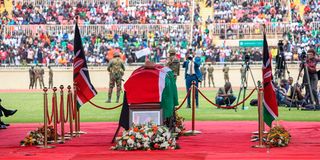
Now Odinga’s swift burial has reopened important conversations about the intersection of tradition, modernity, and personal will. Could this mark the beginning of a quiet end of Luo funeral rites to ease the financial excess, and break from the rituals that sustain cultural identity and collective healing?
Bishop of the Anglican Diocese of Bondo, the Right Reverend Professor David Hellington Kodia, during the state service of Former Prime Minister Raila Odinga at Nyayo National Stadium on October 17, 2025.
Photo credit: Lucy Wanjiru | Nation Media Group
According to Luo tradition, a man of Odinga’s standing is meant to be honoured with a fitting and ceremonious send-off. This typically includes rituals such as ‘Tero Buru’, performed to ward off bad omens, and ‘Tero Yuak’, a mourning rite led by the widow or mother to signal to the community to begin formal grieving.
Maurice Onyango, a sociologist, argues, “in Luo culture, people who are buried quickly are usually those without children, because there’s no one to wait for. But a leader, a family man or a mentor, someone who has shaped the nation’s political thinking, deserves time for people to mourn them properly.”
“Like marriage or initiation, they are guided by norms that must be observed, not only as a sign of respect, but also as a means of preserving the culture. Elders often gather to discuss which burial rites should be observed, based on the deceased’s status. This is why many were shocked when the idea of a 72-hour burial was announced. Traditionally, it is society that dictates how rites should be performed, not the individual; the community prescribes what needs to be done and the appropriate time for preparations.”
ODM party leader Raila Odinga during interview at his Karen home in Nairobi on November 27, 2020.
Photo credit: File | Nation Media Group
The sociologist also emphasises the psychological impact of shortening the mourning period. “In Luo tradition, official mourning starts on the day of burial, three days for women and four for men. Compressing this time leads to disorder and confusion. It creates an anti-climax.”
Additionally, he cautions that a hurried burial can lead to speculation and disbelief.
“People will wonder what we are trying to hide. Why the rush? People need time to absorb and accept what has happened before they can act. Without that time, chaos ensues, like people rushing to airports in disbelief.”
However, former Alego Usonga legislator, Sammy Weya, a close confidant of the late Odinga, told Nation that the expedited burial was entirely in keeping with the former Prime Minister’s wishes.
“Odinga detested the wastefulness often associated with funerals. He frequently spoke about the financial burden that elaborate ceremonies placed on grieving families. This is why he advocated for swift burials. In death, as in life, he has led by example,” Mr Weya said.
ODM party leader Raila Odinga speaks to the Sunday Nation at his Karen home, Nairobi on August 05, 2020.
Photo credit: Joan Pereruan | Nation Media Group
Mr Weya further reflected on the late Odinga’s reasoning. “He questioned why families would hold onto bodies in morgues for weeks, accumulating bills and feeding guests endlessly - only to be left in financial ruin.”
According to Mr Weya, the Orange Democratic Leader (ODM) admired the Islamic tradition of interring the dead within 24 hours. “He often remarked that, in matters of burial, Islamic customs were the most dignified and compassionate. Though not everyone in our community shared his view, I believe his actions will set a precedent others might follow.”
However, Mr Onyango warns against oversimplifying funerals as mere economic waste, arguing that funerals are a deeply communal affair, a shared responsibility rather than a burden shouldered by a single family.
“There has never been a time in Luo history when significant ceremonies were considered affordable,” he says. “Even dowry payments were collective efforts. Some people nowadays say that funerals are too expensive or take too long. But in traditional Luo society, these events were managed collectively, with community members donating livestock, food, and labour. The financial burden was shared, rather than falling solely on one family.”
Mourners gather at the Kasarani International Complex, Nairobi to view the body of Kenya's former Prime Minister Raila Odinga on October 16, 2025.
Photo credit: Reuters
He adds, “one person used to bring a bowl of food, another some grains, young people offered labour and elders might provide wisdom. Even if the deceased was poor, the community would ensure that they were buried with dignity. That’s what it means to pay last respects. Even when we appeal for donations, it's not because families can’t afford it; it's a way to bring people together so everyone can have the final opportunity to pay their respects.”
However, the concept of swift burials is not alien to Luo customs. Philip Otieno, 77, an elder from Lifunga Kobiero in Ugenya, recalled that in earlier times, before the advent of modern mortuaries, bodies were interred within three days.
“In the past, it didn’t matter who you were, rich or poor, elder or child, the body was never kept longer than three days. Modern preservation techniques have changed our customs, but perhaps we’ve forgotten the wisdom of our ancestors,” he says.
The military vehicle carrying the body of former Prime Minister Raila Odinga arrives at Nyayo National Stadium in Nairobi for the state funeral service on October 17, 2025.
Photo credit: Lucy Wanjiru | Nation Media Group
Mr Otieno lamented the shift toward elaborate funerals that leave families financially drained. “Today’s Luos believe in extended mourning and lavish celebrations of life. But that was not our way. I’m glad Odinga is reminding us of our roots,” he says.
Christopher Awuondo, 75, from Kagan in Homa Bay, echoed similar sentiments. “Burials should be swift. In the old days, children were often buried the same day. Adults, at most, after three days.”
However, not all agree. William Owino, 53, from Alego Kadenge in Siaya County, voiced concern that the 72-hour timeline curtails essential cultural rites.
“That’s far too short; families and communities need time to gather, to grieve, to say their goodbyes properly. Imagine saying farewell to someone of such magnitude in just three days,” he quipped.
Mr Onyango, the sociologist, acknowledges that there are families who might take a cue from the swift burials. “If Raila, such a prominent person, could be buried within 72 hours, why can’t my father, or even I? However, I don’t believe it will completely change how Luo funerals are conducted. Each family will still act according to its own circumstances.”
Supporters of the late ODM Party Leader Raila Odinga mourn him along Ngong Road in Nairobi on October 15, 2025.
Photo credit: Bonface Bogita | Nation
He argues that as culture evolves, it should with meaning. “We shouldn’t lose the sense of community, even as we adapt to modern realities. This 72-hour burial will make people think about what truly matters, the ritual or the respect behind it,” he says.
He is skeptical about cremation. “Cremation is not a Luo practice,” he says, “every community has its own rationale for how it handles the dead. Among the Maasai, for instance, bodies were once left for wild animals, but this had consequences, such as losing land, because burials also signify ownership. Culture carries deep symbolic meaning; it’s not something we can abandon just because it seems easier.”