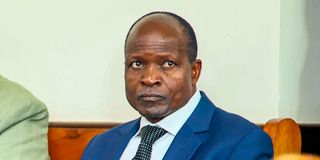
The anti-graft body and the Office of the Director of Public Prosecutions (ODPP) clashed in court on Friday over plans to withdraw a criminal case against former Migori governor Okoth Obado and 10 others.
The DPP told Principal Magistrate Charles Ondieki that the parties, including the accused persons and the Ethics and Anti-Corruption Commission (EACC), had held four meetings exploring an alternative dispute resolution mechanism.
The court heard that the plea agreement was informed by a deal entered into between the EACC and Mr Obado in June last year, under which he forfeited eight properties and two vehicles as a condition for dropping two civil cases against him, his co-accused, and their companies.
However, EACC lawyers objected, saying they had not signed the plea agreement because they were never served with a draft to enable them to seek instructions from their superiors.
In his ruling, Mr Ondieki observed that although it is not mandatory for the DPP to share a draft plea agreement with the EACC, the practice has previously received judicial approval.
He added that the EACC could not be faulted for requesting the document, given its participation in the negotiations.
“Accordingly, this court stays determination of other rival questions of law raised and directs that within three days, the DPP formally shares the plea agreement filed in court with the EACC to deal with it in the manner EACC deems fit, but in any event, within a period of 21 days,” said the magistrate.
Mr Obado and his children — Dan Achola Okoth, Susan Scarlet Akoth, Jerry Zachary, and Evelyne Adhiambo — have been charged with conspiracy to commit economic crimes and money laundering.
Others charged are Jared Peter Odoyo, Christine Akinyi Ochola, Joram Opala, Patroba Ochanda, Penina Auma, and Carolyne Anyango, alongside their companies.
The court was told that negotiations between the parties began on April 22 and the last session was held on August 28 this year with a view to settling the case.
Through his lawyer Kioko Kilukumi, Mr Obado said he had forfeited properties worth Sh235.6 million to the State — three times the Sh73.4 million that the EACC claimed he had misappropriated.
The forfeited properties include two motor vehicles, a house in Loresho, a commercial block in Suna East, Migori, two five-storey residential blocks with 40 units in Migori, two apartments in Greenspan, Nairobi, a maisonette in Greenspan, and a residential property in Kamagambo, Migori.
On its part, the EACC, through lawyer Mary Ng’ang’a, said it had requested a copy of the draft plea agreement, as is the practice between the two institutions, but the request was rejected. She added that the commission was unaware of the document’s contents.
“Our issue is simple: we should be served with the agreement so that we can seek instructions, and if required to sign, we can do so once we receive instructions,” she said.
The EACC further argued that, as the complainant and the body mandated to combat corruption, it was best placed to provide context in the plea agreement process.
It maintained that the civil consent had no bearing on the ongoing criminal case, and if the defence wished to rely on it, they should introduce it as evidence during the trial.
Mr Kilukumi countered that the EACC was not a party to the criminal proceedings and was attempting to usurp the powers of the DPP.
He said the Constitution vested authority to withdraw charges solely in the DPP, in consultation with the accused persons and the court.
“The ODPP, in exercise of its prosecutorial powers, cannot act under the control or direction of any authority. The EACC is intermeddling in constitutional powers vested in the DPP,” he argued.
The lawyer further maintained that the claims in the civil and criminal cases were identical, and since Mr Obado had already forfeited assets valued at Sh235.6 million, the State had recovered far more than the amount in dispute.