Ethics and Anti-Corruption Commission (EACC) has urged a Nairobi court to reject an application by the office of the Director of Public Prosecutions (ODPP) to terminate graft charges against former Migori governor Okoth Obado and his associates.
In submissions filed in court, the anti-graft body maintained that there cannot be a plea negotiation or plea agreement where the prosecution’s sole intention is to terminate the trial.
The EACC added that the DPP’s application of section 87(a) of the Criminal Procedure Code (CPC) in a plea negotiation process is a misapplication of the law.
According to EACC, section 87(a) of the CPC is not applicable in plea negotiations, since if permitted by the court, it effectively terminates criminal proceedings.
The EACC said that plea negotiations, as provided in the CPC, contemplate a conviction on one's own plea followed by a judgment and a verdict on sentence.
“In view of the foregoing, we humbly submit that the attempt by the DPP to withdraw the criminal case under section 87(a) of the CPC under the guise of plea negotiations is an abused of the court process and this honourable court should disallow the same and reject the agreement in totality,” EACC said.
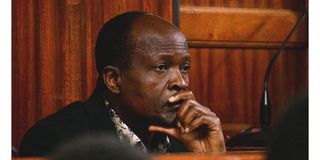
Migori Governor Okoth Obado.
Photo credit: File | Nation Media Group
The ODPP applied to terminate the case against Mr Obado and his children, arguing that the former Migori governor had forfeited the properties, which were the subject of the case, to the State.
EACC, however, objected to the arrangement saying corruption and economic crimes are matters of public interest and such cases should therefore be treated with caution and the seriousness they deserve.
“We respectfully submit that the plea agreement before court fails to meet the public interest threshold. Whereas plea agreement play an important role in the efficient administration of justice, efficiency cannot override legality, proportionality, and accountability and public confidence in the criminal justice system,” EACC added.
The EACC added that the proposed plea agreement substantially undermines the gravity of the offences the accused persons are charged with and allowing the agreement will erode public confidence and send a message that serious corruption and economic crimes can be resolved through undue leniency, thereby undermining deterrence.
EACC maintained that the negotiations between the commission, the ODPP and the accused persons collapsed since they were not being conducted in accordance with the law.
The anti-graft body said the recovery in a civil case cannot substitute the requirement for a factual admission of criminal liability.
The same can, however, be considered by the court during sentencing as a mitigating factor as provided for under section 1371 (2) (d), added the EACC.
The commission said the agreement with Mr Obado treats restitution as though it ‘cures the absence of a factual admission of guilt, which is a misapprehension of the law’.
“We submit that anchoring a plea agreement on restitution alone undermines the objectives of plea bargaining particularly, accountability, transparency and public interest- especially in anti-corruption matters,” the EACC submitted.
Mr Obado and his children- Dan Achola Okoth, Susan Scarlet Akoth, Jerry Zachary and Evelyne Adhiambo have been charged with conspiracy to commit economic crime and money laundering.
Former Migori governor Okoth Obado at the Milimani High Courts on July 14.
Photo credit: File | Nation Media Group
Others charged are Jared Peter Odoyo, Christine Akinyi Ochola, Joram Opala, Patroba Ochanda, Penina Auma, and Carolyne Anyango and their companies.
In September last year, the DPP and Mr Obado’s lawyers indicated that the parties had been holding talks with a view to withdrawing the case.
According to the DPP, the parties held meetings on four occasions to explore an alternative dispute resolution.
The court heard that the plea agreement was necessitated by a deal entered into by the EACC and Mr Obado in June last 2024, forfeiting eight properties and two vehicles, as a condition for dropping two civil cases against the former governor and other accused persons and their companies.
Mr Obado said he had forfeited properties worth Sh235.6 million to the State and that the assets were three times the amount the EACC was seeking from him.
The properties forfeited included two motor vehicles, a house in Loresho, a commercial block in Suna East, Migori, a two five-storey residential blocks with 40 units, still in Migori, two apartments in Greenspan, Nairobi, a massionette in Greenspan and a residential property in Kamagambo, Migori.
Mr Obado argued that the charges mirror the allegations contained in the civil suits, which have since been forfeited.
“It is our submission that contrary to the submissions by EACC, no provision in law bars the withdrawal of criminal charges under section 87 of the CPC in plea negotiations,” Mr Obado said.