The government is pressing to have refugee status granted a Turkish businessman, who has lived in Kenya for nearly two decades, revoked, which could pave the way for his deportation.
Kenyan authorities have informed the United Nations refugee agency that they intend to revoke the refugee status of Mr Osman Erdinc Elsek, who is battling criminal cases in court, the latest being terrorism charges.
Investigators say they traced his travel into areas of Somalia controlled by the militant group al-Shabaab and launched a forensic audit into financial flows through his Kenyan businesses, according to security officials and court documents reviewed by Nation .
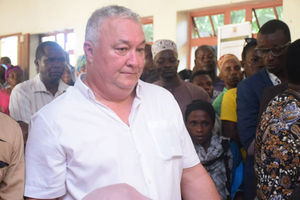
Lawyer Cliff Ombeta (right) with his Client, a Turkish national and businessman Osman Elsek (centre) when he Pleaded not guilty of being in illegal possession of a firearm and being a member of Al-Shabaab on February 3, 2026.
Photo credit: Kevin Odit | Nation Media Group
The move has triggered an escalating standoff between Nairobi and international refugee agencies over whether a man Kenyan authorities describe as a fugitive from justice and a national security risk can continue to claim protection under refugee law.
“The UN is flagging his refugee status, but we do not want him here. If the UN wants him, they can take him to another country — but not Kenya. Not in Kenya. If it is up to us, we will deport him to his country of birth,” said the official who requested anonymity to speak freely.
Security officials say the decision to seek cancellation of Mr Elsek’s refugee status is not the result of a single incident but the culmination of years of detailed police investigations that repeatedly brought the businessman into conflict with the law.
Turkish authorities have sought Mr Elsek since 2008, when he left the country while under investigation for financial crimes.
Court records and Turkish media reports show prosecutors issued warrants accusing him of fraud under Articles 157 and 158 of the Turkish Penal Code, offences that carry multi-year prison sentences, alongside document forgery under Article 204.
He also faces a charge of insulting the President under Article 299, a controversial law frequently used in cases involving critics of President Recep Tayyip Erdoğan and punishable by up to four years in prison.
Turkey’s largest newspaper, Hürriyet, reported in 2019 that officials regard Mr Elsek as a fugitive from justice rather than a political dissident.
Fled persecution or prosecution?
While the presidential insult charge forms part of the case, Turkish authorities have emphasised the fraud and forgery counts, suggesting a pattern of alleged financial criminality that predates his arrival in East Africa.
Mr Elsek disputes that characterisation. He has said he fled persecution after criticising Islamic cleric Fethullah Gülen. According to Turkish media, Turkish authorities say he fled prosecution. He has not returned to Turkey since.
Investigators say the concerns surrounding Mr Elsek in Kenya mirror the allegations that followed him out of Turkey.
Police records reviewed by Nation show some of criminal investigations spanning nearly two decades. In September 2023, police recorded a complaint involving threats to kill and assault under OB No 29/28/09/2023. He is also facing terrorism charges.
Despite the cases, Mr Elsek claims to continue to expand his business interests across East Africa.
He has told investigators and courts that he has built a property portfolio spanning Kenya, Rwanda and South Sudan, including hotels and real estate developments along the Kenyan coast.
The scale of that wealth has now drawn the attention of financial crime investigators seeking to establish the source of the funds.
“The question investigators are asking is straightforward,” said one official familiar with the inquiry. “How does someone holding refugee status accumulate an empire of that size, and where did the money originate?”
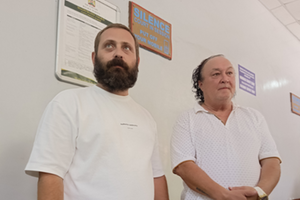
Turkish nationals Gokmen Sandikci (left) and Osman Erdinc Elsek before the Mombasa Law Court on January 14, 2026.
Photo credit: Brian Ocharo | Nation Media Group
The investigation intensified dramatically on January 13 this year, when Mr Elsek was arrested in Mtwapa following a confrontation with the convoy of a senior ODM politician.
During the altercation, officers recovered a licensed Glock pistol at the scene.
Days later, detectives from the Anti-Terrorism Police Unit executed search warrants at the Pearl Beach Hotel in Kikambala and Elsek’s residence in Mtwapa, and seized a second registered firearm — a Beretta pistol — along with laptops, vehicle documents and financial records.
“These are not minor infractions,” one investigator said. “When you look at the history — fraud allegations, sexual offences, threats to kill, assaulting a governor — it raises alarms everywhere.”
It was Mr Elsek’s travel history that transformed the investigation from a criminal inquiry into a national security probe.
Anti-terror detectives say they have traced multiple trips by him into parts of Somalia known to be under the influence of al-Shabaab, the militant group responsible for several deadly attacks in Kenya.
Combined with a forensic audit of financial flows through his businesses, the travel records triggered an investigation into possible terrorism financing and money laundering.
Investigators are examining whether any funds moving through his hotel and real estate businesses may have passed through networks linked to militant activity.
“The question is not only where he travelled,” one security source said. “It is whether the financial infrastructure around those businesses could be used to move illicit funds linked to militants who attack Kenya.”
During questioning, investigators say Mr Elsek withheld information about aspects of his travel and business dealings — behaviour described in internal reports as raising “credibility and risk concerns.”
Under the Prevention of Terrorism Act, a Mombasa court granted investigators 14 days to detain and question Mr Elsek while conducting interrogations.
“Any kind of investigations carried out will therefore require any suspect to be put in some control so that the investigations are not compromised. This however should not be done in a way that contravenes the rights of a suspect,” Senior Resident Magistrate David Odhiambo ruled.
The findings were later forwarded to the Department of Refugee Services, with the Anti-Terrorism Police Unit recommending that his refugee status be cancelled under Sections 17 and 18 of the Refugees Act.
Investigators argued his conduct is “fundamentally incompatible with the protection granted to refugees”.
“These crimes are a serious violation of the laws of Kenya and are fundamentally incompatible with the protection granted to refugees under refugees Act 2021. Therefore, we humbly request for the cancellation of the refugee status of the subject in accordance with section 17 (cancellation) and section 18 (revocation) of the Refugee Act 2021 since he is a threat to national security,” reads the letter dated January 20, this year, addressed to the Commissioner, Department of Refugee Service, requesting cancellation of the refugee status.
The United Nations refugee agency has objected, warning that deportation could expose him to persecution in Turkey.
“He cannot claim refugee protection to avoid facing criminal charges for fraud and forgery in his country,” one government official said. “That is not persecution. That is accountability.”
Senior officials at the Office of the President have reviewed the security file and signalled support for deportation.
“This is a man who slaps governors while carrying a firearm,” one official said. “The Kenya government has an overriding responsibility to protect the Kenyan public first and other interests later.”
Mr Elsek remains free on Sh1 million bond after charges were filed in court on February 3. His lawyers argue the allegations are fabricated and designed to facilitate the seizure of his properties.
But investigators say the pattern that has emerged across two countries and nearly two decades is difficult to ignore.
A businessman wanted in Turkey for financial crimes; a refugee who built a vast property empire in East Africa while repeatedly facing serious criminal allegations. And now a suspect in a terrorism financing investigation.
Security officials close to the investigation say the evidence presented leaves little room for doubt.
“Refugee protection exists for people fleeing persecution,” one investigator said. “Not fugitives who spend twenty years demonstrating they are a danger wherever they settle.”