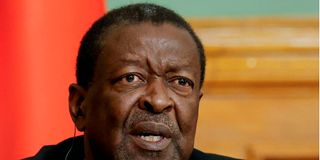
In Moscow, Russia
Kenyans who joined fighting activities abroad may not be eligible for government compensation, particularly if they violated contractual terms or were recruited outside official channels.
Speaking to journalists in Moscow, Russia, on Tuesday, Prime Cabinet Secretary Musalia Mudavadi clarified that the Kenyan government cannot compensate citizens reportedly fighting in Russia as their involvement was not part of a government-sanctioned operation and they were allegedly enlisted illegally.
Mr Mudavadi explained that these individuals were not deployed through official State channels and therefore their participation does not fall under any program or agreement that would make them eligible for compensation.
He noted that compensation frameworks typically apply to citizens serving in recognised national assignments, not to privately arranged foreign engagements.
“The Government of Kenya will not be compensating individuals who went to fight through illegal or unauthorised channels, as their contracts were neither reviewed nor approved by the State. The individuals acted independently and outside official government processes. Since the State was not a party to those agreements, there is no legal basis for compensation. Responsibility lies with the terms agreed upon between the individuals and the recruiting entities. The government cannot assume liability for arrangements made without its knowledge or authorization,” Mr Mudavadi said.
This follows comments by Russian Foreign Minister Sergei Lavrov who said that individuals who allegedly breach contracts cannot be compensated, as responsibility lies with the terms agreed upon.
“Each individual signed a contract that was meant to be fulfilled. If anyone chooses to terminate that contract prematurely, there will be no compensation,” Mr Lavrov said.
Members of the delegations, led by Russian Foreign Minister Sergei Lavrov and Kenyan Foreign Minister Musalia Mudavadi, hold talks in Moscow, Russia, March 16, 2026.
Photo credit: Reuters
On Monday, the Russian and Kenyan governments reached a mutual understanding that no Kenyans will be enlisted in the Russian special forces going forward.
“His Excellency has conversed with us on the issue of the welfare of Kenyans in Russia, particularly those involved in the special operation.And I want to make it clear that we have now agreed that Kenyans shall not be enlisted through the Russian Ministry of Defence they will no longer be eligible for enlistment. There will be no further enlisting,” Mr Mudavadi said at a joint briefing with Lavrov.
The Prme Cabinet secretary stressed that the enlistment of Kenyans into the conflict was not government-sponsored and individuals entered into contracts voluntarily.
“We do not support mercenary programs. This was not a Government of Kenya initiative,” he said.
The government has, however, facilitated the return of affected citizens, with 44 Kenyans already repatriated. Identities have been withheld to protect privacy as many are undergoing traumatic experiences.
According to government records, 252 Kenyans have been identified as involve with ongoing efforts to assist more, particularly those in hospitals or conflict zones.
Russian authorities have confirmed that ten Kenyans are reported missing or killed in action and have requested details of their next of kin to facilitate compensation.
“For prisoners of war, our ministry has positively identified two Kenyans, Evans Kibet and Macharia Willis Muniu, as being held by Ukrainian authorities. I requested Moscow to explore arrangements to transfer Kenyans held in Ukraine to Russia to facilitate subsequent repatriation to Kenya,” Mr Mudavadi added.
He said Kenya plans to seek parliamentary support to amend and strengthen laws governing recruitment agencies to prevent similar incidents in the future.
Through Kenya’s mission in Moscow, the government has established that 44 Kenyans have been safely repatriated, 10 are reported missing or killed, and a further 38 are hospitalized in Russian medical facilities under restricted access. About 160 remain actively involved in the operations.
According to a National Intelligence Service (NIS) report released last week, a total of 1,000 Kenyans have been recruited to fight for Russia in its four-year war against Ukraine.