A public officer is not immune from disciplinary action by the employer for unethical conduct or breach of integrity while in private spaces, a court has ruled.
The Employment and Labour Relations Court (ELRC) ruled that a public officer is bound by the constitutional commands to uphold ethics and integrity at all times, whether acting in his official capacity or in private.
Justice Onesmus Makau sitting in Nyeri said that the constitutional reality must begin to dawn upon every public officer in any rank of the public service that they cannot be "the devil in their private life and an angel while on public duty”.
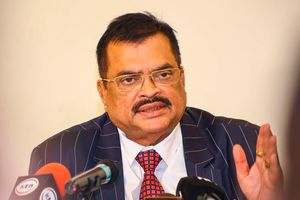
Justice Onesmus Makau of the Employment and Labour Relations Court.
Photo credit: File | Nation Media Group
He made the decision in a case where he found that unethical conduct by MrJames Irungu, an assistant accountant at Murang’a University of Technology (MUT), while away from his official duties, violated the Constitution, Leadership and Integrity Act and the University HR Policy on Staff Codes of Conduct and Ethics.
“That duality in character demeans the public office they hold and exposes the state organ they serve to ridicule,” ruled the judge, on July 23.
The judge added that the violations amounted to valid reasons for dismissing him from MUT employment. Mr Irungu was sacked on November 21, 2023, for misconduct against the Murang’a University Sacco (Musacco) while serving as the treasurer and later chairman, the court heard.
He challenged his termination from employment at the ELRC, seeking a declaration that it was unfair, wrongful and unlawful. The court noted that Mr Irungu was accused by his colleagues of abuse of office, mismanagement of the staff Sacco and failure to service Sacco loans, among other unethical conduct.
“There is no dispute that public entities investigated the allegations against the claimant (Mr Irungu) and found them to be true,” said Justice Makau.
The judge also noted that an inspection report by the Commissioner of Co-operatives was presented to the AGM of the Sacco in the presence of Mr Irungu, and it was unanimously adopted. Justice Makau noted that the report recommended that he should not hold any office in the Sacco because he had abused office, mismanaged finances and run down the Sacco.
“The claimant never challenged the inspection report as provided by the law. I find that the respondent (MUT) has demonstrated that it had the mandate to take disciplinary action against him for violating the Constitution, Leadership and Integrity Act and Schedule 3 of the University HR Policy Manual,” ruled the judge.
The judge added that the dismissal of the claimant was not unfair and unlawful in accordance with Section 45 of the Employment Act.
“Having found that the dismissal was lawful, I must add that the claimant is now disqualified under Article 75 (3) of the constitution from holding any other public office, let alone being reinstated to the one he was holding,” ruled the judge.
Mr Irungu had argued that he was dismissed for accusations not related to his employer, he was not running the Sacco alone and that all decisions were taken collectively by seven officials of the Sacco’s management committee.
He contended that all charges against him were related to the Sacco and that they were not related to breach of his terms of service or the HR Policy.
The claimant told the court that he served as the treasurer and chairman of the Sacco and that no accusations or allegations were ever brought against him by the Sacco or Co-operative office, except allegations by MUT which sought an in-depth audit on the Sacco financial affairs.
MUT told the court that it received distress complaints from its employees who are members of the Sacco, threatening to stop remittances due to mismanagement.
It said that as a stakeholder/agent of Musacco it reported the matter to the Sacco Regulatory Authority (Sassra) and the Department of Co-operative Development, Murang’a county government to investigate the allegations.
MUT said that in June 2023, it received a detailed report from the Department of Co-operative Development, Murang’a County, which was presented by an auditor to the Sacco Annual General Meeting.
The university said that the report passed several recommendations, including that the entire committee of nine officials be barred from serving as officials of the Sacco since they failed to exercise their mandate diligently.
MUT told the court that the claimant and the Sacco committee were found to have abused office, misappropriated and wasted Sacco funds, leaving it with no pay for retiring members.
It said that the actions amounted to gross misconduct under the Employment Act as it was contrary to the Public Officers Ethics Act, Leadership and Integrity Act, University HR Policy on Staff Code of Conduct and Ethics and Chapter six of the constitution. The university said that during the disciplinary hearing, the claimant declined to take a plea and defend himself.[email protected]