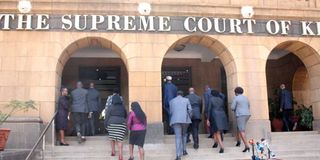
The Supreme Court has struck out a petition seeking constitutional interpretation and a declaration that the next General Election must be held in August 2026, not 2027.
The full bench of the apex court, led by Chief Justice Martha Koome, cited a lack of authority to determine the issues raised by the petitioners —Dr Owiso Owiso (lawyer), Khelef Khalifa (rights activist), and Ashioya Biko (lawyer).
The petitioners approached the apex court in April, asking the top judges to make a determination on the precise date of the next presidential election.
They wanted the court to find that elections should be conducted in August 2026, “which is the fifth year after the 2022 elections”, and not in 2027 as scheduled by the Independent Electoral and Boundaries Commission.
However, the court held that its jurisdiction is an exclusive and original one, which can only be triggered through a petition concerning the validity of a presidential election as provided under Article 140 of the Constitution.
"The said jurisdiction is sacred and cannot be invoked to address pre-election disputes, including the determination of the date of the next presidential election as is alleged by the applicants," said the Supreme Court judges.
Aware that the question relating to the date of the next general election is in the realm of interpretation and application of the Constitution, the court noted that it was the High Court that held such original jurisdiction.
They added that the petition was filed unprocedurally. This is because the petitioners lodged the petition and then sought the court's authority to file and admit the same for hearing since it raised a dispute relating to presidential elections.
"Turning now to the purported procedure of grant of leave to admit a petition as prayed for by the applicants, we wish to state from the onset that such a procedure is alien to the Rules of this Court. We say so because we do not know how a party can file a petition, then simultaneously seek leave to file the same petition which has already been received and admitted as filed by this court," said the judges.
"The absurdity of such a procedure is obvious to us, and in any event, none of the constitutional and statutory provisions cited by the applicants can properly grant this court the jurisdiction to grant such leave," they added.
The petitioners argued that the Supreme Court had jurisdiction to admit and hear the petition as it related to the date of the next presidential election and as such falls within the jurisdiction of this Court under Article 163(3)(a) of the Constitution.
It was their case that conducting the next election on any date other than the second Tuesday of August in the fifth year following August 9, 2022, would amount to an unconstitutional extension of President William Ruto’s term.
In their computations, the next presidential elections after the 2022 ought to be held at the start of the fifth year of the current presidential term, which is August 2026, not after the fifth year of the said term, which is August 2027.
They argued that uncertainty over the election date could create legal challenges, thus requiring the guidance of the Supreme Court.
The petition was opposed by the Attorney-General, the Independent Electoral and Boundaries Commission (IEBC) and former Prime Minister Raila Odinga.
The AG and IEBC were listed as respondents to the petition, while Mr Odinga was named as an interested party. They raised separate preliminary objections calling for dismissal of the petition.
For its part, IEBC argued that the original jurisdiction on the interpretation and application of the Constitution is vested on the High Court and the Supreme Court could handle the matter while sitting in the appellate process.
"The applicants ought to initiate proceedings regarding the date of the next general election at the said court and not this court," said the IEBC, emphasizing that a court acting without jurisdiction acts in vain and must down its tools the moment it becomes apparent that jurisdiction is lacking.
The AG argued that the petition was an abuse of the court process as the petitioners were essentially seeking the court’s Advisory Opinion without the requisite locus standi.
For Mr Odinga, he said the question of elections date has been litigated previously and settled by the High Court and Court of Appeal six times in separate cases.
"The issues raised in this petition are res judicata (have been decided) as the question of the date of the general election in general and the computation thereof has already been heard and determined on merits by various courts," said Mr Odinga, a past presidential candidate.
Opposition politician Jimmy Wanjigi, who was also an interested party, filed a replying affidavit supporting the petitioners’ case on grounds that “the issues raised are fundamental to Kenya's constitutional democracy and require urgent and definitive resolution”.
"The issue of the date of the next presidential election is not merely a legal technicality but one of immense public interest and is inherently time sensitive. The current state of ambiguity, arising from divergent interpretations of Article 136(2)(a) of the Constitution, creates a constitutional vacuum that only an authoritative and final interpretation from the apex court can fill,” stated Mr Wanjigi's lawyer, Willis Otieno.