The decision by the Independent Electoral and Boundaries Commission (IEBC) to stage mini-elections on November 27 this year has triggered political and legal controversy.
Critics are warning that the move breaches constitutional timelines and risks court challenges — even an injunction to halt the polls before they begin.
The contests, though technically localised, are already being cast as a national litmus test for President William Ruto’s broad-based government.
Opposition leaders view the by-elections as a chance to showcase their strength ahead of the 2027 general election. President Ruto’s allies, meanwhile, see them as an opportunity to consolidate his hold on power.
A decisive opposition sweep would sap the President’s re-election momentum; victories for his coalition would give him the political thrust needed to secure a second and final term. Yet, even before campaigns hit full stride, the chosen date has sparked a fierce debate about legality.
Under Article 101(4)(b) of the Constitution, by-elections must be held within 90 days of a vacancy being declared, unless that vacancy arises within three months of a General Election. That clock starts the moment the relevant Speaker — in the National Assembly, Senate or County Assembly — issues a writ declaring the seat vacant.
The IEBC, chaired by Mr Erastus Ethekon, set the date in a Gazette notice on August 8, 2025, ending months of uncertainty for voters in 24 electoral areas who have been without elected representatives.
Counting back from November 27, however, places the starting point near August 27 — at least 16 days beyond the constitutional limit.
On August 11, in a second Gazette notice, the commission acknowledged the vacancies had been formally declared by the respective Speakers: “Following the declaration of vacancies issued by the respective Speakers, by-elections will be held on November 27, 2025.”
The delay stems from a year-long period when the IEBC had no commissioners. All seats fell vacant after the previous team’s mandate expired in January 2023. By the time the new commissioners were appointed, the original writs declaring the vacancies had expired.
The IEBC argues that the August 8 notice, issued after fresh writs, restarted the clock. Critics, however, contend that the Constitution allows no such flexibility.
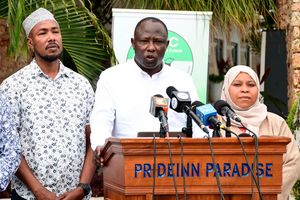
Independent Electoral and Boundaries Commission chairperson Erastus Ethekon (centre), flanked by fellow commissioners, addresses the media at Pride Inn Paradise in Shanzu, Mombasa County on July 19, 2025.
Photo credit: Wachira Mwangi | Nation Media Group
Asked to clarify, Mr Ethekon would only say, “I do not foresee any legal hurdle,” before referring this reporter to the commission’s legal manager, whom he only identifies as Ruth, who had not responded by press time. Legal Director Chrispine Owiye also declined to comment.
The stakes are high in the affected areas, which include Baringo County (Senate), Banissa, Kasipul, Magarini, Malava, Mbeere North and Ugunja constituencies, as well as Kabuchai/Chwele Ward in Bungoma County. For candidates, the countdown is clear: from August 8 to November 27 spans 106 days, not 90.
Nairobi Senator Edwin Sifuna was among the first to criticise the decision. “The law is clear — a by-election must be held within 90 days of a vacancy, starting from when the writ is issued. This commission has started badly by openly flouting the Constitution,” he said. According to Mr Sifuna, when he confronted IEBC officials over the extra days, they told him the matter was functus officio — legally concluded — and suggested he should challenge it in court.
He also accused the IEBC of ignoring the law in replacing former nominated MP John Mbadi after his Cabinet appointment. “Mbadi was nominated under the workers’ category. The law requires that his replacement come from the same category. They didn’t follow that,” he said.
Some legal experts take a different view. Senior Counsel Charles Kanjama argues that the 90-day limit had already expired long before the current commissioners took office. “IEBC now needs to conduct the by-elections within a reasonable time. Given the circumstances, November 27 is reasonable,” he said.
But a more forceful chorus insists the move is unconstitutional. Former Attorney-General and ex-National Assembly Speaker Justin Muturi called it “shocking” that commissioners appointed on the promise of fidelity to the law “would make such basic errors”. The Constitution’s timeline, he said, is non-negotiable: “They have no choice but to comply.”
Lawyer Kibe Mungai warned of a broader agenda. “It starts with small breaches to test how far they can go. This appears designed to look busy while frustrating the recall of MPs. If you can’t follow the law, you’re taking instructions from somewhere else,” he said, warning the date would invite multiple court petitions.
He cited the Supreme Court’s 2017 annulment of the presidential election as proof that legal noncompliance can overturn results. “This is fertile ground for challenges — and a recipe for wasting public funds defending avoidable cases,” he added.
Makueni Governor Mutula Kilonzo Jnr shared that concern. “Constitutional timelines are not optional. Allow a small breach now and the next presidential election could be declared 15 days late. This is completely out of order,” he said.
Independent Electoral and Boundaries Commission chairperson Erastus Ethekon (centre), CEO Marjan Hussein Marjan (left) and Vice Chairperson Fahima Araphat Abdallah address the media at Pride Inn Paradise in Shanzu, Mombasa County on July 19, 2025.
Photo credit: Wachira Mwangi | Nation Media Group
Lawyer David Ochami criticised the IEBC for failing to seek a formal legal opinion from the Attorney-General. “They should explain their computation of timelines for purposes of transparency. While it’s understandable that no polls could be held when there were no commissioners, allocating themselves over 100 days now invites suspicion and litigation,” he said. Makueni Senator Daniel Maanzo went further, calling the decision “grounds for litigation” that could cost the taxpayer dearly.
The vacancies have a complex backstory. Baringo’s Senate seat fell vacant when Senator William Cheptumo died on February 16, 2025. Banissa’s MP, Hassan Kullow, died in a road accident on March 29, 2023. Magarini’s seat was declared vacant on May 31, 2024 when the Supreme Court upheld the nullification of MP Harrison Kombe’s election.
Ugunja’s by-election was triggered by the Cabinet appointment of MP Opiyo Wandayi on August 8, 2024. Malava’s MP, Malulu Injendi, died after an illness on February 17, 2025.
The Mbeere North seat became vacant when President Ruto appointed Mr Geoffrey Ruku to the Cabinet on April 17, 2025, replacing Justin Muturi, who was dismissed after publicly demanding transparency over alleged extra-judicial killings, enforced disappearances and abductions.
For the IEBC, the legal dispute strikes at its credibility.
It enters this electoral cycle with memories still fresh of the Supreme Court’s repeated insistence that timelines and procedures must be observed to the letter.
The commission’s early misstep, critics say, risks setting a precedent that could haunt future elections. Supporters of the November date counter that, with vacancies stretching back over two years in some areas, practical governance now outweighs strict adherence to a timeline that lapsed long ago.
In opposition strongholds, the contests are being framed as a referendum on the President’s economic record and his ‘broad-based’ governance approach, which critics say has failed to deliver tangible benefits to ordinary Kenyans.
In government strongholds, the message is one of consolidation — of rewarding loyalty and ensuring Dr Ruto enters the next General Election with unbroken momentum.
On the ground, candidates are already campaigning.
In Banissa, the race is shaping up as a fierce contest between a veteran local politician backed by the opposition and a youthful aspirant endorsed by the ruling coalition.
In Magarini, the by-election is viewed as a bellwether for coastal politics, where discontent over resource allocation has been rising.
In Baringo, the Senate seat carries symbolic weight, given the county’s history as a political battleground for national figures. Both camps are aware that the political stakes far exceed the number of seats in play. A strong showing by the opposition could embolden them to push harder on calls for electoral reform, while a government sweep would allow President Ruto’s coalition to claim national endorsement ahead of 2027.
What remains uncertain is whether the courts will intervene before voters head to the polls. Legal petitions are already being prepared, according to sources in both political camps. If filed, they could force the IEBC into a defensive legal battle even as it organises the vote.
Observers note that, in Kenya’s litigious political culture, an election held under a cloud of constitutional doubt risks post-poll challenges that could drag on for months.
As November approaches, the IEBC faces the dual task of running a credible election and defending its decision to set a date that many see as outside the law.
For voters in the affected areas, the priority is more immediate: after months or even years without representation, they want their voices back in Parliament and County Assemblies. Whether that happens on November 27 — or later, after the courts have had their say — could become a defining test of the country’s electoral integrity.