Happening Now: NTV KENYA LIVE | Senate Proceedings
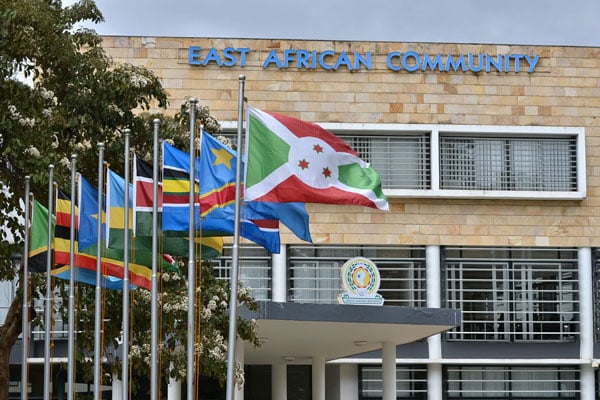
The East African Court of Justice.

The High Court has quashed the nomination of Zablon Muruka Mokua as a judge of the East African Court of Justice (EACJ), which was made in April last year.
Justice Chacha Mwita said the nomination of Dr Mokua was illegal and unconstitutional as it was not subjected to public participation, was not transparent and his suitability was not determined by the Law Society of Kenya (LSK), the body responsible for the conduct and discipline of advocates.
The judge said the JSC was also not consulted to determine whether the nominee fulfilled the qualifications for appointment to the high judicial position in Kenya.
The court said the constitution requires that appointments to public positions be done in an open and transparent manner and there be public participation.
“In the circumstances, and flowing from my analysis above, I agree with the petitioner (LSK) that Dr Muruka’s (Mokua) nomination and subsequent recommendation for appointment as Judge of the East African Court of Justice, First Instance Division, violated the Constitution and the laws of the Republic of Kenya, a Partner State,” said the judge.
Dr Mokua had been nominated as a Justice First Instance Division, by former East African Community CS Peninah Malonza.
His nomination was challenged by LSK arguing that he was not a jurist of recognised competence worth being nominated as a judge.
“The 3rd Respondent (Dr Mokua) does not meet the requisite qualifications to be nominated as a Judge of a Superior Court in Kenya and subsequently as a Judge of the East African Court of Justice’s First Instance Division,” the LSK said in the petition.
Suitability and eligibility
Dr Mokua served as an MCA for Basi Central ward in Kisii County from 2017 to 2022 and was nominated on April 18, 2024, to become a judge in place of Charles Nyachae who resigned in January last year.
According to the LSK, it is the JSC that has the mandate to determine the suitability and eligibility of a person worth being nominated as a judge.
LSK said Dr Mokua only holds a master of theology and a doctorate in theology degrees and not in law and that he has never served as a law lecturer in any university in Kenya.
In his curriculum vitae, Dr Mokua says he was the managing partner and head of litigation at Zablon Mokua & Company Advocates. He is also a pastor at the Pentecostal Mission Church-Kenya.
The government defended his nomination arguing that Dr Mokua meets the qualifications for appointment as a judge of a superior court.
Further, since the appointment of a Judge to the EACJ flows from the recommendation of a Partner State to the Summit, the procedure of identifying the Judge is left to the Partner State’s national laws, policy or adopted national framework which may guide the procedure the Partner State is to follow.
Nomination process
Dr Mokua challenged the jurisdiction of the High Court to determine the case saying it was only EACJ that could interpret the provisions of the Treaty on the issue of his nomination and appointment.
For one to qualify to become a judge, he or she must possess the experience required irrespective of whether that experience was gained in Kenya or in another Commonwealth common-law jurisdiction.
The candidate should at least have 10 years’ experience as a superior court judge or professionally qualified magistrate or at least ten years’ experience as a distinguished academic or legal practitioner or such experience in other relevant legal field.
Further, the LSK said the nomination process of Dr Mokua was shrouded in secrecy thus flouting the national values and principles of governance of rule of law, participation of the people, inclusiveness, equality, protection of the marginalised, transparency and accountability.
LSK said by hand-picking Dr Mokua as Kenya’s nominee for the position, the government denied other qualified Kenyans an opportunity to offer themselves for appointment in a competitive manner.
“Instead, by virtue of Article 24(1) of the EAC Treaty, the nomination of Judges to the East African Court of Justice is a matter within the domain of the East African Community Partner States and as such, the same is guided by the Partner States’ Constitution and law,” the LSK said.