For Mrs Jane Muriithi, pain is a constant companion she has had to endure for the last four months.
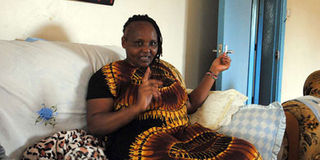
As she lies on the sofa, covered by a blanket in her living room at her house in Githingiri, Murang’a, the agony she has undergone can be felt in her subdued voice as she speaks.
Four months ago, she began experiencing pain in her womb that was unlike anything else she had ever felt.
“I thought it was normal pain until I began bleeding. It was then that I decided to check into Karen Hospital for medical attention,” she told the Nation.
Doctors at the hospital diagnosed her condition as fibroids and advised that she undergo an operation to remove them.
On August 23, Mrs Muriithi was booked into Karen Hospital in Nairobi for the operation to remove fibroids from her uterus.
“Doctors found that my fibroids, which had probably grown for 10 years, had become too long and they had no option but to remove my entire uterus in a procedure known as a hysterectomy,” she said.
“Friends who had undergone the operation, as well as medics, had assured me the recovery process would take a short time and I would be walking around after two days,” she said.
After what seemed like an uneventful operation overseen by a surgeon indicated on hospital documents as Dr Elfenesh Dribsa, Ms Muriithi was wheeled out of theatre to begin the post-operation recovery.
“With the operation over, I looked forward to a return to my previously pain-free life. At most, I was expecting to spend two days before getting discharged,” she said.
This was not to be. On day three, she developed a severe sharp pain in the head that she assumed it resulted from the stitching done after the surgery.
She informed the hospital and the doctor in charge of her post-operative care prescribed some painkillers to deal with the discomfort.
“After two days, I felt pain on my left side. When I told my doctor, he prescribed painkillers that I was to take as I healed,” she said.
Four days after the surgery on August 27, the facility discharged the deputy head teacher of Maua Girls in Meru County. The pain did not abate.
“What was supposed to mark the end of painful fibroids now slowly grew into another painful episode whose cause or source I could not tell,” she said.
At home, the pain got worse and was compounded by cold and shivers that shook her slight frame from time to time.
“The pain was so intense that at some point I found myself struggling just to breathe. The pain was just too much to bear and I asked my husband to supplement my prescribed painkillers with Mara Moja tablets. I overdosed to soothe the pain,” Mrs Muriithi said.
Mr Muriithi recounted the events after the operation, saying that it was painful to watch his once active wife reduced to a shivering, crying invalid.
“While in the ward, my wife began complaining of pain in her body, which persisted beyond her discharge. Soon it became impossible for her to walk. I had to cook and do the cleaning for her, and I have even been bathing her because she is unable to bend or stretch her arms,” he said.
During that time, he was also forced to purchase a pickup-load of firewood to light a fire in the couple’s living room so that she could stay warm throughout the day.
“Taking care of her was a hard task. The fire was on throughout the day as she kept complaining of feeling cold,” he says.
On the ninth day, Mr Muriithi could no longer take it.
“She continued taking the self-prescribed painkillers with the drugs she had been given at Karen Hospital. On the ninth day, I sensed that my wife’s condition was unusual and had to do something about it,” he said.
“Nine days after the operation, my husband felt my stomach to assess if there was any problem and, while at it, he sensed something around the uterus area. He asked me to feel it and I confirmed that, indeed, I had something foreign in my body,” she said.
“I was already suspecting that something must have gone wrong during my surgery and so I asked my husband to take me to Nairobi Hospital.
Subsequent tests by doctors at the facility revealed that Mrs Muriithi had developed complications due to a foreign object in her body.
“Prof Eunice Cheserem, the gynaecologist who examined me, discovered that my discomfort was caused by a foreign object in my body,” Mrs Muriithi recalled.
A report by Nairobi Hospital, signed by Prof Cheserem, indicates that she suffered from discomfort caused by “post hysterectomy septic vaginal gauze”.
This means that a bandage inserted into her birth canal to soak up the bleeding during the operation had somehow ended up in the area where her uterus used to lie, and caused a septic infection.
In a delicate procedure, the medic then removed a sizeable blood-soaked and decomposing gauze from Ms Muriithi’s body.
“The bandage was soaked in blood that was decomposing. I will never forget the stench that filled the ward immediately Prof Cheserem pulled it out,” Mrs Muriithi said.
She was then admitted to Nairobi Hospital for a further six days in order to recover under observation from doctors.
Doctors found she had incurred blood infection occasioned by the bandage’s long stay in her body. Further tests also diagnosed a clot at Mrs Muriithi's lungs.
Following the discovery of the blood clot, doctors immediately put her on medication to clear the infection and manage the clot.
The distressed couple said they have spent close to a million shillings in medication and treatment at both hospitals.
The couple, who have been seeking medication at Karen Hospital for years in its Nairobi and Meru branches, said they have lost faith in the hospital that they had trusted with the well-being of their children and that of themselves.
They said that even after notifying the hospital of the incident, the institution did not bother to offer an apology, let alone accept wrongdoing.
“All I have been dealing with are calls from hospital people telling me to visit the facility if we have a complaint. How can I be the one to visit yet we have been wronged?” Mr Muriithi asked.
He said the least the facility could have done was to accept liability for the mistake, something he says is yet to be done.
“Based on how the hospital treats this matter, our options as a family, including legal action, remain open for now. I am, however, concentrating on ensuring that my wife fully recovers,” he said.
Contacted, the hospital’s public relations department referred us to its lawyer, Mr Njoroge Kimani, who reiterated its willingness to reach an amicable settlement with the couple.
While admitting that Mrs Muriithi’s operation was done at the hospital, Mr Kimani said the matter was still under investigation to ascertain “how to deal with the issue”.
He said the error did not occur out of malice. For now, Mrs Muriithi has to deal with her pain.